Can Trauma Cause Health Anxiety?
A frightening illness, medical emergency or loss can change how a person experiences uncertainty about health. A later sensation may feel more threatening because it recalls what happened before. Some people become more watchful of their bodies or find themselves repeatedly checking for reassurance.
Trauma may contribute to health anxiety for some people. It is neither a necessary cause nor an explanation that can be established from an article. Health anxiety can develop through several interacting influences, and many people cannot identify a single event that started it.
You also do not need to uncover one definitive cause before you can get help. Understanding your history may bring compassion and context. Understanding what happens when worry appears now can offer a practical place to begin.
How might a frightening experience affect health worries?
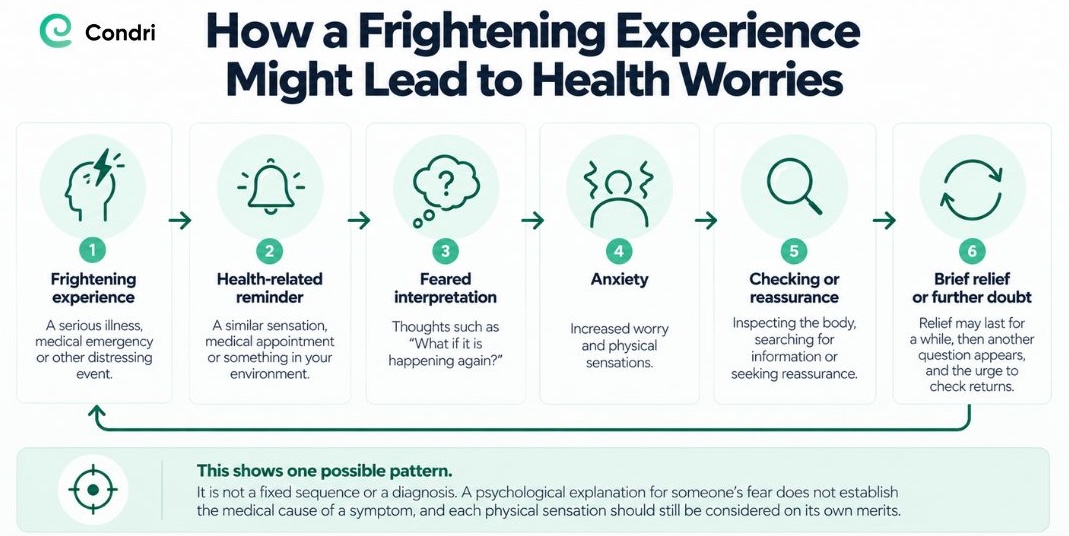
After a frightening event, reminders of what happened may feel especially significant. If the experience involved illness or the body, a similar sensation, a hospital appointment or medical language might bring back fear.
For example, someone who experienced a serious health emergency may later notice an unfamiliar sensation and think, “What if it is happening again?” They may inspect their body, search for an explanation or seek reassurance. Relief may last for a while, then give way to another question.
One possible pattern is:
Frightening experience → health-related reminder → feared interpretation → anxiety →checking or reassurance → brief relief or further doubt
This describes a possible pathway, not a fixed sequence or a diagnosis. The physical sensation still needs to be considered on its own medical merits. A psychological explanation for someone’s fear does not establish the medical cause of a symptom.
What does the research tell us?
The research suggests a possible relationship between adverse experiences and health anxiety, but the findings are mixed and cannot show that a particular experience caused an individual’s difficulties.
In a study of 264 adults, Reiser and colleagues found an association between reported childhood adversity and health anxiety. Adversity no longer made a distinct statistical contribution once negative affect and trait anxiety were included in the analysis. The study measured people’s experiences at one point in time, so it cannot establish a cause-and-effect pathway.
A later study compared 31 people with severe health anxiety with people who had OCD and with participants without a clinical condition. It did not find that illness-related or traumatic childhood events were more frequent in the health anxiety group. Some people with severe health anxiety did, however, describe particular experiences as more traumatic. The groups were small, and the study cannot settle every question about how earlier experiences matter.
Taken together, these findings call for care with the word cause. An adverse experience may be relevant to one person’s story. It should not be assumed to explain everyone’s health anxiety, and the absence of such an experience does not make someone’s anxiety less real.
Which experiences might be relevant?
People may connect their health worries with different experiences, including a serious illness or injury, emergency treatment, intensive care, a difficult diagnostic process, a frightening birth, childhood adversity, or the illness or death of someone close.
These experiences are not interchangeable. Grief, a distressing healthcare experience and PTSD may each call for different kinds of understanding and support. Nor will two people who go through a similar event necessarily respond in the same way.
A later trigger is also different from an original cause. An appointment may bring fear to the surface without explaining why health anxiety developed. You can work with that present-day trigger without having to prove its place in your life history.
Can childhood adversity play a part?
Childhood adversity may affect how some people learn to respond to danger and uncertainty. Experiences of instability, loss, neglect or abuse can carry different meanings and consequences. They should not be treated as equivalent, and reporting adversity does not by itself establish a trauma-related diagnosis.
For one person, an earlier experience might make illness feel especially unpredictable. For another, it may have little apparent connection with current health fears. Family experiences of illness can also shape how a child understands health, alongside their own medical history and information from the wider world.
This is a question for thoughtful exploration, never blame. The available health anxiety research does not justify telling someone that their parents caused their symptoms, or that an earlier event determines how they will feel in the future.
Can a medical experience become a trigger?
Yes. An illness, procedure or period of medical uncertainty can be frightening. Later reminders—a waiting room, a follow-up scan, a familiar sensation may bring back some of the fear associated with that experience.
Someone may respond by monitoring their body closely because it feels protective: If I notice a change early enough, perhaps I can prevent another crisis. That reasoning is understandable, especially when the earlier event was serious.
The difficulty arises if monitoring continues beyond a useful medical plan and becomes a repeated attempt to obtain certainty. A clinician’s instructions about symptoms, tests or follow-up should still be followed. If you are uncertain what needs monitoring, ask your healthcare team rather than using an anxiety exercise to make a medical decision.
A frightening healthcare experience does not automatically mean someone has PTSD. It can still deserve attention and compassion, whether or not a diagnosis applies.
What about the illness or death of someone close?
Seeing someone you care about become seriously ill can alter how immediate illness feels. You may notice a sensation that reminds you of their symptoms, worry when you approach the age at which they became unwell, or feel anxious in a healthcare setting associated with their treatment.
These responses may arise alongside grief. Grief should have room to be grief; it does not need to be recast as a disorder. At the same time, if worry about your own health leads to repeated checking, searching or avoidance, that pattern can be addressed with care.
Your loved one’s experience may explain why a fear carries particular emotional weight. It cannot tell you what a current symptom means or predict that their illness will happen to you.
Why might you become more alert to your body?
After danger, paying close attention can feel like a way to protect yourself. For some people whose frightening experience involved illness, that attention settles on bodily sensations.
You may find yourself scanning for changes, comparing both sides of your body, checking a wearable reading or repeatedly asking whether a sensation feels the same as before. The NHS identifies frequent body checking and reassurance seeking among behaviours that can accompany health anxiety.
Being highly aware of a sensation does not mean you imagined it. Anxiety and physical illness can coexist. The psychological question is what follows the sensation: whether you can take an appropriate medical step when needed, and whether additional checking begins to take over.
The role of uncertainty and control
A frightening event may leave someone especially aware that health cannot always be predicted or controlled. Later uncertainty can then feel difficult to leave unresolved.
You might search several sites, revisit what a clinician said, check your body again or ask the same question in a different way. These actions may provide brief relief. If doubt returns quickly, the search for certainty can become a pattern of its own.
There is a compassionate reason to notice this. You may be trying to prevent another painful experience, not simply “overreacting”. Once you can see what the checking is trying to do for you, you have more room to choose another response.
For example, after following an appropriate medical plan, you might pause and say:
“This uncertainty reminds me of something frightening. I can acknowledge that fear without answering the same question again right now.”
Mindfulness in this context is an opportunity to notice fear and an urge with less judgement. It is not a method for declaring a symptom harmless. If focusing on your body feels distressing, you could instead orient yourself to the room, speak with someone you trust or use a grounding practice that suits you.
How are health anxiety and PTSD different?
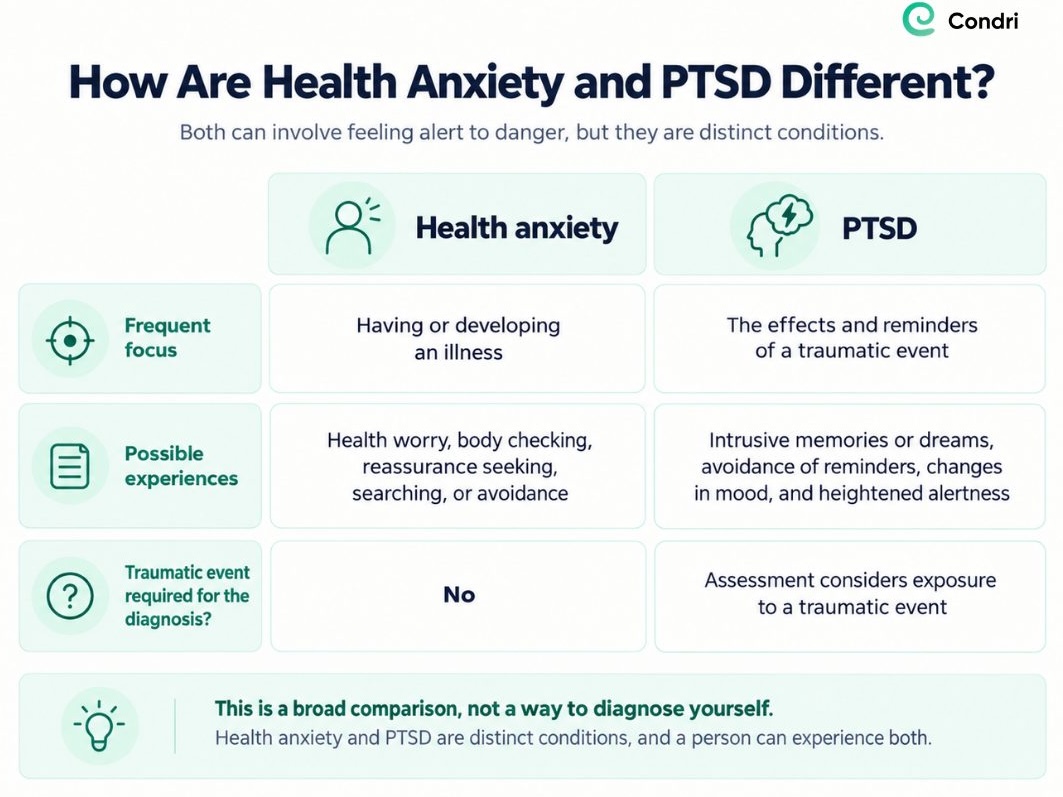
Health anxiety and PTSD can both involve feeling alert to danger. They are distinct conditions, and a person can experience both.
| Health anxiety | PTSD | |
| Frequent focus | Having or developing an illness | The effects and reminders of a traumatic event |
| Possible experiences | Health worry, body checking, reassurance seeking, searching or avoidance | Intrusive memories or dreams, avoidance of reminders, changes in mood and heightened alertness |
| Traumatic event required for the diagnosis? | No | Assessment considers exposure to a traumatic event |
This is a broad comparison, not a way to diagnose yourself. Health anxiety can have trauma-related triggers without meeting criteria for PTSD. PTSD symptoms can also occur alongside fears about physical health. The NHS describes intrusive memories, avoidance and hypervigilance among possible PTSD symptoms; a qualified professional can assess the full picture.
If memories, nightmares, avoidance or distress around reminders are affecting your life, you do not need to decide which label fits before asking for support.
Does everyone who experiences trauma develop health anxiety?
No. People respond differently to difficult experiences, and many people with health anxiety do not identify a traumatic event behind it.
The research on childhood adversity reflects that complexity: studies have found different results, and an association in one group cannot predict what will happen to any one person.
There is no need to search your past for an event that “proves” why you feel this way. If a memory or experience matters to you, it deserves to be heard. If its connection to your current worries is unclear, you can still receive help for those worries.
What support may help?
Support is most useful when it fits the difficulties you are experiencing. A clinician might consider health-related checking and avoidance, trauma symptoms, grief, physical health needs, or several of these together. You and the clinician can then agree what to address and at what pace.
Support for health anxiety
CBT for health anxiety can help people understand frightening interpretations, body vigilance, repeated checking, reassurance seeking and avoidance. Exposure and Response Prevention (ERP) principles may be used to practise meeting uncertainty while reducing a repetitive safety behaviour. This work should never require someone to disregard necessary medical care.
CBT has a substantial evidence base. A 2026 review of 35 trials also found support for several approaches, including acceptance and commitment therapy and mindfulness-based cognitive therapy, when compared with waiting-list controls. The review does not establish that every approach, format or app will work equally well for every person.
A compassionate treatment approach can include learning to observe fear without immediately acting on it, choosing manageable changes and reconnecting with activities that matter. None of this depends on persuading yourself that every sensation is harmless.
Support for PTSD or significant trauma symptoms
If PTSD symptoms are present, assessment may point towards trauma-focused treatment. NICE recommends individual trauma-focused CBT for adults with PTSD or clinically important PTSD symptoms who present more than one month after a traumatic event. Its guidance also recommends or considers EMDR in specified circumstances. A clinician can discuss which approach and timing fit the person.
Trauma-focused therapy is not automatically required because health anxiety followed a difficult event. Equally, work on checking alone may not address intrusive memories or other significant trauma symptoms. Treatment planning should take account of both the person’s history and what is affecting them now.
How Condri fits in
Condri offers self-guided support focused on current health anxiety patterns, including checking, reassurance seeking and difficulty living with uncertainty. Its tools draw on CBT, ERP, acceptance-based approaches and mindfulness. Condri does not determine whether a past experience caused health anxiety, diagnose PTSD, assess physical symptoms or replace medical care or individual therapy.
If you recognise health anxiety patterns in yourself, Condri’s quiz can be a starting point for reflection. A questionnaire cannot diagnose trauma, PTSD or a physical condition.
When should you seek professional help?
Speak to a GP or an appropriate mental health professional if health worries are taking over daily life, self-help is not helping, or distress linked to a past experience remains difficult to manage. In England, adults can also refer themselves to NHS Talking Therapies.
Continue to seek appropriate medical advice for new, persistent, worsening or otherwise concerning physical symptoms, and follow investigations or monitoring recommended by your healthcare team.
Your past may help you understand why a health fear feels so powerful. You do not have to solve your whole history before taking one caring, considered step in the present.
Common questions
- Can trauma cause health anxiety later in life?
- Yes, a frightening or distressing experience may contribute to health anxiety later in life. Experiences involving illness, medical emergencies or loss can make someone more sensitive to health-related fears. However, trauma is not the cause of every case of health anxiety.
- Can childhood trauma lead to health anxiety?
- Childhood experiences involving loss, neglect, abuse or instability may influence how someone responds to health concerns and uncertainty as an adult. Research suggests a possible connection, but it has not established that childhood trauma directly causes health anxiety.
- Can a traumatic medical experience trigger health anxiety?
- Yes, experiences such as serious illness, emergency surgery or a frightening hospital stay can trigger health-related fears. Someone may become more alert to physical sensations or worry about experiencing another medical emergency. These reactions do not automatically mean they have PTSD.
- Is health anxiety a form of PTSD?
- No, health anxiety and post-traumatic stress disorder (PTSD) are separate conditions, but they can occur together. Health anxiety usually involves fears about having or developing an illness. PTSD involves symptoms associated with a traumatic experience, such as intrusive memories, avoidance and heightened alertness.
- Can losing someone close to you cause health anxiety?
- The illness or death of someone close can contribute to health anxiety for some people. They may become more concerned about developing the same condition or begin monitoring their own health more closely. Grief and health anxiety can occur together, but experiencing grief does not automatically mean someone has an anxiety disorder.
- Can health anxiety improve without addressing past trauma?
- Yes, health anxiety can improve without identifying or processing a particular past experience. Cognitive Behavioural Therapy (CBT) can help people address current patterns such as repeated body checking, reassurance seeking and fears about uncertainty. If significant trauma symptoms are present, additional professional support may be helpful.
- What is the best therapy for trauma-related health anxiety?
- The most suitable therapy depends on the symptoms someone is experiencing. CBT is an established treatment for health anxiety. For people experiencing PTSD symptoms, trauma-focused CBT or Eye Movement Desensitisation and Reprocessing (EMDR) may be recommended following a professional assessment.
- How can I stop checking my body after a frightening health experience?
- Reducing repeated body checking may involve recognising what triggers the urge, gradually changing reassurance-seeking habits and learning to tolerate uncertainty. CBT and Exposure and Response Prevention (ERP) techniques may help. Any monitoring recommended by a healthcare professional should continue, and concerning physical symptoms should receive appropriate medical attention.