Health Anxiety: How to Stop Checking Your Body
When you are worried about your health, checking your body can feel like a responsible thing to do. You might inspect an area again, feel for a change or check a reading because you do not want to miss something important. But if each check leaves room for another doubt, checking can begin to take up more of your time and attention.
Reducing body checking starts with understanding what prompts it and what you hope it will provide. You can then practise responding to the urge with more choice and compassion. This does not mean ignoring symptoms or stopping monitoring recommended by a healthcare professional. It means recognising when repeated checks are mainly attempts to relieve anxiety.
What is body checking?
Body checking is repeated inspection, testing, measuring or monitoring of your body to look for signs of illness or feel more certain about your health.
It might involve touching an area, inspecting your skin or checking a wearable reading. Less obvious examples include comparing photographs, asking someone else to inspect a concern or mentally reviewing an earlier check.
No single action means that someone has health anxiety. Looking at a change for a practical reason differs from returning to it repeatedly because the previous check did not feel reassuring enough.
Clinician-directed monitoring, wound care, routine screening and follow-up for an established condition also have a place. They should not automatically be treated as anxiety-driven checking.
Why can checking become hard to stop?
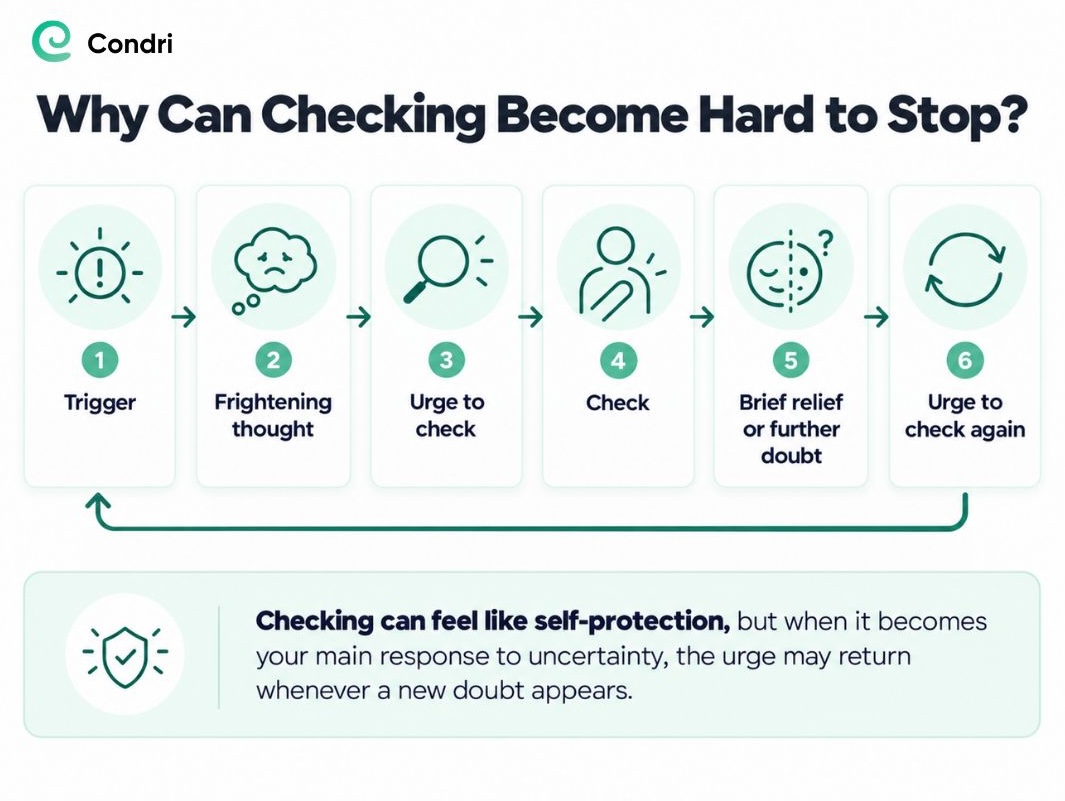
A check may ease worry for a moment. Later, another thought appears: “Did I look closely enough?” or “Has something changed since then?” Checking again can feel like the quickest way to settle the question.
The pattern may look like this:
Trigger → frightening thought → urge to check → check → brief relief or further doubt → urge to check again
Checking is an understandable attempt to care for yourself. The difficulty is that, when it becomes your main response to uncertainty, the urge may return whenever a new doubt appears.
Recognise how and when you check
Start with the behaviour rather than a detailed account of your symptoms. When worry appears, what do you do? What are you hoping the action will give you?
| Action | What you might hope it will provide |
| Inspect an area again | Certainty that it has not changed |
| Reopen a wearable dashboard | Reassurance about a reading |
| Compare photographs | Proof that everything looks the same |
| Ask someone else to look | Confidence that you have not missed something |
| Review an earlier check in your mind | Confidence in your memory |
Notice, without judging yourself, if one form of checking replaces another. You might stop touching an area but start photographing it, or stop inspecting it yourself and ask someone else to look.
The urge may follow a sensation, a health story, an appointment or a memory of an earlier worry. A useful question is: “What happened just before I wanted to check?” You are looking for a pattern in your response, not deciding what a symptom means medically.
[Internal link: Condri’s guide to health anxiety triggers]
Keep any record brief and focused on behaviour
The NHS suggests noting how often you check your body, seek reassurance or look at health information, then trying to reduce these behaviours gradually.
If a record helps, note only the trigger, the action and what happened afterwards. For example: “Read a health story; checked twice; felt calmer briefly, then wanted to check again.”
Avoid recording tiny physical changes, measurements or exhaustive symptom descriptions. If keeping a record makes you more preoccupied, you can stop using it and discuss another approach with a therapist.
Pause before a repetitive check
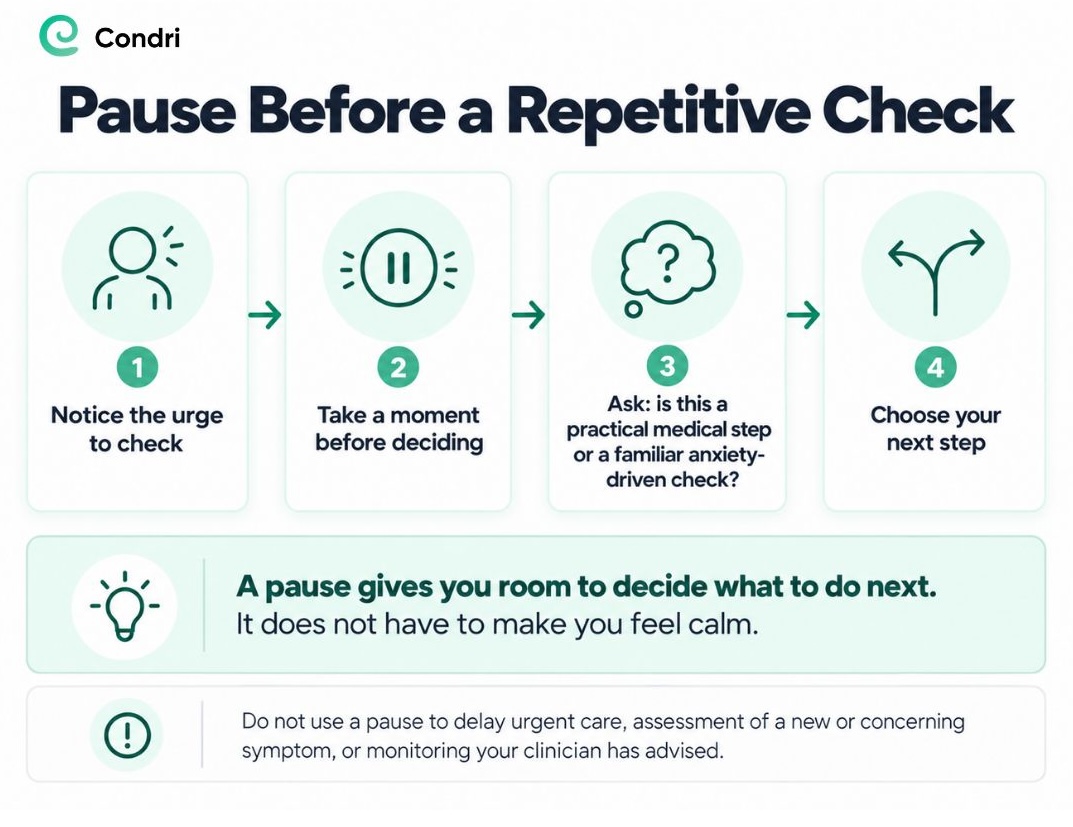
A pause gives you room to decide what to do next. It does not have to make you feel calm.
You might say: “I feel frightened, and I want to check. I can take a moment before deciding.”
Notice the thought, the feeling and the urge. Then consider whether you need a practical medical step or whether you are about to repeat a check to settle a familiar doubt. Where appropriate, try delaying that repetitive check and return your attention to what you intended to do.
A pause is not a test of whether a symptom is safe. Do not use it to delay urgent care, assessment of a new or concerning symptom, or monitoring your clinician has advised.
Reduce checking gradually
An absolute rule such as “I must never check” can create another struggle. A gradual plan may be more workable.
Depending on your circumstances, you might practise checking less often, spending less time inspecting or choosing not to repeat a check solely because it did not bring complete reassurance. There is no universal schedule: the right approach needs to account for your health and any medical plan you have been given.
The aim is to rely less on checking to manage fear, while continuing appropriate care.
Notice when checking changes form
A camera, magnifying mirror, measuring tool or wearable dashboard may have a useful purpose. It may also make a repeated anxiety-driven check almost automatic. If you keep reopening a dashboard mainly for reassurance, for example, closing it between planned uses may help create a pause.
Photographs need the same distinction. Images taken at a clinician’s request for a defined purpose differ from repeatedly taking, enlarging and comparing pictures to feel certain. Continue any prescribed monitoring, and ask your healthcare professional if you are unsure how or when to do it.
Checking can move online or into your thoughts, too. You might resist inspecting your body but then search the same concern, ask an AI tool several versions of the question or replay an earlier examination in your mind. Before searching, consider whether you need information for a practical decision or are revisiting a question that no answer has settled.
Ask supporters for connection, rather than another examination
It is natural to turn to someone you trust when you feel frightened. Repeatedly asking them to inspect the same concern, however, may shift the checking to them.
You could agree during a calmer moment what support would help. They might listen, acknowledge how difficult the uncertainty feels or help you follow a coping plan you have chosen. They do not need to interpret a symptom or take responsibility for a medical decision.
That agreement should always leave room for a new concern and appropriate medical advice. Compassionate support is not a blanket refusal to talk about health.
Where do CBT, ERP and mindfulness fit?
Cognitive Behavioural Therapy (CBT) can help you understand your own pattern: how you interpret a concern, what a check does for you immediately and what happens over time. Oxford Health’s specialist service describes CBT as an evidence-based treatment for health anxiety.
Exposure and Response Prevention (ERP) may form part of this work. It involves approaching a trigger or uncertainty while reducing a familiar checking or reassurance response. For body checking, that could mean practising a planned pause instead of carrying out another repetitive check. It is never an instruction to take a medical risk or disregard healthcare advice.
Mindfulness can help you notice a sensation, a frightening thought and an urge without treating them as a single command. For example: “I’ve noticed a sensation, and I’ve noticed that I want to check.” This names your experience without declaring the sensation harmless.
Research supports CBT for health anxiety. A 2026 review also found evidence for several other approaches, including acceptance and commitment therapy and mindfulness-based cognitive therapy, compared with waiting-list controls. Those findings concern the treatments studied; they do not guarantee an outcome for an individual or establish the effectiveness of a particular app.
What if the urge feels overwhelming?
Begin with one manageable step. Acknowledge the fear: “I want to check because I’m scared.” Ask what you need from the check: information for a decision, or relief from uncertainty?
Follow any medical plan and seek appropriate advice for a new or concerning issue. If this is a familiar urge to repeat a check, try a pause that feels manageable. You might then return to a conversation, a task, rest or another part of your day.
You may still feel anxious. Progress can mean making a considered choice while anxiety is present, rather than waiting for it to disappear. If you do check again, respond with curiosity rather than criticism: what made that moment difficult, and what might help next time?
When should you seek professional or medical support?
Consider psychological support if checking takes substantial time, disrupts daily life or remains difficult to change through self-help. The NHS advises seeing a GP when health worries interfere with ordinary life or self-help is not working. It lists CBT among the treatments that may be offered. In England, you can also refer yourself to NHS Talking Therapies.
Seek medical advice for a new, persistent, changing, worsening or otherwise concerning symptom. Continue recommended screening, investigations, medication, monitoring and treatment. If you think you need medical help now, NHS 111 can direct you to appropriate care; call 999 for a life-threatening emergency.
Psychological support and physical healthcare can be appropriate at the same time.
How Condri may support your practice
Condri is a health-anxiety self-help app informed by lived experience and established psychological approaches. Its practices may help you recognise urges to check, search or seek reassurance, make room for uncertainty and choose a response aligned with what matters to you.
Condri cannot assess a physical symptom or individual medical risk, and it does not replace a healthcare professional or individual psychological treatment when these are needed.
Reducing body checking does not mean caring less about your health. It means giving yourself more choice about when care calls for a practical medical step and when anxiety is drawing you back to the same unanswered question.