Health Anxiety Treatment Costs Compared
Support for health anxiety can be free through NHS Talking Therapies in England. Other routes include private therapy, subsidised charity services, groups, books and self-help apps. Their prices differ, but so does the support they provide.
The NHS says private therapy can cost from £35 per session; this is a starting figure for private therapy generally, not a typical fee for specialist CBT. Condri’s published monthly app price is $12.99. Neither figure tells you which option fits your needs.
This guide compares costs and levels of support. It cannot assess which treatment is appropriate for you. Health anxiety can also occur alongside physical illness: seek appropriate medical advice for new, persistent, changing, worsening or otherwise concerning symptoms.
Prices checked: September 2026. Check current fees and eligibility before booking or subscribing.
Health anxiety support costs at a glance
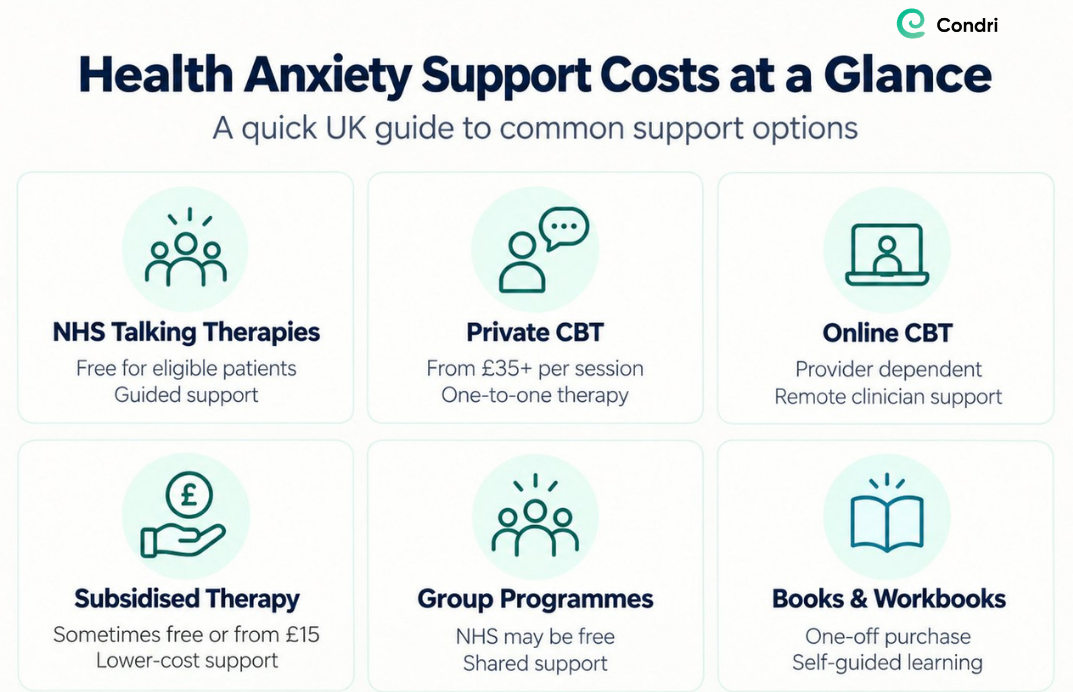
| Option | Indicative direct cost | Support provided |
| NHS Talking Therapies in England | Free to eligible patients | Practitioner or therapist support; format depends on assessment and local service |
| Private CBT | Provider dependent; the NHS says private therapy generally starts from £35 per session | Individual therapist |
| Private online CBT | Provider dependent | Therapist-led care by video or another remote format |
| Private exposure-based work | Usually part of a therapist’s assessment and session fees | Individual therapist |
| Charity or subsidised therapy | Sometimes free; the NHS says lower-cost sessions can start from £15 | Varies by service and practitioner |
| Group therapy or programmes | Provider dependent; NHS options may be free | Shared practitioner or facilitator time |
| Books and workbooks | Purchase price | Self-guided |
| General mental health apps | Free to subscription-based | Usually self-guided; features vary |
| Condri | Published price: $12.99 per month | Health-anxiety-focused self-help app |
| Prescribed medication | Depends on prescription rules and exemptions | Assessment and prescribing by a qualified professional |
These are different forms of care, not interchangeable treatments. A book or app may help someone practise skills, while individual therapy can provide assessment, a personalised plan and feedback. Medication costs depend on a prescribing decision, not a comparison of therapy prices.
Why do costs vary?
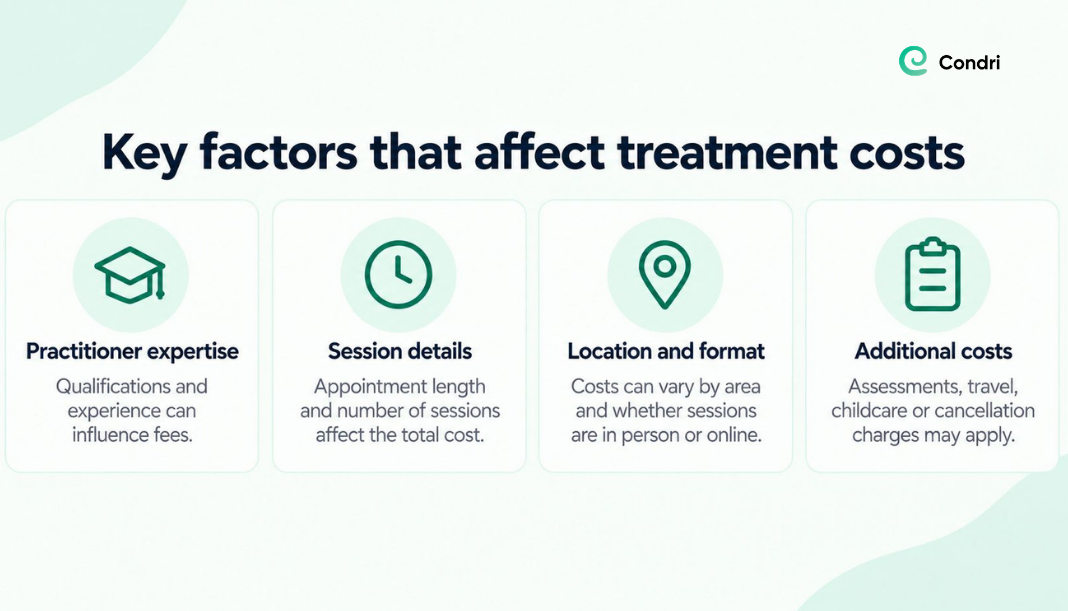
Therapy fees can reflect the practitioner’s qualifications and experience, appointment length, location and the type of service offered. The number of sessions matters as much as the price of one.
For example, 12 sessions at £75 would cost £900 in session fees. That is an illustration, not a recommended course length or a quoted market rate. An initial assessment, travel, childcare or cancellation charges could add to the total.
A higher fee does not guarantee a better outcome. When comparing therapists, ask about their qualifications, experience with health anxiety, approach, session fees and likely review points. The BABCP provides a register where you can check accredited CBT therapists.
What does NHS treatment cost?
In England, NHS Talking Therapies provides psychological support for eligible adults at no charge to the patient. Health anxiety is among the difficulties these services address. You can refer yourself without first obtaining a GP referral or a mental health diagnosis.
Depending on assessment and local availability, care may involve supported self-help, individual or group work, or remote appointments. An online NHS programme may still include practitioner or therapist support; being delivered digitally does not make it equivalent to an independent self-help app.
Availability and waiting times vary. If you live elsewhere in the UK, ask your GP or local NHS service about the routes available where you are.
What might private CBT cost?
Private CBT is usually charged per appointment. The NHS says private therapy can cost from £35 per session, while fees vary. That figure should not be read as a typical specialist health-anxiety CBT price or a promise that appointments are available at that rate.
Ask a prospective therapist:
- What are the assessment and session fees?
- How long is each appointment, and what is the cancellation policy?
- What CBT training and accreditation do they hold?
- Do they have experience working with health anxiety?
- When will you review whether the approach is helping?
CBT for health anxiety may address frightening interpretations, repeated checking, reassurance seeking and avoidance. Research supports CBT as a psychological treatment for health anxiety, although individual outcomes vary.
Does exposure-based work have a separate price?
Often, exposure-based work is part of a broader CBT plan rather than a separately priced service. It may help someone practise approaching uncertainty while reducing repetitive checking or reassurance seeking. The work should be tailored to the person and must never involve disregarding necessary healthcare.
If a private therapist offers it, ask whether assessment, planning and between-session support are included in their usual fee. There is no reliable single UK-wide price for “exposure therapy”. A 2026 review linked exposure and response prevention components with improved outcomes across the treatments studied; it does not prescribe the same exercises for every person.
Is online therapist-led CBT cheaper?
It may be, but do not assume the session fee will be lower. A clinician is still providing professional time. Remote appointments may reduce travel, parking or time away from work.
Check whether an advertised “online CBT” service means live individual therapy, a digital programme with practitioner support, or fully self-guided material. The amount of human support can differ substantially.
What lower-cost support is available?
Charities and other non-profit services may offer free or subsidised appointments. The NHS says lower-cost therapy starting from around £15 can sometimes be available and points readers towards Mind and Anxiety UK. Availability, eligibility, practitioner qualifications and the type of therapy vary; a low-cost counselling appointment should not automatically be described as specialist CBT for health anxiety.
Groups may cost less per person because practitioner time is shared. A structured therapy group also differs from a peer support group: both may offer something valuable, but they provide different kinds of help. Ask who leads the group, what it covers, how many sessions are included and what support is available if you need more individual attention.
Books and workbooks generally involve a one-off purchase. They can offer an accessible way to learn and practise at your own pace, but they cannot provide an individual assessment or feedback when an exercise does not fit your circumstances.
Guided self-help is worth checking carefully. In an NHS service, it can mean structured materials used with a trained practitioner. A commercial workbook or app may be entirely self-guided despite covering similar ideas.
How should you compare mental health apps?
Apps range from free tools to subscriptions. Some focus on general anxiety or mindfulness; others address particular difficulties. Check the price, renewal terms, available support and whether the content is relevant to health anxiety.
A feature can also serve different purposes in different circumstances. Tracking symptoms may be part of a clinician’s medical plan, while repeatedly reviewing the same information to seek reassurance may maintain a health-anxiety pattern. Continue any monitoring recommended by your healthcare professional.
An app cannot diagnose a physical condition or decide whether a symptom needs medical assessment.
What does Condri cost?
Condri’s pricing page lists $12.99 per month for its health-anxiety self-help app, with cancellation available at any time. It says longer plans purchased through its health anxiety quiz cost less per month. UK readers should check the amount and currency shown at checkout, the renewal terms and any conversion applied by their payment provider; app-store offers or discounts may differ.
Condri is informed by lived experience and psychological approaches including CBT, exposure and response prevention, acceptance and mindfulness. It offers self-guided practice focused on health-anxiety patterns. It does not provide the assessment, individual treatment relationship or medical care available from qualified professionals. It does not diagnose conditions, judge whether symptoms are medically serious or provide emergency support.
Evidence for psychological therapies must not be presented as proof that a particular app will produce the same outcomes. If you use Condri’s health-anxiety quiz, treat it as a reflection tool, not a diagnosis.
[Internal links: Condri’s guide to overcoming health anxiety; Condri’s health-anxiety quiz]
What might medication cost?
A GP or other qualified prescriber may discuss medication for anxiety according to your clinical circumstances. Do not choose, change or stop medication on the basis of cost alone.
In England, the NHS prescription charge was £9.90 per item when this article was checked. Some people and items are exempt. If you regularly pay for several items, a Prescription Prepayment Certificate may reduce your costs.
NHS prescriptions are generally free in Scotland and Northern Ireland. In Wales, entitlement and arrangements for dispensing across the England–Wales border have specific rules, so check the guidance that applies to you. Private prescribing and medicine fees can differ from NHS charges.
What other costs should you consider?
The advertised fee may be only part of the expense. Depending on the service, consider assessment fees, travel, parking, childcare, time away from work, cancellation terms, books, subscriptions and any insurance excess.
You can estimate expenditure with a simple calculation:
Total cost ≈ appointments or subscription payments + other expected expenses
This compares money spent, not clinically equivalent care. Twelve private appointments at £75 would mean £900 in session fees. Six months at Condri’s published monthly price would mean $77.94 before any applicable currency conversion or other charges. The first includes individual therapist time; the second is a self-help subscription. Neither calculation tells you what level of support you need.
An employer, university, insurer or local charity may help with costs. Check eligibility, approved providers, session limits and any amount you would still pay.
How can you choose a suitable option?
Begin with the support you need, then look at its full cost. You may want to consider whether you would benefit from individual assessment and guidance, whether a group or supported self-help is suitable, and whether a self-guided resource feels manageable at present.
The most expensive option is not guaranteed to help more, and the least expensive option does not necessarily provide enough support for every person. CBT has an established evidence base for health anxiety. A 2026 review also found evidence for several other psychological approaches compared with waiting-list controls, but those findings do not make every format or product interchangeable.
If health worries are interfering with everyday life or self-help is not helping, speak to a GP or an appropriate mental health professional. Seek medical advice for concerning physical symptoms and continue any recommended investigations, treatment and monitoring.
Cost is a real constraint, and you deserve a clear account of what each price includes. A useful next step is to identify the kind of support that fits your circumstances, then check the current fees and access routes without expecting a price tag to provide certainty about the outcome.
Common questions
- Is health anxiety treatment free on the NHS?
- Yes, NHS Talking Therapies offers free psychological support to eligible adults in England. You can refer yourself without needing a GP referral. The type of support available and waiting times depend on your local service.
- How much does private CBT for health anxiety cost in the UK?
- The NHS states that private therapy can start from £35 per session, but fees vary depending on the therapist, their experience and the type of treatment offered. Specialist CBT may cost more, so it is worth checking session fees before booking.
- Can health anxiety be treated without paying for therapy?
- There are free and lower-cost options available, including NHS Talking Therapies, charity services, support groups and self-help resources. These offer different levels of support, and some people may benefit from professional guidance rather than relying on self-help alone.
- Is online CBT cheaper than face-to-face therapy?
- Online CBT may reduce travel expenses and time away from work, but appointment fees are not always cheaper. Costs depend on whether the service provides individual therapist sessions, guided self-help or independent online resources.
- Are mental health apps useful for health anxiety?
- Mental health apps can provide tools for recognising anxious thought patterns, reducing reassurance-seeking behaviours and practising self-help techniques. However, an app cannot replace professional assessment or medical care when these are needed.
- How many CBT sessions are needed for health anxiety?
- The number of CBT sessions varies depending on individual needs, symptom severity and progress during treatment. A therapist can discuss a suitable treatment plan and review whether the approach is helping.
- What is the most affordable treatment for health anxiety?
- NHS Talking Therapies is a free option for eligible adults in England. Charities, subsidised counselling and self-help resources may provide lower-cost support. The most suitable choice depends on the level of guidance and treatment you need, rather than price alone.