Health OCD vs Health Anxiety: What's the Difference?
Health anxiety and obsessive-compulsive disorder (OCD) with health-related obsessions can look remarkably similar. Both may involve fears about illness, close monitoring of the body, repeated online searching, reassurance seeking, avoidance and doubts that a clinician or test has missed something. These responses are not signs of weakness or attention seeking. They are usually understandable attempts to feel safe when uncertainty feels threatening.
The difference is not reliably found in the illness being feared or in one visible behaviour. It lies in the wider pattern: how the concern is experienced, what the person feels driven to do in response, the function of that response, whether other obsessions or compulsions are present, and how the pattern affects daily life.
"Health OCD" is an informal description, not a separate diagnosis or officially recognised subtype of OCD. "Health anxiety" is also used broadly in everyday and clinical language; it should not automatically be treated as another name for one specific diagnosis.[1,2]
Because the patterns can overlap and co-occur, an article, quiz or single symptom cannot determine which diagnosis applies. A careful professional assessment can help when fear, checking, mental rituals or avoidance cause significant distress or interfere with everyday life. Whatever the eventual formulation, the person deserves an approach that is accurate, compassionate and free from blame.
Understanding the Terms
The NHS describes OCD as involving obsessions and compulsions. An obsession is an unwanted and distressing thought, image or urge that repeatedly enters the mind. A compulsion is a repetitive behaviour or mental act that a person feels driven to carry out, commonly to reduce distress or prevent a feared outcome. Any relief is often temporary, and the cycle begins again.[3]
When obsessions concern health, illness, contamination, bodily processes or responsibility for harm, people sometimes use the phrase "health OCD". Examples might include a recurring fear of having contracted a disease, an intrusive image of becoming seriously ill, or a doubt that an action has been completed safely. The response may be visible, such as checking or washing, or internal, such as reviewing, counting, repeating words or trying to neutralise a thought.
The NHS describes health anxiety as worrying so much about being ill, or becoming ill, that the worry begins to take over a person's life. Common behaviours include checking the body, asking for reassurance, worrying that medical tests have missed something, repeatedly searching for health information and avoiding health-related material.[1]
Health anxiety is a useful descriptive term, but diagnostic systems do not organise all health-related worry in exactly the same way. Prominent health anxiety may occur within illness anxiety disorder or other clinical presentations, and it can also occur alongside a genuine physical condition. Current research continues to examine how illness anxiety should be classified and distinguished from related difficulties.[2]
Health OCD vs Health Anxiety at a Glance
| Area | Health anxiety pattern | OCD with health-related obsessions |
| Main experience | Persistent preoccupation with having or developing an illness, often linked to bodily sensations or medical information | Recurrent unwanted obsessions about health, illness, contamination, bodily processes or feared consequences |
| Repetitive responses | Checking, searching, reassurance seeking, avoidance or repeated healthcare use may function as safety behaviours | Overt compulsions or mental rituals are performed in response to obsessional distress or according to rigid rules |
| Intrusive thoughts | Health fears can be repetitive, unwanted and difficult to disengage from | Recurrent obsessions are a defining feature of OCD |
| Mental rituals | Reviewing and rumination may occur; their function requires assessment | Neutralising thoughts, mental checking, reviewing, counting, repeating or praying may be prominent compulsions |
| Other themes | Not required | Other current or previous OCD themes may be present, but are not required |
| Clinical emphasis | Illness preoccupation, interpretation of bodily or medical information, safety behaviours and healthcare patterns | The relationship between obsessions, distress, compulsions, neutralisation, rules and avoidance |
| Psychological treatment | CBT has the strongest established evidence; the precise intervention is guided by formulation | CBT incorporating exposure and response prevention (ERP) is a central evidence-based treatment |
This table describes tendencies rather than diagnostic rules. The same person may show features in both columns, and the same action may serve different functions.
How the Patterns Overlap
Research examining OCD and illness anxiety describes substantial overlap in cognitive-behavioural processes. Both can involve heightened attention to threat, frightening interpretations of thoughts or physical sensations, and repetitive actions intended to reduce distress.[4]
Shared experiences may include:
· fear of serious illness, infection or harm
· difficulty tolerating uncertainty
· close monitoring of bodily sensations
· repeated checking or comparison
· reassurance seeking from clinicians, relatives, friends or digital tools
· repeated symptom searching or rereading medical information
· avoidance of healthcare, illness-related material or bodily sensations
· brief relief followed by renewed doubt
· disruption to work, sleep, relationships, finances or ordinary activities
These similarities are why self-diagnosis from a symptom list is unreliable. They also explain why someone may repeatedly alternate between descriptions of health anxiety and OCD without reaching lasting certainty.
Compassion is important here. Checking, searching, reassurance and avoidance often developed because they brought relief or seemed protective at a frightening time. Understanding their function does not mean endorsing them indefinitely. It creates a kinder starting point from which the person can learn new responses without treating themselves as irrational or failing.
A Compassionate and Mindful Response to Uncertainty
Mindfulness can support awareness of a thought, sensation or urge without requiring an immediate reaction. In this context, mindfulness does not mean deciding that a symptom is harmless, emptying the mind, suppressing fear or forcing the body to relax. It means noticing what is present with openness and choosing the next action deliberately.
A brief mindful pause might involve:
· noticing, "A frightening health thought is here"
· recognising the urge to check, search, avoid or seek reassurance
· observing sensations without repeatedly testing or interpreting them
· allowing some uncertainty to remain, where it is safe and appropriate to do so
· responding with the same patience one would offer to another person in distress
· choosing a next step guided by values, an agreed therapeutic strategy or an existing medical plan
This approach draws a distinction between having an experience and obeying every instruction anxiety gives. The aim is not to make anxiety disappear on demand. It is to increase flexibility while the thought, sensation or uncertainty is present.
Mindfulness must not be used as a medical test. Feeling calmer after an exercise does not prove that a symptom is medically harmless, just as remaining anxious does not prove that illness is present. New, changing, persistent or concerning symptoms still require appropriate clinical consideration.
What Clinicians Look for in OCD With Health-Related Obsessions
In OCD, clinicians look for a pattern of obsessions and compulsions rather than simply the presence of strong health worry.
Health-related obsessions may concern:
· having or contracting a disease
· contaminating another person or causing illness
· overlooking a sign of danger
· being responsible for a health-related harm
· failing to complete a preventive action correctly
· becoming persistently aware of breathing, swallowing, blinking or another bodily process
· never obtaining enough certainty about a feared outcome
Possible compulsions include body checking, washing, researching, seeking reassurance, repeating tests or appointments, reviewing memories, monitoring sensations, repeating words internally, counting or replacing a feared thought with a supposedly safer one.
The cycle can be summarised as:
Obsession or trigger → distress → compulsion, avoidance or neutralising response → short-term relief → renewed doubt
Not every repetitive thought is an obsession, and not every repeated action is a compulsion. A clinician considers whether the response feels driven, whether it is linked to an obsession or rule, what it is intended to prevent or neutralise, what happens when it is resisted, and how much time or impairment it creates.
What Clinicians Look for in Health Anxiety
In health anxiety, bodily sensations, changes in appearance, health information or medical uncertainty may be interpreted as evidence of serious illness. Attention can then narrow further towards the body, increasing awareness of sensations that might otherwise have passed unnoticed.
A common pattern is:
Bodily sensation or health cue → threatening interpretation → anxiety and increased monitoring → checking, reassurance, searching or avoidance → short-term relief → renewed worry
Common features may include:
· repeatedly scanning the body for signs of illness
· interpreting ordinary or ambiguous sensations as threatening
· difficulty accepting appropriate medical reassurance
· concern that a test, examination or clinician has missed something
· repeated health-information searching
· seeking multiple opinions without a clear clinical reason
· avoiding appointments because of fear of bad news
· avoiding exercise, travel or other activities because sensations or uncertainty feel unsafe
Cognitive-behavioural research supports the importance of attention, interpretation and safety behaviours in health anxiety, while also showing that not every proposed mechanism is equally established in every person.[5]
Health anxiety is not evidence that physical symptoms are imagined. Physical illness and health anxiety can coexist, and new or changing symptoms still deserve appropriate medical consideration. A compassionate formulation takes both the person's distress and the relevant medical context seriously.
Intrusive Thoughts Do Not Decide the Diagnosis
The phrase "intrusive thought" is often associated with OCD, but unwanted and repetitive thoughts occur across many forms of psychological distress. A person with health anxiety may also experience thoughts that arrive repeatedly, feel frightening and are difficult to dismiss.
Clinicians therefore look beyond whether a thought feels intrusive. They may explore:
· whether it is a thought, image, urge, sensation or doubt
· how frequently it occurs and how much distress it creates
· what meaning the person assigns to it
· whether the person tries to suppress, replace, disprove or neutralise it
· whether overt or mental compulsions follow
· whether the response is governed by rules or a need for something to feel "just right"
· whether other obsessional themes are present
· how the overall pattern affects daily functioning
The topic of the thought also does not settle the diagnosis. Fear of cancer, heart disease or infection could occur within health anxiety, OCD, another anxiety presentation, trauma-related distress, depression, or an understandable response to a real medical situation.
Mindful noticing can sometimes help a person relate differently to an intrusive thought: "I am noticing the thought that something has been missed" rather than immediately treating the thought as a fact or trying to eliminate it. This is not a diagnostic test and should not be imposed as reassurance. It is one possible way of creating space before the usual response.
Compulsions, Safety Behaviours and Mental Rituals
The words used to describe repetitive responses may differ between clinical models. In OCD, a compulsion is understood in relation to an obsession and the person's attempt to reduce distress, prevent harm or make an experience feel complete. In health-anxiety formulations, checking, reassurance, avoidance and searching are often described as safety behaviours.
The outward behaviour may be identical. For example, two people may both check their neck repeatedly. For one person, the behaviour may be part of persistent monitoring for illness. For another, it may be a compulsion linked to an obsession and a rule that the check must be completed in a particular way. Careful functional assessment is more informative than the movement itself.[4]
Mental compulsions are especially easy to miss. They may include:
· replaying a clinician's words until they feel certain
· reviewing memories for possible exposure to illness
· silently repeating a reassuring phrase
· mentally checking the body
· comparing one sensation with previous sensations
· neutralising an image with a "safe" thought
· repeatedly trying to prove that a feared possibility is impossible
NICE guidance specifically recognises mental rituals and neutralising strategies when recommending CBT with exposure and response prevention for OCD.[6]
Rumination and mental reviewing can also occur in health anxiety. Their presence should prompt closer assessment rather than an automatic conclusion that the person has OCD.
Checking, Reassurance and Online Searching
Checking and reassurance seeking occur in both patterns. They are understandable attempts to reduce fear and gain certainty, but the relief may not last.
Examples include:
· asking whether a mark, lump or sensation seems normal
· requesting the same reassurance in slightly different words
· checking pulse, breathing, skin or symmetry
· repeatedly revisiting a test result or medical message
· asking several people for the same opinion
· searching Google, social media or forums for symptom explanations
· asking an AI system to diagnose a symptom or choose between diagnoses
· seeking another appointment primarily to relieve doubt
Online health searching can intensify distress as well as respond to it. A systematic review and meta-analysis found a positive association between online symptom searching and health anxiety, although this does not establish a simple one-way causal relationship for every person.[7]
Information seeking can be appropriate when it supports a practical decision, follows a clinician's advice or helps someone prepare for an appointment. It becomes more concerning when the same question is researched repeatedly, relief is brief, and each answer creates another need to check.
A compassionate pause can help before acting on the urge: "It makes sense that I want certainty right now. Will another search help me take a necessary practical step, or am I trying to make all uncertainty disappear?" The aim is curiosity rather than self-criticism.
Avoidance and Healthcare Use
Both OCD and health anxiety can involve avoidance. Someone may avoid hospitals, illness-related programmes, particular foods, exercise, travel, contamination cues or any situation that produces noticeable bodily sensations.
Healthcare use can also move in opposite directions. Some people repeatedly seek examinations, investigations or additional opinions. Others delay or avoid appropriate medical care because they fear what they might learn. Neither pattern is specific to one diagnosis.
A clinician will usually consider the purpose and consequences of the behaviour:
· What feared event is the person trying to prevent?
· Does the behaviour reduce distress only briefly?
· Is it consistent with an agreed medical plan?
· What happens if the person postpones or resists it?
· Has it restricted ordinary life or increased dependence on reassurance?
This distinction matters because treatment should not encourage either unnecessary repeated reassurance or unsafe avoidance of legitimate care.
Wider OCD Themes Can Provide Context
A history of other obsessions or compulsions may support an OCD formulation. Themes can involve contamination, harm, responsibility, checking, symmetry, taboo intrusive thoughts, or "just right" experiences.[3]
However, themes are not separate types of OCD, and they can change over time. A person may experience OCD mainly around health without obvious concerns in other areas. Conversely, having another obsessional concern does not prove that every health worry is part of OCD.
Clinicians consider the consistency of the underlying pattern: recurrent obsessions, the urge to neutralise or prevent a feared outcome, compulsions or mental rituals, avoidance, and the effect on functioning.
Why One Behaviour Cannot Determine a Diagnosis
No single sign reliably separates health anxiety from OCD with health-related obsessions. Body checking, reassurance seeking, avoidance, medical appointments and online searching can appear in both.
Useful assessment questions include:
· What triggers the fear?
· What does the person believe the thought or sensation means?
· What are they trying to achieve by checking, searching or reviewing?
· Do they feel driven to act according to rules or until it feels complete?
· Are mental rituals or neutralising strategies present?
· Is the concern part of a broader pattern of illness preoccupation?
· Are other obsessional themes present now or in the past?
· How much time, distress and functional impairment does the cycle create?
· What is the relevant physical-health context?
· Are other psychological difficulties contributing?
Validated questionnaires may support assessment, but they do not replace a clinical interview or determine a diagnosis on their own. A functional analysis of what happens before, during and after the behaviour is often essential.[4]
Can Health Anxiety and OCD Occur Together?
Yes. OCD and illness anxiety can co-occur, and research describes shared vulnerabilities and behavioural patterns.[4]A person may also have a physical health condition alongside either form of psychological difficulty.
Diagnostic categories are tools for organising clinical information; real experiences do not always fall into neat, separate boxes. Assessment should consider the whole picture, including the person's history, current symptoms, medical context, obsessions, compulsions, safety behaviours, avoidance and impact on life.
This broader view helps prevent two errors: forcing every concern into one label, and overlooking a clinically important pattern because some features appear to belong to another condition.
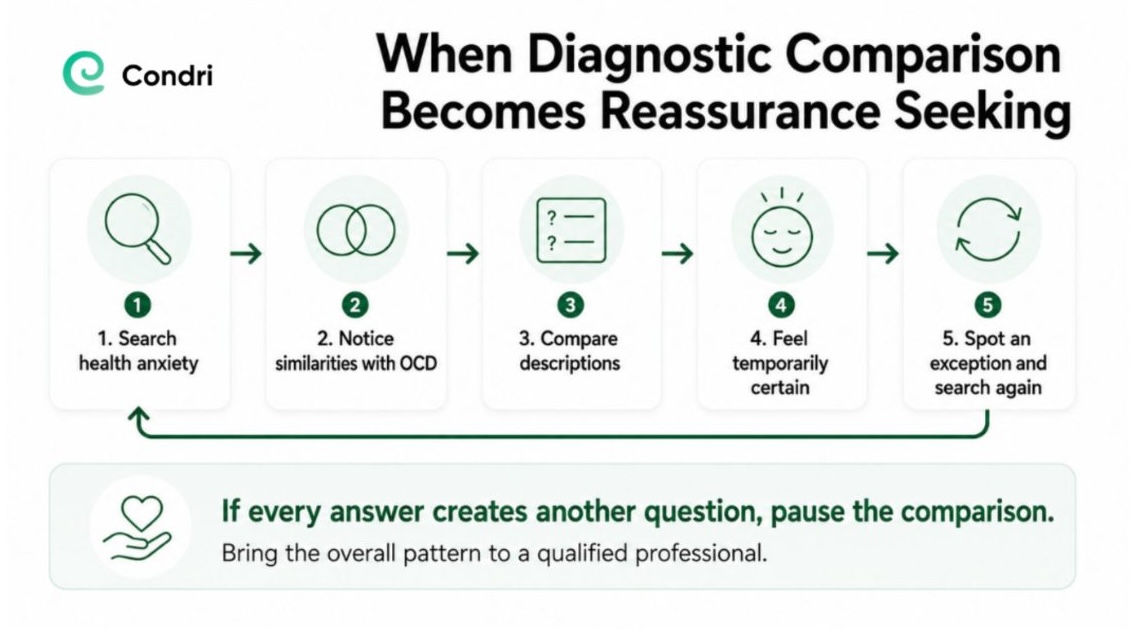
When Comparison Becomes Reassurance Seeking
Learning about mental health can be useful. For some people, however, repeatedly comparing diagnostic descriptions becomes another attempt to obtain complete certainty. Recognising this pattern is not a reason for shame; it is an opportunity to notice what the search is doing and choose a different response.
The cycle may look like this:
Search for health anxiety → compare it with OCD → feel temporarily certain → notice an exception → search again
Related behaviours can include taking multiple online quizzes, repeatedly asking others which diagnosis sounds more likely, reviewing criteria, or asking an AI system to decide.
One useful question is: Is this information helping me take a practical next step, or am I rereading it to make uncertainty disappear?
If every answer produces another diagnostic question, further comparison may maintain the cycle. Bringing the complete pattern to a qualified professional is more useful than repeatedly trying to solve the diagnosis alone.
Does Treatment Differ?
Treatment can overlap because both patterns may involve avoidance, checking, reassurance and difficulty responding to uncertainty. It should nevertheless be guided by an individual assessment and formulation.
For health anxiety, CBT has the strongest established psychological-treatment evidence.[2,8] Depending on the formulation, it may include:
· developing a shared understanding of the anxiety cycle
· examining catastrophic interpretations of sensations or medical information
· changing patterns of attention and body monitoring
· behavioural experiments
· gradually approaching avoided situations or sensations
· reducing repeated checking, reassurance and searching
· developing a planned, proportionate approach to healthcare
Depending on the person's formulation and treatment plan, acceptance and commitment therapy (ACT) and mindfulness-informed practices may contribute additional skills. These can include noticing thoughts without treating them as commands, making room for uncomfortable uncertainty, responding with self-compassion and continuing with actions connected to relationships, work, health or other personal values. They should support, rather than replace, appropriate medical assessment and evidence-based psychological treatment.
For OCD, UK guidance recommends CBT incorporating exposure and response prevention (ERP). ERP involves planned exposure to feared thoughts, images, situations or sensations while reducing the compulsions or neutralising responses that usually follow. NICE also addresses response prevention for mental rituals, not only visible compulsions.[3,6]
ERP is part of CBT for OCD. Exposure and response-prevention principles may also be used within CBT for health anxiety, but this does not make the two formulations identical. Treatment should be tailored to the function of the behaviour, relevant medical information, the person's goals and the level of impairment. Exposure exercises should not be used to override medical restrictions or to prove that a symptom is harmless. A compassionate approach supports willingness and choice; it does not use exposure as punishment or force.
Medication may also be considered. The NHS identifies selective serotonin reuptake inhibitors (SSRIs) as a main medication option for OCD and states that medication for anxiety may be offered for health anxiety.[1,9] Medication decisions belong with a qualified prescriber, taking account of diagnosis, other conditions, current medicines, potential benefits, adverse effects and individual preferences.
What a Careful Assessment May Include
The aim of assessment is not merely to choose a label. It is to understand what is happening, what maintains the difficulty and what support fits the person.
A clinician may ask about:
· the content, frequency and history of health fears or obsessions
· overt compulsions, mental rituals and neutralising responses
· body checking, reassurance, searching and avoidance
· beliefs about responsibility, threat and certainty
· use or avoidance of healthcare
· current physical symptoms and relevant medical assessment
· other OCD themes or psychological difficulties
· medication, substances, sleep and stress
· the effect on work, study, relationships and ordinary activities
· previous treatment and what did or did not help
· risk, safeguarding and urgent needs
A diagnosis should not be inferred solely from whether a person fears illness, notices bodily sensations or performs a particular check. Nor should anxiety be assumed to explain a physical symptom without appropriate clinical consideration.
When to Seek Professional Support
Consider seeking professional support when health fears, intrusive thoughts, checking, mental rituals or avoidance:
· take up substantial time
· cause marked distress
· feel increasingly difficult to resist
· interrupt sleep or concentration
· affect relationships, work, study or finances
· lead to repeated or avoided healthcare
· prevent ordinary activities
· continue despite self-help efforts
· drive repeated searching for diagnostic certainty
The NHS advises seeking help when OCD has a significant impact on life and seeing a GP when health anxiety prevents someone from living normally or self-help is not working.[1,3] In England, adults can self-refer to NHS Talking Therapies; a formal diagnosis is not required for self-referral, and the service includes support for people who worry constantly about their health or experience OCD.[10]
Depending on the person's needs, assessment might involve a GP, NHS Talking Therapies service, appropriately trained CBT therapist, clinical psychologist, psychiatrist or specialist OCD service.
Medical Safety and Urgent Help
Experiencing health anxiety or OCD does not make someone immune to physical illness. New, changing, persistent or concerning symptoms should be handled through appropriate healthcare rather than dismissed as "just anxiety". Follow any medical monitoring or follow-up plan already agreed with a qualified clinician.
If you are unsure what urgent medical help is needed in the UK, use NHS 111 online or call 111. Call 999 or go to A&E for a life-threatening emergency. Mental health crises also deserve urgent support; use the urgent-help routes appropriate to your location and situation.[11]
Online information, symptom checkers and AI tools cannot examine you, diagnose the cause of a symptom or replace professional assessment.
How Condri Fits Into Support
Condri is designed to support people experiencing health anxiety. Its structured tools focus on patterns such as repeated worry, checking, reassurance seeking, symptom searching, avoidance and difficulty tolerating uncertainty.
Condri's clinical approach is informed by CBT, exposure and response prevention principles, ACT and mindfulness. Across these approaches, the emphasis is on recognising the health-anxiety cycle, meeting distress without judgement, reducing unhelpful automatic responses, making room for uncertainty and returning attention to meaningful daily life. Compassion is not used to reassure the person that nothing is wrong; it is expressed through patience, dignity and support while they practise a different response.
Condri does not diagnose OCD, distinguish OCD from health anxiety, decide whether a physical symptom needs medical assessment or replace individual psychological treatment. Its educational content should be used alongside appropriate healthcare and professional support where needed.
For someone whose main difficulty is health anxiety, Condri can provide a framework for practising different responses to familiar triggers. This may include mindful awareness of thoughts, sensations and urges; compassionate reflection; acceptance of uncertainty; and values-guided action alongside CBT-based learning. The aim is not to achieve perfect calm or certainty, but to support more flexible and independent responding.
If prominent obsessions, compulsions, mental rituals, wider OCD themes or significant functional impairment are present, a professional assessment may help clarify whether OCD-focused or specialist support is indicated.
The Condri health anxiety quiz can help a person reflect on common patterns. It cannot diagnose a condition, rule out a medical problem or determine which treatment is appropriate.
References
- NHS. Health anxiety. Accessed 14 September 2026.
- Kikas K, Werner-Seidler A, Upton E, Newby J. Illness Anxiety Disorder: A Review of the Current Research and Future Directions. Current Psychiatry Reports. 2024;26(7):331-339. doi:10.1007/s11920-024-01507-2.
- NHS. Obsessive compulsive disorder (OCD): Overview. Accessed 14 September 2026.
- Knowles KA, Jakes KS, Olatunji BO. Obsessive-Compulsive Disorder and Illness Anxiety: Examining Commonalities and Comorbidity. Journal of Cognitive Psychotherapy. Published online 24 August 2022. doi:10.1891/JCP-2022-0027.
- Leonidou C, Panayiotou G. How do illness-anxious individuals process health-threatening information? A systematic review of evidence for the cognitive-behavioral model. Journal of Psychosomatic Research. 2018;111:100-115. doi:10.1016/j.jpsychores.2018.06.001.
- National Institute for Health and Care Excellence. Obsessive-compulsive disorder and body dysmorphic disorder: treatment (CG31), recommendations. Published 29 November 2005. Accessed 14 September 2026.
- McMullan RD, Berle D, Arnáez S, Starcevic V. The relationships between health anxiety, online health information seeking, and cyberchondria: Systematic review and meta-analysis. Journal of Affective Disorders. 2019;245:270-278. doi:10.1016/j.jad.2018.11.037.
- Cooper K, Gregory JD, Walker I, Lambe S, Salkovskis PM. Cognitive Behaviour Therapy for Health Anxiety: A Systematic Review and Meta-Analysis. Behavioural and Cognitive Psychotherapy. 2017;45(2):110-123. doi:10.1017/S1352465816000527.
- NHS. Obsessive compulsive disorder (OCD): Treatment. Accessed 14 September 2026.
- NHS. Find NHS talking therapies for anxiety and depression. Accessed 14 September 2026.
- NHS. NHS services and urgent help. Accessed 14 September 2026.
Common questions
- What is the difference between health anxiety and health OCD?
- Health anxiety usually centres on persistent worry about having or developing an illness, often linked to bodily sensations, medical information or fear that something has been missed. Health-related OCD involves obsessions alongside compulsions or mental rituals intended to reduce distress, prevent harm or create certainty. The two patterns can overlap, so one behaviour alone cannot distinguish them.
- Is health OCD an official diagnosis?
- No. “Health OCD” is an informal term used to describe OCD where obsessions and compulsions focus heavily on health, illness, contamination or related fears. It is not a separate recognised subtype or diagnosis.
- Can health anxiety and OCD happen at the same time?
- Yes. OCD and illness anxiety can occur together, and a person may show features associated with both patterns. A physical health condition can exist alongside either health anxiety or OCD too, which is why assessment needs to consider the wider clinical and medical picture.
- Are intrusive health thoughts always a sign of OCD?
- No. Intrusive, repetitive and unwanted thoughts can occur across different forms of psychological distress, including health anxiety. Clinicians look at factors such as compulsions, mental rituals, rules, neutralising behaviours, distress and the effect on daily life rather than using intrusive thoughts alone to make a diagnosis.
- Can reassurance seeking happen with both health anxiety and OCD?
- Yes. Repeated reassurance seeking, body checking, symptom searching and rereading medical information can appear in both health anxiety and OCD. The reason behind the behaviour, what happens before and after it, and whether it follows an obsession or rigid rule can help clinicians understand the pattern.
- What are mental compulsions in health-related OCD?
- Mental compulsions can include reviewing conversations with clinicians, replaying memories, silently repeating reassuring phrases, mentally checking the body, comparing sensations or trying to neutralise frightening thoughts. These behaviours may be difficult for other people to notice because they happen internally.
- Is the treatment for health anxiety different from OCD?
- There can be overlap, but treatment is guided by the person's individual pattern. CBT has the strongest established psychological-treatment evidence for health anxiety. For OCD, UK guidance recommends CBT incorporating exposure and response prevention, often called ERP.
- When should someone seek professional support?
- Professional support may be helpful when health fears, intrusive thoughts, compulsions, checking, mental rituals or avoidance take up substantial time, cause significant distress or interfere with sleep, relationships, work, study, finances or everyday activities. Adults in England can self-refer to NHS Talking Therapies without needing a formal diagnosis first.