How AI Symptom Searching Can Feed Health Anxiety
with a clinician. It can also give you an answer within seconds, at any hour, when a symptom feels frightening.
For someone experiencing health anxiety, that ease can turn one question into a longer search for certainty. You may feel reassured briefly, then remember a detail you left out, ask the question another way or consult a second tool. An alarming answer can prompt just as many follow-up questions.
AI does not cause health anxiety simply because you use it. What matters is what you are asking it to do. Is it helping you understand general information for a practical purpose, or have you begun relying on it to settle the same health fear repeatedly?
Why is AI appealing during a health worry?
A chatbot is immediate, private and conversational. You can describe a concern in your own words and ask follow-up questions without having to decide when the conversation is finished.
That can be useful. A plain-language explanation of a medical term, for instance, may help you understand a document or prepare a question for an appointment.
It can also make reassurance seeking easy to repeat. If an answer does not feel certain enough, you can add another symptom, ask for a probability or request a different explanation. The NHS identifies frequent reassurance seeking and repeated searches for health information among common health anxiety behaviours. A chatbot can become another place where those behaviours happen.
How does an AI checking cycle develop?
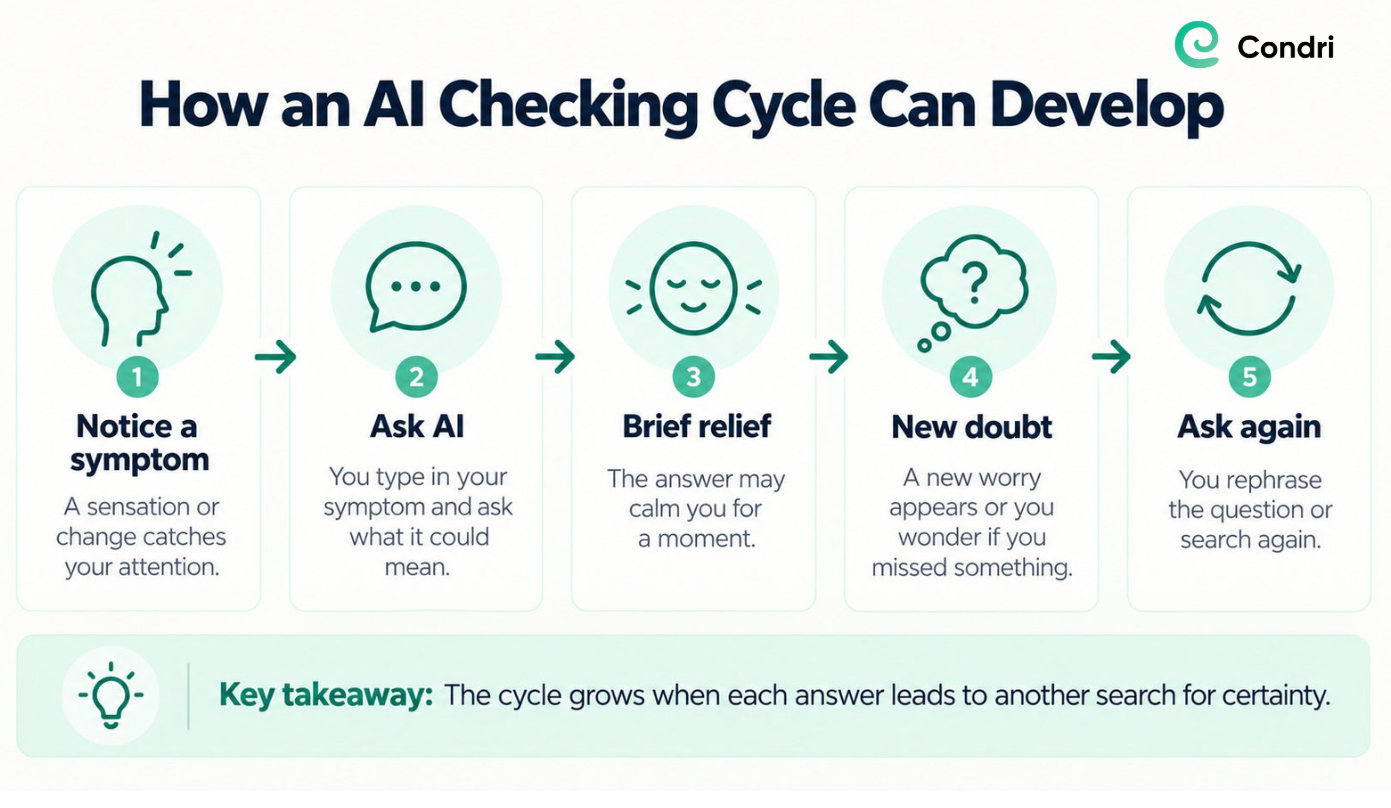
A conversation may begin with a reasonable question and gradually change purpose:
Health trigger → frightening thought → ask AI → brief relief or greater alarm → new doubt →ask again
Suppose you notice a sensation and ask what might cause it. You read the answer and feel calmer. Later you wonder, “What if I described it incorrectly?” You revise your prompt. The next answer mentions a condition you fear, so you ask several questions about that condition.
The issue is not the number of questions alone. It is whether each answer sends you back for more because you are trying to reach a level of certainty the conversation cannot provide.
Relief is possible; so is increased worry. Neither reaction tells you what the symptom means medically.
Why can an answer feel convincing even when it is incomplete?
AI can produce fluent, tailored explanations. Yet confident language is not the same as reliable evidence or an individual clinical assessment. The World Health Organization (WHO) warns that large language models can produce health responses that sound plausible and authoritative while containing serious errors. Its later guidance also highlights the risk of false, biased or incomplete information.
A response may feel particularly personal because it refers to the details you typed. But the system is responding to information you supplied; it has not independently examined you or established that the possibilities it mentions are likely.
This cuts both ways. A reassuring answer should not be treated as a medical all-clear, and an alarming list of possibilities should not be treated as a diagnosis.
When a possibility becomes the focus
If you ask, “Could this be condition X?”, the reply may explain ways in which X could relate to what you described. That is not the same as a clinician identifying X as a likely explanation after an appropriate assessment.
For a person with health anxiety, the most frightening possibility can capture attention. You may then ask:
- “How likely is it?”
- “What else would I notice?”
- “Does this new detail make it more likely?”
- “Can you rule it out?”
The discussion can become increasingly specific while remaining unable to answer the individual medical question. If you need an assessment, use an appropriate healthcare service.
What do we know about people’s experiences of AI health searches?
In a 2026 survey commissioned by AXA Health, 59% of respondents who used AI said one health question always or often led to more, while 78% said AI had helped them understand medical terminology, test results or treatment plans. Respondents also reported experiences of increased anxiety and misleading information.
Those are accounts of what surveyed users said. They do not establish that AI caused the anxiety, show how accurate a particular tool is, or predict what will happen to every user. They do illustrate both sides of the experience: AI can help someone understand information and can become a place where a health worry continues to grow.
How can you tell information seeking from reassurance seeking?
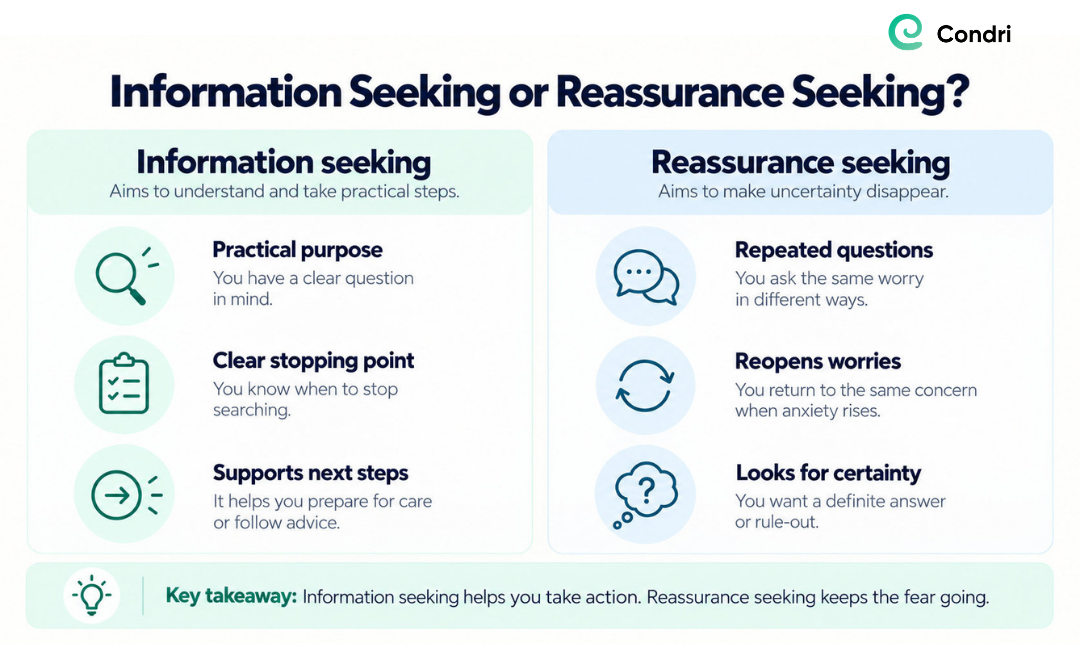
The same question can serve different purposes on different days. Consider what you hope the answer will allow you to do.
| Information seeking | Reassurance seeking |
| Has a practical question or decision in mind | Aims to make uncertainty disappear |
| Has a reasonable stopping point | Leads to repeated variations of the question |
| Helps you prepare for or follow appropriate care | Reopens an agreed plan whenever anxiety rises |
| Leaves room to ask a clinician what remains unclear | Asks AI to confirm or rule out an individual condition |
These are reflection prompts, not diagnostic criteria. You might notice that you keep asking “Are you sure?”, compare several chatbots, return to the conversation whenever fear rises, or feel relief that fades quickly.
Try asking yourself: “What am I hoping the next answer will give me that the previous one could not?”
Can switching tools keep the same cycle going?
Yes. You might close a chatbot, then search Google, read a forum, inspect your body or ask someone close to you to look at a symptom. Each action feels like a new way to investigate, but it may still be an attempt to settle the same doubt.
It helps to look at the purpose of the behaviour rather than treating one website or app as the whole problem. Support from another person can still be valuable: they can listen to how frightened you feel without having to diagnose a symptom or provide a guarantee.
When can AI be useful?
AI may help with a defined, general task, such as explaining terminology, putting an information leaflet into plainer language or helping you draft questions for an appointment. Check important information against the original source and ask a healthcare professional when its meaning for your care is unclear.
A useful boundary is to decide on the task before opening the tool. For example: “I want to understand the term in this letter so I can ask my clinician a clearer question.” Once you have that explanation, notice if you begin asking the tool to interpret your symptoms or repeatedly reassure you about what the letter means.
Be thoughtful about what personal health information you enter. WHO has also raised concerns about how sensitive information supplied to some AI systems may be handled.
How can you reduce repetitive AI symptom checking?
Start gently. The urge to ask again makes sense when you are afraid; criticising yourself for it is unlikely to make the fear easier to manage.
- Notice the trigger. What happened before you opened the chatbot—a sensation, a thought, a test result or something you read?
- Name what you want from the answer. Do you need information for a practical step, or are you hoping to feel completely certain?
- Pause before sending another prompt. You can acknowledge the worry without answering it immediately.
- Watch for rephrasing. Adding small details or moving between tools may be a sign that you are seeking reassurance about the same concern.
- Return to an appropriate medical plan. Follow advice you have been given. Seek new guidance if the situation has changed or you have a concern that needs assessment.
- Choose a small next action. When no further medical step is indicated, return to a task, rest or a person who matters to you, even if some uncertainty remains.
The NHS recommends noting and gradually reducing repeated reassurance seeking and health-information searching. Your approach can be gradual too; it does not need to become a rigid ban on asking questions.
A mindful pause may sound like: “I’m frightened, and I want to ask again. I can notice that urge before I decide what to do.” The purpose is to create a little choice, not to prove that a symptom is harmless or force yourself to feel calm.
When should you seek medical advice instead?
A general-purpose chatbot cannot replace an individual clinical assessment. A healthcare professional can consider information beyond the text of a conversation, including your history, the course of symptoms and any examination or investigations that are appropriate.
Seek suitable medical advice for a new, persistent, worsening or otherwise concerning symptom, and follow any existing care or follow-up plan. Use an appropriate urgent or emergency service when urgent help is needed. Reducing repetitive reassurance seeking must never mean delaying necessary healthcare.
Health anxiety and physical illness can coexist. You deserve an appropriate response to both.
Can psychological support help with the AI checking habit?
Yes. CBT can help someone understand the connection between a health fear, the urge to ask and the temporary effect of reassurance. Exposure and Response Prevention (ERP) principles may help a person practise delaying or reducing a repeated prompt when doing so is medically appropriate. Acceptance-based and mindfulness practices can help them notice fear, allow some uncertainty and return to meaningful activity without demanding that the fear disappear first.
This work is not about taking medical risks or testing whether a symptom is safe. It concerns the additional, repetitive questions used to manage anxiety after appropriate healthcare decisions have been made.
If health worries are interfering with daily life or self-help is not working, the NHS advises speaking to a GP. In England, adults can also refer themselves to NHS Talking Therapies.
How Condri can support a different response
Condri offers self-guided practice focused on the health anxiety cycle, including symptom searching, checking and reassurance seeking. Its approach draws on CBT, ERP, ACT and mindfulness. It is designed to help you notice an urge and practise what to do next; it is not a symptom checker, a source of medical reassurance or a replacement for professional care.
The aim is not to find a chatbot that gives a more comforting answer. It is to become more able to recognise when you need genuine information or medical care—and when another answer is unlikely to settle the fear for long.
Common questions
- How much does health anxiety treatment cost in the UK?
- Health anxiety treatment costs depend on the type of support you choose. NHS Talking Therapies is free, while private CBT can start from £35 per session, with specialist providers often charging £75 to £90 or more. Lower-cost options include charity services, self-help books and mental health apps.
- Can you get free treatment for health anxiety on the NHS?
- Yes, NHS Talking Therapies provides free psychological treatment for health anxiety in England. Adults can refer themselves without needing a GP referral or formal mental health diagnosis. Available treatments may include CBT, guided self-help and group therapy, depending on individual needs and local services.
- How much does private CBT for health anxiety cost?
- Private CBT can cost from £35 per session, though many specialist therapists charge approximately £75 to £90 or more. The total cost depends on the number of appointments, therapist fees and any additional assessments. For example, 12 sessions at £75 each would cost £900.
- Are there cheaper alternatives to private therapy for health anxiety?
- Yes, cheaper options include NHS Talking Therapies, subsidised charity counselling, group programmes, self-help workbooks and mental health apps. Some employers, universities and insurance providers may cover therapy costs. The level of professional support varies between these options.
- Are health anxiety apps cheaper than therapy?
- Health anxiety apps typically cost less than private therapy. Some are free, while others require a subscription. For example, Condri costs $12.99 per month and provides structured self-guided exercises focused on health anxiety. However, an app does not provide the same individual assessment or therapist support as professional treatment.
- Is expensive therapy more effective for health anxiety?
- Not necessarily. Higher treatment costs do not automatically mean better results. NHS services provide evidence-based psychological treatment at no direct cost to eligible patients. Treatment suitability depends on individual needs, the approach used and the level of professional support required.