How Effective Is CBT at Treating Health Anxiety
Cognitive Behavioural Therapy (CBT) is one of the most extensively studied psychological approaches for health anxiety. Research suggests that it can reduce health-anxiety symptoms for many people, and some studies have found that improvements can continue after treatment ends.
That does not mean CBT works equally well for everyone, that every form of CBT is the same, or that a positive research finding can be applied automatically to every therapist, course or app. It also does not mean that people who do not benefit have failed treatment.
A more useful question than “Does CBT work?” is: what kind of CBT was studied, compared with what, for whom, and what did improvement mean? It also matters whether treatment feels collaborative, compassionate and relevant to the person receiving it.
This article examines the evidence honestly. It explains what CBT may offer, where its limits lie, and how mindfulness, acceptance and compassion can make work with health anxiety more humane and personally meaningful.
What Is CBT for Health Anxiety
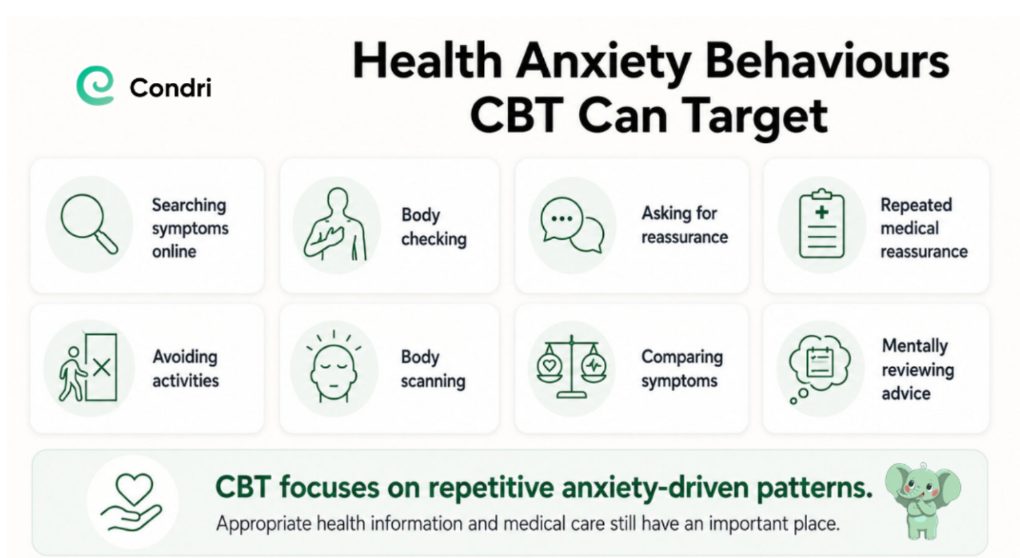
CBT for health anxiety explores how bodily sensations, thoughts, emotions, attention and behaviour can interact to keep fear going.
A sensation or piece of health information may be interpreted as evidence of danger. Anxiety rises and the person understandably tries to feel safe. They may search symptoms, check their body, ask for reassurance, mentally review medical advice or arrange another consultation.
These actions may reduce anxiety briefly. When uncertainty returns, however, another check can feel necessary. The mind learns that the doubt must be resolved each time it appears.
For example:
· Sensation: You notice a headache.
· Interpretation: “What if this means something serious?”
· Response: You search online, compare symptoms and ask someone whether you look unwell.
· Immediate effect: Anxiety falls for a short time.
· Longer-term effect: The next headache may trigger an even stronger urge to investigate.
This is not a moral failing or evidence that someone is being irrational. Checking and reassurance are attempts to protect oneself. CBT examines whether these strategies are providing lasting help or unintentionally strengthening the cycle.
What CBT Is and What It Should Not Become
Good CBT is not simply “thinking positively” or replacing every frightening thought with a reassuring one. It should not involve telling someone that their symptoms are imaginary, arguing them out of their fear or promising that nothing is medically wrong.
At its best, CBT is collaborative. The person and therapist develop a shared understanding of what happens when uncertainty appears, then explore different ways of responding. The work may include observing patterns, testing predictions, reducing repetitive safety behaviours and returning to activities that anxiety has restricted.
Poorly fitted or rigidly delivered CBT can feel very different. If the emphasis falls mainly on correcting thoughts, a person may feel analysed, blamed or emotionally unseen. A technically correct intervention can still be unhelpful if it does not make room for the person’s history, relationships, physical health, culture, preferences and emotional experience.
The name of the therapy therefore tells us less than it may appear to. The quality of the therapeutic relationship, the individual formulation and the way methods are introduced all matter.
How CBT Treats Health Anxiety
CBT can help a person identify how they respond to health-related uncertainty and practise alternatives to patterns that may be maintaining anxiety.
Treatment varies, but may include:
· developing an individual formulation of the health-anxiety cycle
· noticing catastrophic interpretations and attentional biases
· exploring beliefs about illness, uncertainty and responsibility
· reducing repeated checking, symptom searching and reassurance seeking
· approaching situations or sensations that have been avoided
· using behavioural experiments to test specific predictions
· developing a plan for responding to future setbacks
Exposure-based work may involve approaching a situation, activity or sensation that someone has been avoiding while reducing the checking or reassurance that usually follows. This should be planned collaboratively, with consent and an appropriate understanding of the person’s physical-health circumstances.
A central shift is moving away from trying to prove:
“This sensation definitely is not dangerous.”
and towards questions such as:
“What happens when I allow some uncertainty without immediately checking?”
No psychological therapy can provide permanent certainty about future health. The aim is to become more able to make considered decisions without allowing every frightening possibility to dictate the next action.
Which Health Anxiety Behaviours Can CBT Address
CBT often focuses on responses that bring short-term relief while leaving the person more dependent on certainty later.
These can include:
· repeatedly searching symptoms or diseases online
· checking the body, pulse, skin or another area for changes
· scanning the body for sensations
· repeatedly asking other people for reassurance
· seeking additional medical reassurance without new information or an agreed clinical reason
· mentally reviewing appointments, test results or a clinician’s words
· comparing symptoms with other people’s experiences
· avoiding exercise, travel, medical information or other triggers
· using grounding or relaxation as a test of whether a symptom is harmless
Context is essential. Searching for information, monitoring a condition or seeking medical care is not inherently problematic. The relevant questions are whether the behaviour is medically indicated, how often it is repeated, what it is intended to achieve and whether relief lasts.
The NHS similarly identifies repeated body checking, reassurance seeking and health-information searching among patterns associated with health anxiety, and advises gradually reducing them where appropriate.
What Happens During CBT for Health Anxiety
Treatment usually begins with assessment and a shared formulation. This may cover triggers, feared outcomes, interpretations of sensations, previous health experiences, checking, avoidance, reassurance and the impact on daily life.
The therapist and patient may then agree on specific goals. These might include spending less time searching, returning to valued activities, responding differently after medical reassurance or becoming more able to allow uncertainty.
Between-session practice is common because health anxiety usually appears in everyday life rather than only in the therapy room. Practice should be purposeful and proportionate. It should not become another performance test or source of self-criticism.
CBT should not depend on the therapist repeatedly saying, “There is nothing wrong with you.” It should help the person understand why certainty feels so necessary and explore what becomes possible when the reassurance cycle is not automatically repeated.
How Effective Is CBT for Health Anxiety According to Research
The evidence is encouraging, but a single “success rate” can be misleading.
A 2019 systematic review and meta-analysis examined 19 randomised controlled trials comparing CBT with non-CBT control conditions. The pooled between-group effect on health anxiety was moderate to large, with a Hedges’ g of 0.79. After adjustment for possible publication bias, the estimate was 0.62.
The review reported a pooled response rate of 66% and a remission rate of 48%. These figures should not be interpreted as guarantees. Response generally means improvement by a predefined amount. Remission usually means falling below a specified clinical threshold. Neither necessarily means complete recovery, the absence of anxious thoughts or permanent freedom from health worries.
The review also found that effects were largely sustained at follow-up between 12 and 18 months. Results varied across studies, and the comparison condition mattered: effects tended to look larger when CBT was compared with passive controls, such as a waiting list, than when it was compared with a more active alternative.
The review found limited improvement in quality of life despite clearer improvement in health-anxiety symptoms. This is clinically important. A reduction on a symptom measure does not automatically mean that every part of a person’s life has improved to the same extent.
What the CHAMP Trial Adds
The UK CHAMP trial studied an adapted form of CBT for health anxiety in people attending medical clinics. A total of 444 participants were allocated to either CBT adapted for health anxiety or standard care. The intervention involved between five and ten sessions.
At one year, health-anxiety improvement was greater in the CBT group. The original report found that benefits were sustained over two years, and a later report followed outcomes for up to five years.
This is useful evidence because the participants were already using hospital medical services. It does not show that every person will benefit, that brief CBT is sufficient for every presentation or that the same results apply to an unrelated digital product.
Can Internet Delivered CBT Be Effective
Some therapist-guided internet CBT programmes have produced meaningful reductions in health anxiety.
An early randomised trial compared internet-delivered CBT with an attention-control condition in 81 participants. A follow-up paper reported large improvements from baseline to one year in the internet-CBT group.
A later randomised non-inferiority trial included 204 adults with a principal diagnosis of health anxiety. Participants received either 12 weeks of therapist-guided internet CBT or individual face-to-face CBT. Internet CBT met the study’s predefined non-inferiority criterion during treatment, and follow-up data were collected for up to 12 months.
Non-inferiority has a specific statistical meaning: the study was designed to test whether internet CBT was not unacceptably worse than face-to-face CBT by more than a prespecified margin. It does not establish that the two formats are identical for every person or every outcome.
These findings support the particular structured and therapist-guided programmes that were studied. They do not prove that every online course, self-guided programme or app described as “CBT-based” will produce the same outcomes.
How Long Can Benefits Last
Several studies suggest that improvements can remain measurable after treatment ends. The 2019 review found that effects were largely sustained at 12 to 18 months, while the CHAMP study reported group differences over longer follow-up, extending to five years.
Long-term findings require care. Some participants are lost to follow-up, treatments differ and later experiences may also influence outcomes. A lasting difference between groups does not mean that therapy continues working automatically without any further learning, practice or support.
For some people, benefit may involve remembering how to respond when anxiety returns rather than never experiencing health anxiety again.
How Quickly Can CBT Begin to Help
There is no universal point at which CBT should start working.
Some health-anxiety interventions are brief, while others run for approximately 12 weeks or longer. Progress may initially appear as a change in behaviour rather than a dramatic fall in anxiety.
Early signs of movement might include:
· noticing the urge to check before acting on it
· delaying a reassurance request
· spending less time searching symptoms
· returning to an avoided activity
· responding to a setback with less self-criticism
· recognising that anxiety can be present without determining the next decision
Treatment length is not a countdown to being “cured”. Progress depends on the person, the treatment, the therapeutic relationship, the wider context and what happens between sessions.
Who May Benefit From CBT
CBT may be considered when health worries, checking, reassurance, avoidance or symptom searching are causing distress or interfering with everyday life.
It may be particularly relevant when someone understands intellectually that reassurance does not last but still feels compelled to seek it, or when fear has begun to restrict work, relationships, movement, travel or healthcare decisions.
Recognising these patterns does not establish a diagnosis. Physical symptoms and medical concerns still deserve appropriate assessment. Psychological support and physical healthcare can be needed at the same time.
The NHS advises speaking to a GP when health worries prevent someone from leading a normal life or self-help has not been effective. In England, adults can also self-refer to NHS Talking Therapies.
Which Factors Can Influence Outcomes
Treatment effectiveness depends on more than the label “CBT”. Relevant factors can include:
· how well the approach fits the person’s difficulties and preferences
· the therapist’s training, experience and ability to form a collaborative relationship
· the quality and individuality of the formulation
· whether the person feels emotionally understood and safe enough to engage
· treatment format and accessibility
· opportunities for practice between sessions
· physical-health circumstances and coexisting mental-health difficulties
· social, cultural, financial and practical pressures
· whether treatment can be adapted when the initial approach is not helping
Engagement can matter, but unsuccessful treatment should never be reduced to “the person did not try hard enough”. Therapy can be poorly matched, inaccessible, too rigid, insufficiently individualised or unable to address other important needs.
Effectiveness statistics describe groups. They cannot determine how one person will respond.
What If CBT Feels Invalidating or Is Not Right for You
Some people find CBT practical and liberating. Others experience it as overly intellectual, corrective or focused on changing thoughts before they have felt understood.
If therapy seems to imply that your physical experience is not real, that every concern is distorted or that you are responsible for eliminating anxiety, it is reasonable to raise this. Good psychological work should distinguish between validating distress and confirming a feared medical interpretation.
Questions you might discuss with a therapist include:
· Can we spend more time understanding what the fear means in my life?
· How will we distinguish appropriate healthcare from anxiety-driven repetition?
· Can we work with thoughts without debating every one of them?
· Can mindfulness, acceptance or compassion be included?
· What will we do if an exercise feels overwhelming or medically inappropriate?
· How will we know whether this approach is helping?
Changing the formulation, pace, therapist or therapeutic approach may sometimes be appropriate. This is not a failure. Treatment should be collaborative enough to respond when the work is not fitting the person.
Where Mindfulness Compassion and Acceptance Fit
Mindfulness and compassion can change the tone and purpose of work with health anxiety.
Mindfulness involves noticing thoughts, sensations, emotions and urges as they arise, without immediately treating each experience as a command or a medical conclusion. It is not a method for proving that a symptom is harmless, forcing the body to relax or emptying the mind.
Compassion involves recognising that fear and checking developed for understandable reasons. It replaces blame with curiosity while still supporting change. Compassion is not reassurance and does not require saying that everything is fine.
Acceptance does not mean approving of anxiety, giving up on healthcare or deciding that symptoms do not matter. It means allowing some internal discomfort and uncertainty to be present while choosing an action guided by medical advice, personal values and the life the person wants to live.
These principles can sit alongside behavioural work. For example, someone may mindfully notice the urge to check, respond to themselves with kindness and then choose not to repeat a check that is not part of an agreed medical plan.
The health-anxiety-specific evidence base is currently stronger and more extensive for CBT than for compassion-focused or mindfulness-only interventions. Condri should therefore avoid presenting these approaches as though they have identical bodies of evidence. Their inclusion reflects an integrative clinical philosophy and the importance of how psychological methods are experienced, not a claim that all approaches have been studied equally.
How CBT Differs From Reassurance
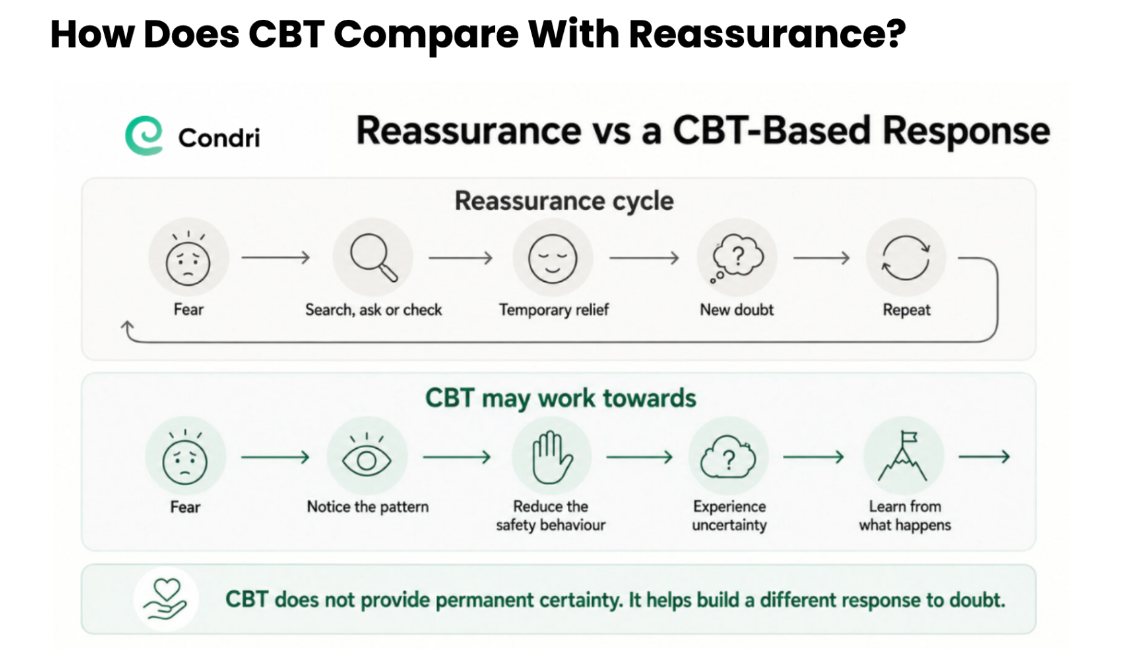
Reassurance usually attempts to remove uncertainty quickly:
Fear → check, search or ask → temporary relief → new doubt → repeat
CBT may instead support a different sequence:
Fear → notice the pattern → choose whether medical action is genuinely needed → reduce the repetitive safety response → allow uncertainty → learn from what follows
Mindfulness and compassion can make that sequence less adversarial:
Fear → notice the experience kindly → make space for the urge → choose a considered action → return to what matters
None of these approaches requires avoiding appropriate healthcare. New, changing, persistent or concerning symptoms should not automatically be labelled as anxiety. The distinction is between appropriate assessment and repeatedly reopening the same question primarily to obtain certainty.
How Condri Draws on CBT Without Being Defined by It
Condri is designed specifically for health anxiety. Its approach is informed by CBT, Exposure and Response Prevention, Acceptance and Commitment Therapy, mindfulness and compassion-focused principles.
The app focuses on patterns such as checking, reassurance seeking, symptom searching, avoidance, catastrophic interpretation and difficulty tolerating uncertainty. It encourages users to notice these patterns, respond with greater awareness and self-compassion, and practise actions that support recovery and valued daily life.
Condri is not intended to tell people that their thoughts are wrong or that physical symptoms are “just anxiety”. It does not diagnose medical or mental-health conditions, assess individual symptoms, interpret test results or determine whether healthcare is required.
Evidence supporting therapist-delivered or therapist-guided CBT cannot be used as proof that Condri produces the same outcomes. Condri should be understood as structured, health-anxiety-specific self-help, not a replacement for individual assessment or treatment.
When to Work With a Therapist
Professional support may be appropriate when health anxiety is significantly affecting daily life, self-guided approaches are not enough, or the person would benefit from an individual assessment and formulation.
Consider additional support when:
· checking, reassurance or avoidance feels increasingly difficult to resist
· health worries are disrupting sleep, work, relationships or ordinary activities
· anxiety is affecting how medical advice is understood or used
· other mental-health difficulties are present
· exposure work needs clinical adaptation or supervision
· previous treatment felt invalidating, ineffective or poorly matched
In England, people can self-refer to NHS Talking Therapies, while a GP can discuss available options. People seeking private CBT can check whether a practitioner is appropriately qualified and accredited, including through the British Association for Behavioural and Cognitive Psychotherapies.
No psychological treatment should be used to dismiss new or unexplained physical symptoms. Medical concerns should be discussed with an appropriate healthcare professional, while therapy can address the anxiety patterns surrounding those concerns.
A Balanced Answer
CBT has meaningful research support for health anxiety. Across randomised trials, many participants have improved, and some benefits have remained measurable after treatment. Therapist-guided internet CBT has also performed well in specific studies.
The evidence does not show that CBT works for everyone, that all CBT is equally good or that one set of trial results can be transferred to every therapist, programme or app. It also does not justify reducing CBT to correcting “negative thoughts”.
For CBT to be helpful, it should be collaborative, individualised and respectful of genuine physical-health needs. Mindfulness, acceptance and compassion can help ensure that change does not become another battle with the self.
The most useful question may therefore be not only “Does CBT work?” but also: “Is this approach being offered in a way that fits this person, respects their experience and helps them build a freer life?”
References Used for Clinical Review
· NHS. Health anxiety. Updated guidance describing health-anxiety patterns, self-help and treatment options.
· Axelsson E, Hedman-Lagerlöf E. Cognitive behavior therapy for health anxiety: systematic review and meta-analysis of clinical efficacy and health economic outcomes. Expert Review of Pharmacoeconomics and Outcomes Research. 2019. doi:10.1080/14737167.2019.1703182.
· Tyrer P, Cooper S, Salkovskis P, et al. Clinical and cost-effectiveness of cognitive behaviour therapy for health anxiety in medical patients: a multicentre randomised controlled trial. The Lancet. 2014;383:219-225. doi:10.1016/S0140-6736(13)61905-4.
· Tyrer P, Salkovskis P, Tyrer H, et al. Cognitive-behaviour therapy for health anxiety in medical patients: a randomised controlled trial with outcomes to 5 years. Health Technology Assessment. 2017;21(50):1-58. doi:10.3310/hta21500.
· Hedman E, Andersson G, Andersson E, et al. Internet-based cognitive-behavioural therapy for severe health anxiety: randomised controlled trial. British Journal of Psychiatry. 2011;198:230-236. doi:10.1192/bjp.bp.110.086843.
· Hedman E, Andersson E, Lindefors N, et al. Cost-effectiveness and long-term effectiveness of internet-based cognitive behaviour therapy for severe health anxiety. Psychological Medicine. 2013;43:363-374. doi:10.1017/S0033291712001079.
· Axelsson E, Andersson E, Ljótsson B, et al. Effect of internet vs face-to-face cognitive behavior therapy for health anxiety: a randomized noninferiority clinical trial. JAMA Psychiatry. 2020;77:915-924. doi:10.1001/jamapsychiatry.2020.0940.
Common questions
- How effective is CBT for health anxiety?
- Research suggests that CBT can reduce health anxiety for many people. A 2019 review of 19 randomised controlled trials found meaningful improvements compared with non-CBT control conditions. Results varied between studies, and CBT does not work equally well for everyone.
- What is the success rate of CBT for health anxiety?
- One systematic review reported a response rate of 66% and a remission rate of 48%. These figures should not be treated as guarantees. Response and remission are research measures and do not necessarily mean that someone will never experience health-related worry again.
- How does CBT help with health anxiety?
- CBT can help people recognise patterns that may keep health anxiety going, such as repeated body checking, symptom searching, reassurance seeking and avoidance. Therapy may help someone practise different responses to uncertainty rather than repeatedly trying to obtain complete reassurance.
- How long does CBT take to work for health anxiety?
- There is no fixed point at which CBT starts helping. Some programmes are relatively brief, whereas others run for around 12 weeks or longer. Early progress may involve checking less often, delaying reassurance, spending less time searching symptoms or returning to activities that anxiety has restricted.
- Can health anxiety come back after CBT?
- Health-related anxiety can still occur after treatment. Research suggests that improvements from CBT can remain measurable after therapy has ended, with some studies reporting benefits over longer follow-up periods. Treatment may help people develop ways of responding when anxiety returns rather than removing every future health worry.
- Is online CBT effective for health anxiety?
- Research has found positive results for some structured, therapist-guided internet CBT programmes. One study involving 204 adults found that therapist-guided internet CBT met the study's criteria for non-inferiority compared with face-to-face CBT. This does not mean that every app, online course or self-guided programme will produce the same results.
- What behaviours can CBT address in health anxiety?
- CBT may work with repeated symptom searching, body checking, reassurance seeking, scanning the body for sensations, mentally reviewing medical information and avoiding feared situations. The aim is not to stop appropriate healthcare but to recognise when repeated behaviours are being driven mainly by the need for certainty.
- What if CBT has not worked for my health anxiety?
- A previous course of CBT not helping does not mean that every form of psychological support will be ineffective. The approach may have been poorly matched, too rigid, insufficiently individualised or unable to address other needs. It may be useful to discuss the experience with a suitably qualified therapist or healthcare professional.
- Can mindfulness and acceptance be used alongside CBT for health anxiety?
- Yes. Mindfulness, acceptance and compassion-based principles can sit alongside CBT techniques. They may help someone notice anxious thoughts and urges without automatically reacting to them, respond with less self-criticism and make considered choices when uncertainty is present.
- Does CBT mean ignoring physical symptoms?
- No. CBT for health anxiety should not involve dismissing new or concerning physical symptoms. Appropriate medical assessment and psychological support can exist together. Therapy focuses on the anxiety patterns surrounding health concerns rather than assuming that every physical sensation is caused by anxiety.