How to Help Someone with Health Anxiety
Helping someone with health anxiety is not about finding the perfect reassurance that will make fear disappear. The most useful support usually combines warmth with clear limits: listen to the distress, avoid repeatedly trying to prove that the person is medically safe, encourage appropriate healthcare, and help them return to the coping strategies and activities they have chosen.
You can take a person's fear seriously without agreeing that a feared illness is present. You can offer comfort without promising that nothing is wrong. You can also support access to healthcare without becoming responsible for diagnosis or medical decisions.
The aim is not to eliminate anxiety on demand. It is to help the person build a different relationship with uncertainty while protecting both their autonomy and your relationship.
Understand What Health Anxiety Can Look Like
Health anxiety is more than an occasional worry about health. The NHS describes it as spending so much time worrying about being ill, or becoming ill, that the worry begins to take over everyday life.[1] The term is often used broadly. It does not automatically mean that someone meets criteria for a particular diagnosis, and it does not mean their physical symptoms are imagined.
Health anxiety can occur whether or not a person has a diagnosed physical condition. Physical illness and health anxiety can coexist. A person should not have a new, changing or persistent symptom dismissed simply because they also experience anxiety.
Common patterns include:
· repeatedly checking the body for lumps, pain, tingling, asymmetry or other changes
· asking other people for reassurance that they are not ill
· worrying that a clinician or medical test has missed something
· repeatedly searching for health information online or in the media
· avoiding medical information, appointments, exercise, travel or social activities because they feel dangerous
· returning to a health question after it has already been discussed or medically assessed
These behaviours are understandable attempts to feel safer. Research on health anxiety supports a cognitive-behavioural account in which threatening interpretations, heightened attention to bodily information, avoidance and safety behaviours can maintain distress.[2,3] The evidence is strongest for the overall pattern; not every proposed mechanism has been established equally well.
A common cycle is:
A bodily sensation or health cue leads to a threatening interpretation, which increases anxiety and attention to the body. Checking, searching, avoidance or reassurance brings short-term relief. Because certainty never lasts, doubt returns and the behaviour is repeated.
Recognising this cycle can help you respond to the anxiety without treating the person as irrational, difficult or attention-seeking.
Listen Without Judging or Dismissing
Listening does not mean agreeing with the illness the person fears. It means recognising what they are experiencing before trying to solve it.
If someone says that a sensation has frightened them, an immediate response such as "there's nothing wrong with you" may miss the emotional message and provide only momentary relief. Dismissive responses can add shame or conflict to an already frightening experience.
Helpful responses include:
· "I can see this is making you very anxious."
· "It sounds as though the uncertainty is hard to sit with."
· "I'm listening. What is frightening you most right now?"
Avoid ridicule, criticism or arguments about whether the person "should" feel anxious. Calm listening and emotional acknowledgement are compatible with maintaining a boundary around symptom analysis.
Validate the Feeling Without Confirming the Fear
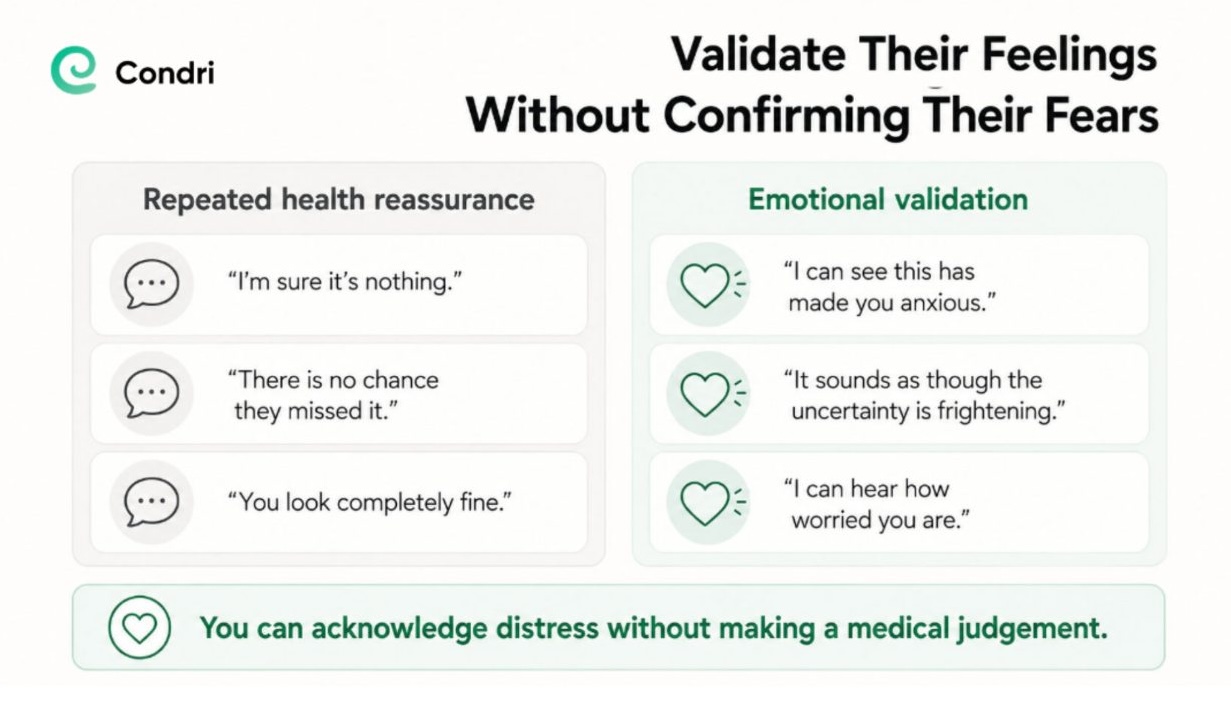
Validation acknowledges distress. Medical reassurance tries to settle whether a symptom is harmless. The distinction matters because a supporter can respond compassionately without stepping into the role of clinician.
| Situation | Reassurance that tries to create certainty | Validation that stays within a supporter's role |
| They notice a sensation | "I'm sure it's nothing." | "I can see that this sensation has frightened you." |
| They fear a clinician missed something | "There is no chance they missed it." | "It sounds as though not knowing for certain feels very difficult." |
| They ask what a symptom means | "It definitely isn't serious." | "I can't tell you what it means medically, but I can stay with you while the anxiety is high." |
| They ask whether they look ill | "You look completely fine." | "I can hear how worried you are about how you feel." |
Validation is not a medical judgement. It communicates, "Your distress matters," rather than, "Your feared explanation is true" or, "I can guarantee that you are safe."
Respond Differently to Repeated Reassurance Seeking
Reassurance is not inherently wrong. People reasonably seek information and comfort when a concern is new or when they are following medical advice. The difficulty arises when the same question is asked repeatedly to obtain certainty that cannot be maintained.
The NHS identifies repeated reassurance seeking as a feature of health anxiety and advises people to notice and gradually reduce checking, reassurance seeking and repeated health-information searching.[1] Research across anxiety disorders also links excessive reassurance seeking and accommodation by relatives with greater symptoms or impairment, although much of the supporter research comes from OCD and childhood anxiety rather than adult health anxiety specifically.[4,5]
Repeated reassurance can include:
· inspecting a mole, swelling or other body area again
· listening to someone's breathing or checking their pulse
· repeatedly confirming that they do not look ill
· restating what a GP or specialist said
· reviewing test results or medical letters multiple times
· answering repeated "what if" questions about a feared disease
· searching symptoms on the person's behalf
Do not turn this guidance into a rigid rule or a punishment. Abruptly refusing all discussion can feel rejecting and may increase conflict, especially if reassurance has long been part of the relationship. A more collaborative response is:
"I know you are frightened and I want to support you. We have already gone through this question, and another answer does not seem to help for long. Can I help you use the strategy you chose for this situation?"
This response provides connection without supplying another medical conclusion.
Agree on a Plan When Anxiety Is Lower
It is easier to change a reassurance pattern when both people agree on the response before anxiety peaks. Choose a calm time and approach the conversation with curiosity rather than accusation.
A shared plan can cover:
· what reassurance seeking usually looks or sounds like
· which questions tend to repeat
· how you will acknowledge distress
· what alternative strategy the person wants to practise
· how either of you can pause the conversation if it becomes overwhelming
· what existing medical advice or follow-up plan should still be followed
· what to do if a symptom is new, changing, persistent or urgent
For example:
When I ask what you think a symptom means, please acknowledge that I am anxious, avoid analysing the symptom repeatedly, remind me of the strategy I chose, and help me return to what I was doing.
The plan should reflect the person's goals and any guidance from their healthcare or psychological professional. Your role is to support the plan, not to design treatment or police compliance.
Help Them Notice Checking and Certainty Seeking
Reassurance seeking is not always obvious. A casual question may function as another attempt to remove uncertainty:
· "Does this side look bigger?"
· "Can you feel this?"
· "Have you ever had this sensation?"
· "Does my skin look a different colour?"
· "What did the doctor mean by that sentence?"
· "Can you compare this photo with yesterday's?"
· "Can you ask an AI tool what this symptom means?"
· asking the same question in slightly different words after receiving an answer
Pointing out every instance can make you feel like a monitor and the other person feel watched. A gentler prompt is:
"Do you think you are looking for useful information right now, or for certainty?"
The question gives the person space to identify the pattern themselves.
Avoid Becoming Their Symptom Researcher
Repeated online health searching is associated with health anxiety and cyberchondria, although association alone does not prove that searching causes the anxiety.[6] In practice, searching can sometimes answer a legitimate question, but repeated searches often expose the person to more alarming possibilities and create further doubt.
If someone asks you to search on their behalf, the checking behaviour may simply transfer from them to you. You might say:
"I understand why you want an answer now. I don't think another search is helping the anxiety. What did you want to practise when the urge to search appears?"
This does not mean avoiding reliable health information. Appointment instructions, screening information, medication guidance, safety-netting advice and resources recommended by a healthcare professional remain appropriate. For current medical guidance in the UK, use official NHS services rather than social media, forums or unverified AI-generated symptom interpretations.
Support a Return to Avoided Activities
Health anxiety can gradually narrow a person's life. Exercise, work, travel, social contact or hobbies may be avoided because they involve bodily sensations, perceived contamination, distance from healthcare or uncertainty.
The NHS recommends gradually returning to activities avoided because of health worries.[1] Support can involve invitation and companionship, not pressure:
· "Would you like me to come for a short walk with you?"
· "We can still go to dinner. If anxiety comes with us, we do not have to make the whole evening about symptoms."
· "What would be one manageable step back towards the activity you miss?"
Respect genuine medical restrictions and professional advice. A supporter should never override a clinician's instructions or push someone into an activity that may be medically unsafe. Where the distinction is unclear, encourage the person to clarify it with an appropriate healthcare professional.
Use Grounding as Support Rather Than Proof
Grounding and calming skills may help a person stay connected to the present while anxiety is high. Options include slowing the conversation, noticing the immediate surroundings, walking, continuing a familiar activity, or using a breathing or mindfulness practice the person already knows.
The purpose is important. A breathing exercise can become another safety behaviour if it is used to test whether a symptom is harmless or to demand that anxiety disappear. A more helpful frame is:
"Let's use the skill you have been practising while the anxious feeling is here."
The goal is to make room for distress and choose the next action, not to use a change in heart rate, breathing or sensation as proof of medical safety.
Do Not Become Their Therapist or Clinician
Supporters can encourage recovery without taking responsibility for treatment. NHS Talking Therapies describes psychological work as an active collaboration between the person and a trained therapist or practitioner, with goals and exercises tailored to the individual's needs.[7]
You do not need to become responsible for:
· interpreting symptoms or test results
· deciding whether a feared illness is present
· designing exposure exercises
· deciding which behaviours are compulsions or safety behaviours
· monitoring homework or progress
· keeping anxiety low
· being available for reassurance at all hours
· deciding how quickly recovery should happen
If the person is using exposure-based work or response prevention within therapy, ask how they would like you to support the agreed plan. Do not create, force or intensify exposure exercises yourself.
Support Appropriate Medical Care Without Taking Over
Health anxiety should not be used to explain away physical symptoms. Encourage the person to follow existing clinical advice and attend agreed follow-up. If a symptom is new, changing, persistent or concerning, they should seek advice from an appropriate healthcare professional rather than relying on a friend or family member to decide what it means.
With permission, you can help the person prepare for a GP appointment by noting:
· the main physical concern and when it began
· changes over time
· relevant medical guidance already received
· how much time the worry, checking or searching occupies
· effects on sleep, work, relationships or daily activities
· questions they want to ask and the follow-up plan they want clarified
Avoid speaking for the person unnecessarily, demanding investigations, assuming the symptom is caused by anxiety, or interpreting clinical advice on their behalf.
If you are unsure what level of urgent help is needed in England, NHS 111 can advise; call 999 for a life-threatening emergency.[8] Follow local services elsewhere in the UK or outside the UK. This article cannot assess an individual symptom or replace medical care.
Encourage Professional Psychological Support
If health worries are taking over daily life or self-help is not helping, the NHS advises speaking with a GP.[1] Adults in England can also self-refer to NHS Talking Therapies; a formal diagnosis is not required to refer, and the service explicitly includes people who constantly worry about their health.[9]
CBT has the strongest psychological treatment evidence for health anxiety. Reviews and clinical trials support both face-to-face and guided internet-delivered CBT, while also noting gaps in research using current diagnostic criteria.[2,10] Evidence for approaches including ACT and mindfulness-based interventions is promising but smaller and less established for illness anxiety disorder specifically.[2]
A supportive invitation focuses on impact and choice:
"I have noticed how much time these worries are taking from you. Would you be open to getting support with the anxiety itself?"
Avoid using therapy as a threat or a judgement. The person should retain choice about what support they explore.
If They Do Not Identify With the Term Health Anxiety
You cannot make someone accept a label or diagnosis. Repeated attempts to persuade them may turn the conversation into an argument and obscure what is happening in daily life.
Focus on observations:
· "I have noticed that health worries are taking up several hours and seem exhausting."
· "You have checked this several times tonight and still feel worried afterwards."
· "It seems as though you have stopped doing things you value because of the fear."
You can discuss changes in sleep, routines, research time, reassurance requests, avoided activities, work, family life or relationship tension. A qualified professional can assess whether health anxiety, another psychological difficulty, a physical condition or a combination is present.
Set Compassionate Boundaries
Caring for someone does not require unlimited availability. Repeated symptom discussions can disrupt sleep, routines and relationships and can leave supporters feeling responsible for keeping another person calm.
A useful boundary states what you can offer as well as what you cannot:
· "I want to be with you, but I cannot keep checking the same symptom tonight."
· "I can listen to how frightened you feel. I cannot decide whether the symptom is medically serious."
· "I can help you follow the plan you agreed with your clinician. I cannot search for another explanation online."
Keep boundaries calm, predictable and proportionate. If possible, agree them in advance. Maintaining your own rest, friendships, work and interests is not selfish; it helps keep support sustainable. If the situation is affecting your mental health, consider speaking to your GP, a therapist or someone you trust.
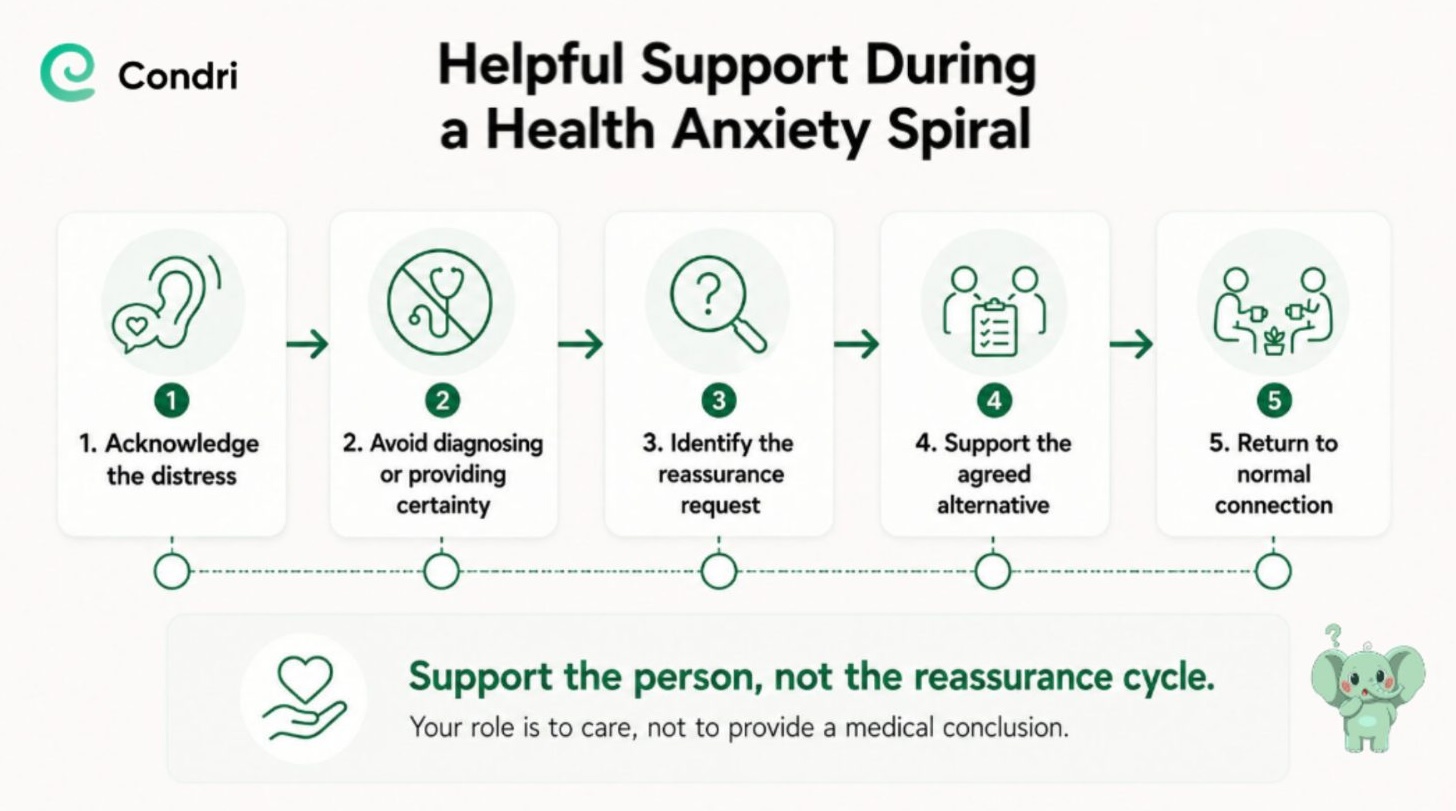
Respond During a Health Anxiety Spiral
When anxiety rises quickly, use a short sequence rather than slipping automatically into symptom analysis.
- Acknowledge the distress. Say, "I can see you are very anxious right now."
- Stay within your role. Do not diagnose, repeatedly inspect the body, search for causes or promise that everything is fine.
- Identify the request. Notice whether the person is asking for emotional support, practical help, medical action or renewed certainty.
- Follow the agreed plan. Support the coping strategy, activity or professional guidance the person previously chose.
- Use appropriate healthcare when needed. Do not let an anxiety plan override new or urgent medical concerns.
- Return to ordinary connection. When possible, cook, walk, watch something, talk about the day or continue the activity you had planned.
Returning to ordinary connection is not dismissal. It reminds both of you that the relationship and the person's life are larger than the anxiety.
How Condri May Support Independent Practice
Condri is designed as a structured self-help app for people experiencing health anxiety. Its exercises and daily tools aim to help users notice the health-anxiety cycle and practise different responses to checking, reassurance seeking, avoidance and uncertainty. Condri's stated clinical approach draws on CBT, exposure and response prevention principles, ACT and mindfulness, with clinical input from its Consultant Psychologist.
The app is intended to support independent skills practice, not to turn a partner or relative into the main source of certainty or treatment. It does not diagnose, provide emergency support, assess physical symptoms or replace medical assessment or individual psychological treatment.
If someone chooses to use Condri's health anxiety quiz, they should complete it for themselves as a reflective or screening tool. A supporter should not use the result to diagnose them or to settle a disagreement about their health.
References
- NHS. Health anxiety. Last reviewed 8 November 2023; accessed 13 September 2026.
- Kikas K, Werner-Seidler A, Upton E, et al. Illness Anxiety Disorder: A Review of the Current Research and Future Directions. Current Psychiatry Reports. 2024;26:331-339.
- Leonidou C, Panayiotou G. How do illness-anxious individuals process health-threatening information? A systematic review of evidence for the cognitive-behavioral model. Journal of Psychosomatic Research. 2018;111:100-115.
- Rector NA, Kamkar K, Cassin SE, Ayearst LE, Laposa JM. Assessing excessive reassurance seeking in the anxiety disorders. Journal of Anxiety Disorders. 2011;25(7):911-917.
- Lebowitz ER, Panza KE, Bloch MH. Family accommodation in obsessive-compulsive and anxiety disorders: a five-year update. Expert Review of Neurotherapeutics. 2016;16(1):45-53.
- McMullan RD, Berle D, Arnaez S, Starcevic V. The relationships between health anxiety, online health information seeking, and cyberchondria: Systematic review and meta-analysis. Journal of Affective Disorders. 2019;245:270-278.
- NHS England. NHS Talking Therapies for anxiety and depression. Accessed 13 September 2026.
- NHS. NHS website for England. Guidance on NHS 111 and emergencies; accessed 13 September 2026.
- NHS. Find NHS talking therapies for anxiety and depression. Last reviewed 14 February 2025; accessed 13 September 2026.
- Axelsson E, Andersson E, Ljotsson B, et al. Effect of Internet vs Face-to-Face Cognitive Behavior Therapy for Health Anxiety: A Randomized Noninferiority Clinical Trial. JAMA Psychiatry. 2020;77(9):915-924.
Common questions
- How can I help someone with health anxiety?
- Listen calmly, acknowledge how frightened they feel and avoid repeatedly trying to prove that nothing is wrong. You can support them in using coping strategies, following appropriate medical advice and returning to normal daily activities.
- Should I reassure someone with health anxiety?
- Occasional reassurance can be natural, but repeated reassurance may provide short-term relief without settling the worry for long. It can be more helpful to acknowledge their distress and gently return to a coping strategy or plan they have already chosen.
- What should I say to someone experiencing health anxiety?
- Try phrases such as, “I can see this is making you very anxious” or “I can hear how worried you are.” This recognises their feelings without making a medical judgement about the symptoms they are experiencing.
- Should I search symptoms online for someone with health anxiety?
- Repeated symptom searching can become part of the health-anxiety cycle. Rather than researching symptoms for them, you can encourage them to follow reliable medical guidance and use the coping approach they have chosen for urges to search.
- How do I set boundaries with someone who has health anxiety?
- Be clear about the support you can offer. For example, you might listen to how they feel but explain that you cannot repeatedly check symptoms, interpret medical information or search for new explanations online. Calm and consistent boundaries can protect the relationship and both people's wellbeing.
- When should someone with health anxiety seek professional support?
- If health worries are taking over everyday life or self-help is not helping, the NHS advises speaking with a GP. Adults in England can self-refer to NHS Talking Therapies, which supports people experiencing anxiety, including persistent worries about health.
- Can someone have health anxiety and a genuine medical condition?
- Yes. Health anxiety and physical illness can exist at the same time. New, changing or persistent symptoms should not automatically be dismissed as anxiety, and appropriate medical advice should still be sought when needed.
- What should I do during a health anxiety spiral?
- Acknowledge the person's distress, avoid diagnosing or repeatedly checking symptoms, identify what support they are asking for and follow any coping plan they have already chosen. New or urgent medical concerns should still receive appropriate healthcare.