How to Stop Googling Your Symptoms
If you repeatedly Google symptoms because you feel anxious about your health, simply banning yourself from searching may not address the reason you keep going back.
A more useful approach is to understand what happens between noticing a symptom and opening your browser. You can learn to recognise the urge, create some space before checking, and practise responding to uncertainty without automatically seeking reassurance.
Looking up health information is not inherently a problem. The difficulty can begin when searching becomes repetitive, difficult to resist, and less about obtaining useful information than about trying to reach a feeling of certainty that you are safe.
The NHS identifies frequent body checking, asking other people for reassurance, and obsessively looking at health information online or in the media as behaviours that can occur with health anxiety. Its self-help guidance recommends monitoring these behaviours and gradually reducing them.
This guide explains how symptom searching can become part of the health anxiety cycle and gives you practical, CBT-informed ways to change the pattern without telling you to ignore genuine physical health concerns.
Reducing anxiety-driven searching is not the same as avoiding medical care. If you have a new, persistent, worsening or otherwise concerning symptom, or you have been advised to seek medical attention, speak to an appropriate healthcare professional. Psychological strategies for health anxiety should never be used as a substitute for medical assessment.
Recognise When Symptom Searching Has Become a Safety Behaviour
Symptom searching may be functioning as a safety behaviour when you use it repeatedly to reduce anxiety, check whether you are safe, rule out feared illnesses, or obtain certainty about what a physical sensation means.
In CBT, safety behaviours are actions people use to prevent a feared outcome or reduce the distress associated with a perceived threat. Checking and reassurance seeking can be part of this pattern. Psychological treatment for health anxiety commonly focuses on understanding and changing behaviours such as checking, reassurance seeking and avoidance.
The important question is therefore not simply: “How often do I use Google?”
It is: “What am I trying to achieve when I search?"
Helpful information seeking:
• You have a specific, practical question.
• You know what information you are looking for.
• You can stop when you have obtained what you need.
• You are using an appropriate source for the question.
• You accept that online information cannot give you a personal diagnosis.
Reassurance-driven searching:
• You are trying to become completely certain that nothing serious is happening.
• One answer leads to another question.
• You repeatedly change your search terms.
• You compare multiple websites because the first answer did not feel reassuring enough.
• You look specifically for evidence that a feared illness is unlikely.
• You compare your symptoms with stories on Reddit, forums or social media.
• You ask an AI system the same question in several different ways.
• You feel calmer briefly, but the doubt returns.
• You move from Google to AI, Reddit, TikTok, forums or another source when reassurance does not last.
None of these behaviours automatically means that you have health anxiety.
The useful question is whether searching has become your automatic response to uncertainty.
Understand the Health Anxiety Cycle
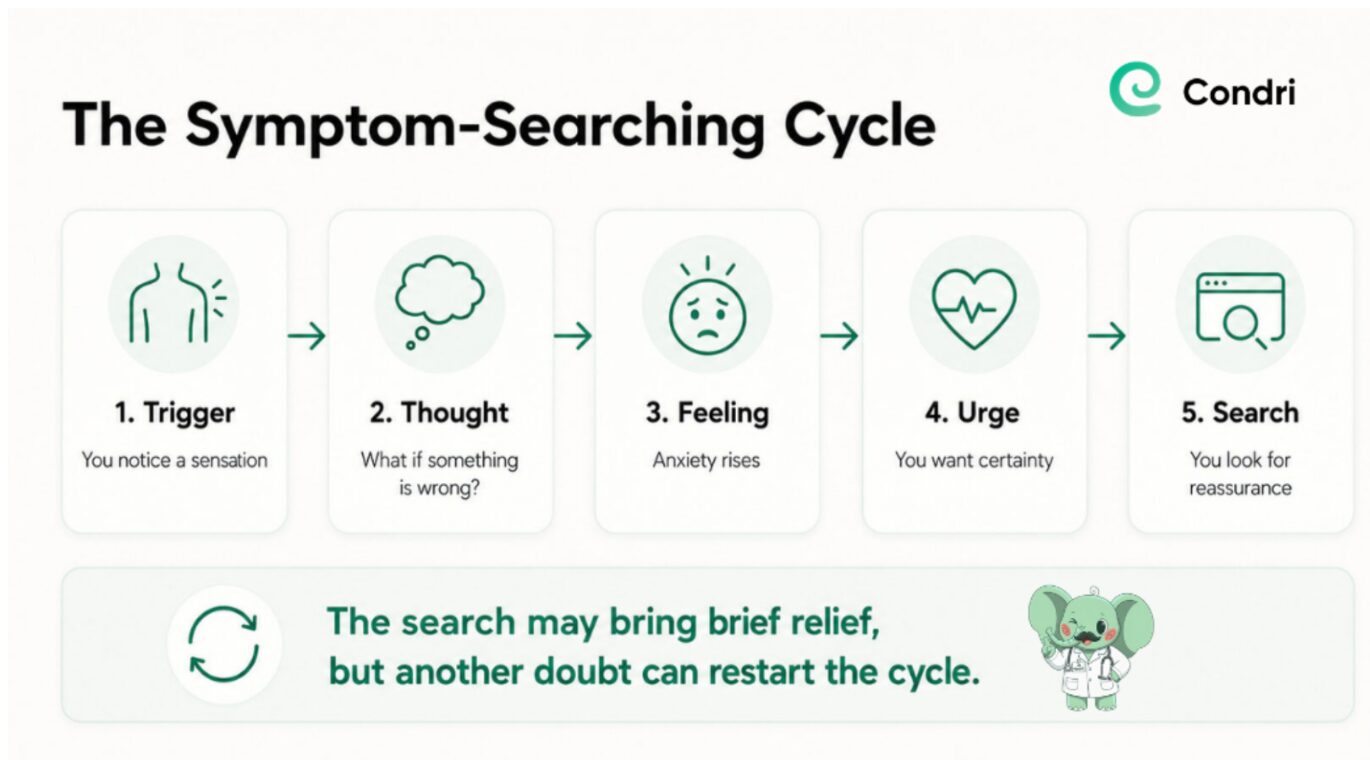
One reason symptom searching can become so persistent is that it often works in the short term.
You notice something unusual.
You become concerned.
You search.
You find an explanation that temporarily reduces the fear.
Then another possibility occurs to you.
You search again.
The relief may be real, but it does not necessarily last.
A simplified version of the cycle looks like:
Sensation → Threat interpretation → Anxiety → Urge to check → Search/reassurance → Temporary relief → Doubt returns → More checking
For example:
You notice an unfamiliar sensation while working.
A thought appears: “What if this means something is wrong?”
You feel anxious.
Your mind starts looking for an answer.
You search.
You find several possible explanations.
Some are reassuring. Others are frightening.
You search again.
Before long, the original question has become several new questions.
The aim of changing this pattern is not to prove that the original thought was false.
It is to notice the moment when uncertainty starts pulling you towards checking.
That distinction is important.
Health anxiety treatment is not about convincing yourself that every physical sensation is harmless. It is about changing the relationship between uncertainty, anxiety and the behaviours that follow.
Why Searching Can Keep the Cycle Going
When searching repeatedly produces a reduction in anxiety, your brain can learn that searching is what you should do whenever uncertainty appears.
That does not mean you are doing anything irrational.
From your perspective, checking makes sense: “If I can just find out what this is, I can stop worrying.”
The difficulty is that online information cannot provide the kind of certainty that health anxiety demands.
Symptoms can have many possible causes. General health information is not the same as an individual medical assessment. And even a reassuring explanation may leave room for another question: “But what if it isn't that?”
This is one reason the goal of recovery is not to become exceptionally good at researching symptoms.
It is to become less dependent on searching as a way of managing uncertainty.
Identify What Triggers the Urge to Google Your Symptoms
The urge to search usually has a trigger.
Learning to notice what happens immediately before you reach for your phone or open another browser tab can make the behaviour easier to change.
Triggers can include:
• noticing a bodily sensation
• seeing a physical change
• hearing about somebody else's illness
• seeing a health story on social media
• watching or reading the news
• having a medical appointment
• waiting for test results
• remembering an earlier health concern
• feeling stressed or overwhelmed
• having unstructured time
• noticing increased bodily sensations when you are tired or anxious
A simple pattern might look like:
Trigger → Thought → Feeling → Urge → Behaviour → Short-term consequence
For example:
Trigger: You notice an unfamiliar sensation.
Thought: “What if this is something serious?”
Feeling: Anxiety and uncertainty.
Urge: “I need to find out what this means.”
Behaviour: You open Google.
Short-term consequence: You may feel relieved, frightened, or both.
Later: Another doubt appears.
The purpose of identifying the pattern is not to decide whether the feared illness is present.
It is to understand what you do when uncertainty appears.
That is the part you can practise changing.
Delay Searching Instead of Trying to Stop Immediately
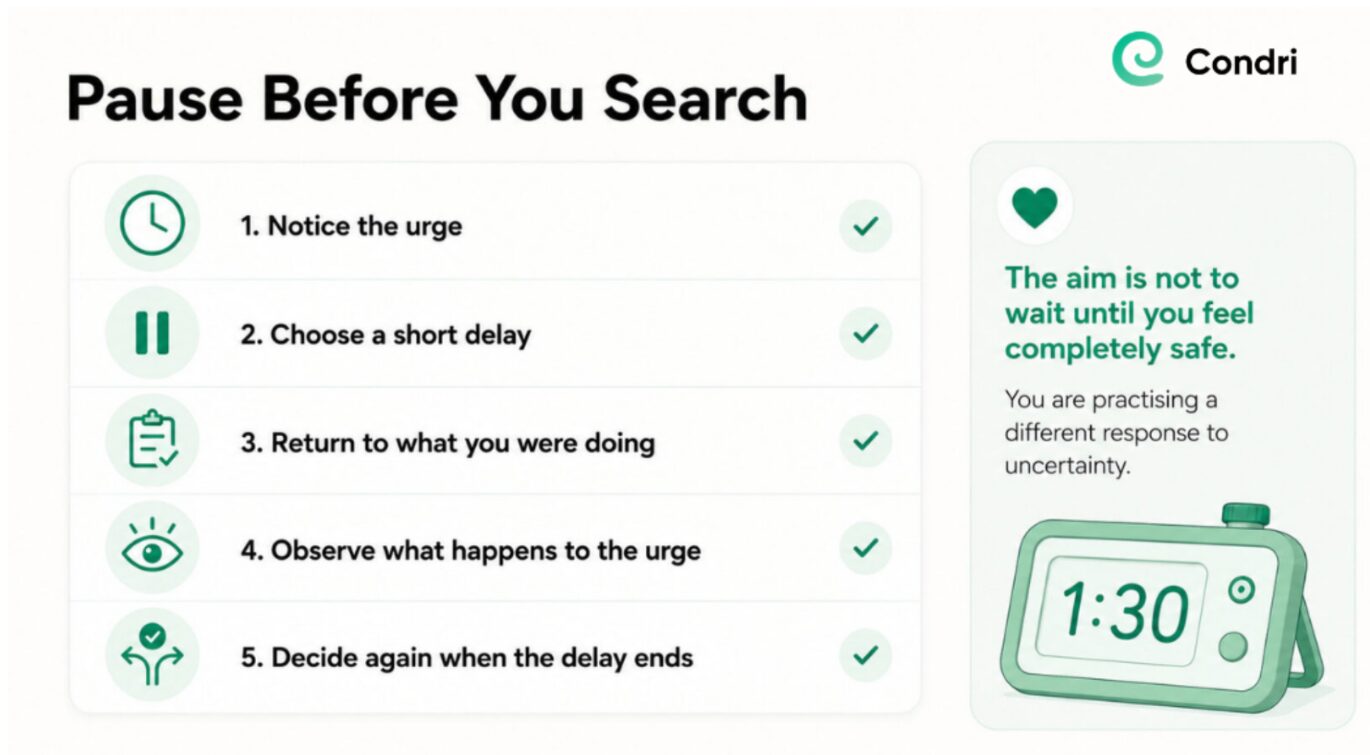
If stopping symptom searches immediately feels unrealistic, start by creating a delay.
A delay changes an important part of the pattern: searching is no longer the immediate response to anxiety.
When you notice the urge:
- Acknowledge that you want to search.
- Decide on a reasonable period before you act on the urge.
- Return to whatever you were doing, if possible.
- Notice whether the urge changes while you wait.
- When the planned period ends, make a deliberate decision rather than automatically following the urge.
There is no single delay that everyone needs to use.
The point is not to find a magic number of minutes.
The point is to practise creating space between uncertainty and checking.
The NHS similarly recommends keeping track of checking, reassurance seeking and looking at health information, and gradually reducing these behaviours.
Most importantly, the purpose of the delay is not: “I'll wait until I feel completely calm, and then I'll know I'm safe.”
It is closer to: “I'm practising not responding automatically just because I feel anxious.”
That distinction prevents the exercise from becoming another form of reassurance.
Notice the Urge Without Acting on It
An urge can feel urgent without actually requiring an immediate response.
When a health worry appears, try identifying what is happening without entering into a debate about the feared illness.
You might notice: “I'm having the urge to search because I feel uncertain.”
That is different from telling yourself: “I know this is nothing serious.”
The first statement describes your experience.
The second is an attempt to reassure yourself about the medical question.
You may notice restlessness, tension, mental images, catastrophic thoughts or an increasing desire to investigate.
You do not have to settle those thoughts before returning to what you were doing.
This principle overlaps with behavioural approaches used in CBT, including exposure-based work where appropriate. The emphasis is on changing habitual responses such as checking, avoidance or reassurance seeking rather than trying to eliminate every uncomfortable thought first.
For people with significant health anxiety, structured CBT with a suitably trained professional may be particularly helpful. CBT has a substantial evidence base for health anxiety.
Keep a Record of How Searching Affects Your Anxiety
Tracking the behaviour can help you discover whether searching is actually resolving the worry or simply restarting the cycle.
Keep the record brief. You do not need to catalogue every physical sensation.
You could record:
Trigger | What I wanted from the search | What I did | Short-term effect | What happened later
Example:
Noticed a sensation while working | Wanted certainty that it was not serious | Searched several websites | Felt calmer briefly | Thought of another possibility
Saw a health story online | Wanted to know whether it applied to me | Searched the condition | Became more focused on symptoms | Checked again later
Felt uncertain after an appointment | Wanted reassurance | Asked several people what they thought | Brief relief | Started questioning the answers
You might also record approximately how strong the urge was and how long you spent searching.
The aim is not perfect data.
It is pattern recognition.
You may discover that certain triggers lead to longer searches, searching late at night is harder to stop, one search often turns into several, reassurance feels helpful briefly but does not settle the underlying uncertainty, or you move between different information sources when one answer does not feel sufficient.
That information gives you something concrete to work with.
Create Practical Barriers Between You and Search Engines
A small amount of friction can interrupt an automatic behaviour long enough for you to notice what is happening.
You could:
• close symptom-search tabs after using them
• remove health-related bookmarks
• clear saved symptom searches
• move your browser away from the first screen of your phone
• use website or app limits if they are helpful
• stop keeping health forums permanently open
• turn off search suggestions if they encourage repeated searching
• avoid moving between multiple health-information platforms during the same anxiety spiral
These strategies are supports rather than the treatment itself.
The important change is behavioural: “I am creating an opportunity to choose what I do next.”
Be careful not to turn technological restrictions into another safety ritual. If you spend your time checking whether the blocker is working, finding ways around it, or monitoring how anxious you feel without Google, the underlying cycle may simply have changed form.
Google Is Not the Only Form of Symptom Searching
Stopping Google does not necessarily stop reassurance seeking.
You can move from:
Google → AI → Reddit → TikTok → health forums → partner → back to Google
The technology changes. The function may not.
This matters because the broader target is not one particular website. It is the repeated attempt to use information or reassurance to eliminate uncertainty.
AI deserves particular attention because it makes repeated questioning extremely easy.
You can ask: “Could this be serious?”
Then: “But what if it is this particular condition?”
Then: “What symptoms would make that more likely?”
Then: “Are you sure?”
Then: “What about this other symptom?”
Each question can look reasonable in isolation.
Together, they can become another form of checking.
AI is therefore not inherently different from Google in this respect. If you repeatedly ask an AI system similar health questions because you are trying to achieve certainty or reduce anxiety, the interaction may be functioning as reassurance seeking.
AI tools also cannot provide individual medical assessment. They should not be used to decide whether a potentially concerning symptom requires medical attention.
Replace Symptom Searching With a Planned Alternative
Resisting a search is easier when you already know what you will do instead.
A useful alternative is not one designed to prove that you are safe.
It is one that helps you continue living while uncertainty is present.
You might:
• return to the task you were doing
• continue with a planned activity
• go for a short walk
• write down the urge without investigating it
• practise a CBT exercise
• return to a normal routine
• speak to somebody about how difficult the urge is without asking them to interpret the symptom
• use a health-anxiety-specific self-help exercise
The distinction can be subtle.
Reassurance disguised as support:
“I won't Google this. I'll ask my partner whether they think it sounds serious.”
A different response:
“I'm having a strong urge to search. Can you help me stick with my plan without answering questions about what the symptom means?”
The same applies to AI.
Reassurance disguised as research:
“I won't use Google. I'll ask an AI chatbot until I understand every possible explanation.”
A different response:
“I notice that I'm looking for certainty. I'm going to pause the search and return to what I was doing.”
You are not trying to prove that the feared outcome will not happen.
You are practising a different response to uncertainty.
Use CBT-Based Tools to Change Your Response to Health Worries
CBT is one of the best-supported psychological approaches for health anxiety. Randomised trials and systematic reviews have found that CBT can reduce health-anxiety symptoms, with benefits that can persist beyond the end of treatment.
CBT for health anxiety can involve understanding the relationship between:
• bodily sensations
• interpretations of those sensations
• attention and monitoring
• anxiety
• checking
• reassurance seeking
• avoidance
• other behaviours that maintain the cycle
Depending on the individual formulation, behavioural work may include gradually reducing checking or reassurance seeking, behavioural experiments, exposure-based exercises, and practising greater tolerance of uncertainty.
It is important not to collapse all of this into the instruction: “Just challenge your thoughts.”
CBT is not simply replacing every frightening thought with a reassuring one.
In health anxiety, the behavioural response is often just as important as the thought itself.
For example, someone might have the thought: “What if this sensation means something serious?”
The therapeutic goal is not necessarily to produce: “It definitely doesn't.”
A more useful direction may be: “I notice the thought, and I don't need to investigate it repeatedly right now.”
That is a fundamentally different relationship with uncertainty.
What about ERP?
Exposure and response prevention (ERP) is an established behavioural approach, particularly within OCD treatment, and similar principles can be relevant when health anxiety involves compulsive checking or reassurance seeking.
However, it is important not to imply that evidence for CBT as a whole automatically proves the effectiveness of every particular ERP exercise for every person with health anxiety.
The evidence base for health anxiety is strongest at the level of CBT as a treatment approach.
If health anxiety is severe, persistent or significantly interfering with your life, working with a clinician who understands health anxiety or OCD-spectrum difficulties can help you develop an appropriate formulation and treatment plan.
What If You Understand the Cycle but Still Keep Searching?
This is extremely important.
You can understand health anxiety intellectually and still Google symptoms.
Knowing “This is reassurance seeking” does not automatically make the urge disappear.
The learning happens through repeated experiences of responding differently.
You notice the urge.
You pause.
You do not immediately check.
You allow some uncertainty.
You return to your life.
Then the same thing happens again another day.
That repetition is where behavioural change develops.
Recovery is therefore not measured only by whether health-related thoughts disappear.
You might instead notice:
• you delay more searches
• searches become shorter
• you check less often
• you use fewer reassurance sources
• you recover more quickly after a trigger
• you return to ordinary activities sooner
• you become less dependent on certainty before carrying on with your day
These are meaningful signs of progress.
What to Do After You Search Again
A setback does not need to become an entire day of checking.
You may manage the urge successfully for several days and then find yourself spending an evening moving between Google, Reddit and AI.
Try not to turn that episode into another reason to judge yourself.
Instead, examine what happened.
Ask:
• What triggered the search?
• When did one search become several?
• What was I hoping the next answer would give me?
• Was I looking for information, or had I started looking for certainty?
• Did I move to another platform when the first answer did not feel sufficient?
• What could I do differently the next time this particular trigger appears?
The episode becomes information rather than failure.
You are learning where the pattern is strongest.
Progress does not require perfect consistency.
It requires gradually changing what happens after the urge appears.
How Condri Can Help You Practise Breaking the Loop
Understanding the cycle is useful.
Practising a different response when the urge is strongest is harder.
That is the space Condri is designed for.
Condri is a self-help app focused on health anxiety. Its approach is built around practising skills that can help interrupt the cycle of worry, checking, reassurance and short-lived relief — rather than providing symptom reassurance.
When you feel pulled towards Google, checking your body or asking somebody else what a symptom means, Condri can give you a structured alternative to immediately following the urge.
Its tools include health-anxiety-focused CBT exercises, exposure and response-prevention exercises, guided practices, daily check-ins and an in-the-moment panic tool.
The philosophy is deliberately simple:
Condri does not need to tell you that you are fine.
It helps you practise what comes next.
That might mean noticing the urge to search, sitting with uncertainty for a little longer, writing down what is happening, or returning to the activity that health anxiety interrupted.
This distinction matters.
The aim is not to replace Google with another source of reassurance.
The aim is to become less dependent on reassurance in the first place.
Condri also offers a free Health Anxiety Quiz based on the SHAI-14, a validated screening questionnaire used in research and clinical contexts. A screening questionnaire is not a diagnosis, and a score cannot determine whether a physical symptom is medically significant.
Condri is a self-help tool. It does not diagnose physical or mental health conditions, determine whether an individual symptom is serious, or replace medical assessment or psychological treatment.
Seek Additional Support if Symptom Searching Is Affecting Your Life
If health worries and symptom searching are taking up significant amounts of time, interfering with work, relationships or everyday activities, or feel difficult to manage alone, professional support may be appropriate.
The NHS recommends speaking to a GP when worries about your health are preventing you from leading a normal life or when self-help is not working. It also notes that people diagnosed with health anxiety may be offered talking therapy such as CBT, and NHS Talking Therapies can be accessed directly in England in many circumstances.
Seeking help for health anxiety does not mean ignoring physical health.
You can have genuine physical symptoms and health anxiety at the same time.
The two are not mutually exclusive.
If you have a symptom or health concern that requires individual assessment, speak to an appropriate healthcare professional. Do not use symptom-searching reduction strategies as a system for deciding whether medical attention is necessary.
And if you have been advised to seek urgent or emergency medical care, follow that advice.
This article is for informational purposes only and is not medical advice. If you're concerned about your health or mental health, speak to a qualified professional. If you or someone you know is in crisis, contact a helpline near you.
Common questions
- Why Can't I Stop Googling My Symptoms?
- Repeated symptom searching can become reinforcing when it is used to reduce anxiety or obtain reassurance. A search may give you temporary relief. But if uncertainty returns, you may feel driven to search again. Over time, searching can become an automatic response to health-related uncertainty. The problem is therefore not simply that you use Google too much. It may be that searching has become one of your main ways of coping with uncertainty.
- Should I Completely Stop Searching for Health Information?
- Not necessarily. The goal is not to avoid all health information. Reliable health information can be useful, particularly when you have a clear question and know when to seek professional advice. The issue is repetitive, anxiety-driven searching that has become difficult to stop or is primarily being used to obtain reassurance. A useful question is: “Am I looking for information, or am I trying to make uncertainty disappear?” If it is the second, practising a different response may be more helpful than finding another website.
- Is Googling Symptoms a Sign of Health Anxiety?
- It can be one behaviour associated with health anxiety, but Googling symptoms does not by itself mean that you have health anxiety. The NHS describes health anxiety in terms of persistent and excessive worry about health that can take over a person's life, alongside behaviours such as body checking, reassurance seeking and obsessive health-information searching. If health worries are significantly affecting your daily life, consider discussing them with a healthcare or mental health professional.
- Can AI Symptom Searching Become Reassurance Seeking?
- Yes. The platform is not the main issue. If you repeatedly ask an AI system similar health questions because you are trying to become completely certain, reduce anxiety or rule out feared illnesses, the interaction may be serving the same function as repeatedly searching Google, checking forums or asking other people for reassurance. AI can also create a particularly easy environment for repeated checking because you can immediately ask another question when the previous answer does not feel certain enough. AI should not be treated as a substitute for individual medical assessment.
- What Should I Do When I Feel the Urge to Search?
- Start by noticing the urge rather than automatically following it. You could: 1. Name what is happening: “I want to search because I feel uncertain.” 2. Delay the search rather than responding immediately. 3. Notice what happens to the urge. 4. Return to your current activity if you can. 5. Record the trigger if that helps you identify patterns. 6. Use a CBT-informed exercise or another planned response. 7. Seek appropriate medical advice when the situation genuinely calls for it. The aim is not to force anxiety to disappear. It is to practise having the urge without automatically following it.
- What If I Have a Real Symptom?
- Health anxiety and physical illness can coexist. Reducing reassurance-seeking behaviour does not mean ignoring symptoms, cancelling appropriate appointments or refusing medical assessment. If you are concerned about a symptom, use an appropriate healthcare professional or established medical service to determine what assessment is needed. Once appropriate medical advice has been obtained, however, repeatedly researching the same question may still become part of an anxiety cycle. Those are two separate issues: Medical care answers medical questions. Psychological work can help you change what you do with uncertainty afterwards.
- Can I Use Condri Instead of Therapy?
- Condri is designed as a self-help tool and can be useful for practising health-anxiety skills independently or alongside professional support. It is not a replacement for therapy, diagnosis, medical assessment or emergency care. If you can access appropriate psychological treatment, particularly CBT from someone experienced in health anxiety or related difficulties, that remains an important option. Evidence from clinical trials and systematic reviews supports CBT as an effective treatment for health anxiety. Condri's role is to make structured practice more accessible between sessions, while waiting for treatment, or when someone is working on these skills independently.