How to Overcome Your Health Anxiety
Health anxiety is not about simply worrying too much about your health, and overcoming it does not mean learning to ignore your body or becoming certain that nothing will ever be wrong.
A more useful way to understand health anxiety is as a pattern that can develop when bodily sensations, health information or uncertainty are interpreted as threatening. This can lead to increased attention to the body, checking, reassurance seeking, symptom searching, avoidance or repeated attempts to obtain certainty.
These behaviours can provide short-term relief. However, when they become repetitive or anxiety-driven, they can also keep the health-anxiety cycle going.
If you are wondering how to stop health anxiety from controlling your day, helpful approaches can include recognising the pattern, understanding how attention affects bodily sensations, gradually reducing anxiety-driven safety behaviours, learning to tolerate uncertainty, approaching situations you have been avoiding and using Cognitive Behavioural Therapy (CBT)-based techniques to respond differently when health fears appear.
Importantly, this does not mean ignoring genuine health concerns or avoiding appropriate medical care.
Important: Health Anxiety Does Not Mean That Physical Symptoms Should Be Dismissed
Health anxiety is not the same as imagining symptoms or having “nothing medically wrong”.
People with health anxiety can experience genuine physical sensations, and people can also have genuine medical conditions alongside anxiety.
The clinical issue is the way symptoms, uncertainty and perceived health threats may be interpreted and responded to.
If you have a new, persistent, worsening or otherwise concerning physical symptom, seek appropriate medical advice. Follow recommendations from your GP or other healthcare professional, including investigations, treatment and monitoring where advised.
This article focuses on anxiety-driven patterns such as repeated checking, reassurance seeking, symptom searching and avoidance. It is not a tool for deciding whether an individual symptom is medically serious.
The aim is not to replace appropriate healthcare with self-help. It is to help you recognise when anxiety may be influencing what you do after a health concern appears.
What Is Health Anxiety?
Everyone worries about their health from time to time. Health anxiety becomes a problem when concerns about illness become persistent, difficult to disengage from or begin to interfere significantly with everyday life.
You may notice that you:
- Frequently worry that you are ill or may become seriously ill.
- Pay close attention to bodily sensations.
- Repeatedly check your body for signs of illness.
- Search symptoms or medical information online.
- Ask other people for reassurance.
- Worry that doctors or tests may have missed something.
- Repeatedly review medical information or previous conversations.
- Avoid activities because of feared health consequences.
- Avoid illness-related information or, alternatively, become drawn to it.
- Find it difficult to move on from a health question until you feel completely certain.
Health anxiety can occur in people who are physically healthy and in people who have genuine medical conditions. The presence of a real symptom does not automatically mean that health anxiety is absent.
What matters is the wider pattern: how much attention is being directed towards health, how threatening symptoms or uncertainty feel, and what you feel compelled to do in response.
The NHS identifies frequent body checking, reassurance seeking, repeated health-information searching, concerns that doctors or tests have missed something, and avoidance as common features associated with health anxiety. (nhs.uk)
Understand the Health-Anxiety Maintenance Cycle
One of the most useful ways to understand health anxiety is through a cognitive-behavioural maintenance cycle.
A simplified version looks like this:
Trigger or sensation → threat interpretation → anxiety and increased attention → safety behaviour or avoidance → short-term relief → increased future vigilance
For example:
You notice a sensation → “What if this is something serious?” → anxiety increases → you check or search online → you feel temporarily reassured → another doubt appears → you check or search again.
The cycle can also begin with information rather than a physical sensation:
You read about an illness → notice similarities with yourself → interpret them as potentially significant → become more alert to your body → notice more sensations → search for explanations → become more concerned.
The behaviour makes sense in the moment. You are trying to protect yourself.
The difficulty is that if the behaviour repeatedly becomes the way you deal with uncertainty, your brain may learn that the uncertainty is dangerous and must be resolved.
This can increase the urge to check, search or seek reassurance the next time a health concern appears.
A More Complete Health-Anxiety Model
Several processes can interact:
- Threat interpretation: interpreting an ambiguous sensation or piece of information as evidence of serious illness.
- Probability overestimation: giving a feared illness more weight or likelihood than the available information warrants.
- Catastrophic interpretation: focusing on the most threatening possible explanation or outcome.
- Selective attention: becoming highly focused on bodily sensations or health-related information.
- Interoceptive attention: closely monitoring internal sensations such as heartbeat, breathing, dizziness, tingling or discomfort.
- Intolerance of uncertainty: feeling unable to move on without knowing exactly what a sensation means.
- Safety behaviours: checking, searching, reassurance seeking or other actions intended to reduce perceived risk.
- Avoidance: staying away from activities, situations or information because they trigger health concerns.
- Mental checking: repeatedly reviewing memories, sensations, medical information or possible explanations.
- Short-term relief: anxiety temporarily falls after checking, searching or reassurance.
- Renewed vigilance: uncertainty returns, increasing the likelihood of repeating the behaviour.
These processes can reinforce one another.
This is why the goal is not simply:
“Stop worrying.”
A more useful goal is:
“Understand what happens after the worry appears, and practise changing that response.”
Distinguish Appropriate Health Behaviour From Anxiety-Driven Safety Behaviour
This distinction is important.
The goal is not to eliminate sensible health behaviours.
Checking a symptom once, attending a recommended appointment, taking prescribed medication, following a clinician’s monitoring plan or seeking medical assessment when appropriate can all be reasonable.
A behaviour becomes more relevant to health-anxiety treatment when it is repetitive, disproportionate to the situation, driven primarily by anxiety, or mainly intended to obtain certainty or make distress disappear.
For example:
**Appropriate health behaviour:**“I have been advised to monitor this symptom and record changes for my next appointment.”
**Anxiety-driven checking:**“I have already checked this several times, but I need to check again because I still don’t feel completely certain.”
The difference is not always obvious.
That is why it can be helpful to ask:
“What is the purpose of what I am doing right now?”
Am I following appropriate medical advice?
Or am I repeatedly trying to remove uncertainty because anxiety is demanding an answer?
Notice How Attention Can Amplify Bodily Sensations
Health anxiety is not only about checking the body.
You can become highly vigilant to ordinary internal sensations without deliberately touching or examining yourself.
When attention becomes strongly focused on the body, sensations that might normally pass unnoticed can become much more noticeable.
This does not mean the sensation is imaginary.
It means attention can influence what you notice and how prominent a sensation becomes in conscious awareness.
A possible cycle is:
Sensation → attention → concern → increased monitoring → more sensations noticed →increased concern
For example, you might briefly notice your heartbeat.
If you become concerned that the sensation means something is wrong, you may begin monitoring your heartbeat closely.
The more you monitor it, the more changes in rhythm, strength or timing you may notice.
Those changes can then become further evidence for the anxious interpretation.
This can make the body feel unusually unpredictable or threatening.
The aim is not to prove that every sensation is harmless.
Instead, you can begin noticing when your attention has become locked onto the body and practise allowing your attention to return to other parts of your life.
Identify Your Health-Anxiety Triggers
Recognising your triggers can help you notice the cycle earlier, before an urge to check, search or seek reassurance becomes automatic.
Triggers differ between people.
They may include:
- A physical sensation.
- A new symptom.
- Health-related news.
- Someone else becoming ill.
- A medical appointment.
- Waiting for test results.
- Social media.
- Health-related advertising.
- Reading about a serious illness.
- Stress.
- Tiredness.
- A previous illness or difficult medical experience.
- Hearing about an illness in someone close to you.
- A change in your normal bodily sensations.
The aim is not to monitor yourself more closely.
Instead, look for broader patterns.
You could make a short note using this structure:
Trigger: What started the spiral?
Interpretation: What did my mind predict or fear?
Feeling: What emotion or physical response appeared?
Urge: What did I feel compelled to do?
Behaviour: What did I actually do?
Short-term effect: Did the behaviour reduce anxiety temporarily?
Longer-term effect: What happened afterwards?
For example:
Trigger: I read a story about a serious illness.
Interpretation: “I have some of those symptoms. What if I have the same condition?”
Feeling: Fear and increased bodily awareness.
Urge: Search the symptoms.
Behaviour: I searched several websites and asked someone whether they thought I was okay.
Short-term effect: I felt calmer.
Longer-term effect: A few hours later, another doubt appeared.
This helps reveal the maintenance cycle without requiring you to solve the original health question repeatedly.
Reduce Repetitive Body Checking Gradually
If you repeatedly examine, touch, measure, photograph, compare or monitor your body because you are anxious about your health, gradually reducing those behaviours can help weaken the checking cycle.
Checking can include:
- Looking repeatedly at the same area.
- Touching or pressing a part of your body.
- Comparing one side with the other.
- Taking photographs and comparing them.
- Repeatedly checking a wearable or health metric.
- Asking someone else to examine something for you.
- Monitoring how a sensation feels throughout the day.
- Checking whether a sensation has changed.
- Repeatedly taking measurements that you do not medically need to take.
The NHS recommends keeping track of behaviours such as body checking, reassurance seeking and health-information searching, then gradually reducing them. (nhs.uk)
The important word is gradually.
You might begin by noticing the urge before acting on it.
You could then:
- Delay a repetitive check.
- Reduce how frequently you check.
- Avoid repeating a check you have just completed.
- Return to the activity you were doing before the urge appeared.
- Notice what happens to the anxiety when you do not immediately respond.
Pay attention to substitution.
You might stop checking in the mirror but start taking photographs.
You might stop touching an area but start checking a wearable.
You might stop searching Google but repeatedly ask an AI tool.
The behaviour has changed, but its purpose may still be the same: trying to obtain certainty or make anxiety disappear.
This advice concerns repetitive anxiety-driven checking. It does not mean stopping medical monitoring that has been recommended by a healthcare professional.
Break the Symptom-Searching Cycle
Searching for health information can be useful when you genuinely need general information.
The problem is repeated searching for reassurance or certainty.
A search may begin with a reasonable question.
Then you may find yourself:
- Opening multiple websites.
- Rewording the same search.
- Comparing different explanations.
- Reading forums.
- Watching health-related videos.
- Reading other people’s experiences.
- Re-reading information you have already seen.
- Searching for increasingly specific symptoms.
- Asking an AI chatbot the same question in different ways.
- Looking for an answer that feels reassuring enough.
The internet can always provide another possibility, interpretation or question.
This means an attempt to eliminate uncertainty can actually create more information to analyse.
Before searching, try asking:
“Am I looking for information I genuinely need, or am I trying to make this anxious feeling go away?”
If the search is primarily reassurance-driven, you can practise delaying it.
You might close the browser, put your phone down, return to the activity you were doing or allow the urge to be present without immediately responding.
Be careful not to simply move the same reassurance behaviour to another platform.
Avoiding Google but asking Reddit, social media, a friend or an AI tool the same question repeatedly can leave the underlying cycle unchanged.
AI and Health Anxiety
Modern technology creates a particularly easy route into reassurance seeking.
Using an AI tool repeatedly to ask whether a symptom is serious can become another form of reassurance seeking.
If you find yourself asking the same health question repeatedly, especially with slightly different wording, the useful question may be less:
“Can I find a more reassuring answer?”
and more:
“Am I caught in a reassurance cycle?”
AI tools should not be used as a substitute for appropriate medical assessment or as a way of repeatedly checking whether a feared illness is present.
Gradually Reduce Reassurance Seeking
Reassurance seeking can involve much more than asking:
“Do you think I’m okay?”
You might ask:
- A partner.
- A parent.
- A friend.
- A colleague.
- An online community.
- A healthcare professional.
- An AI tool.
It can also be more subtle.
You may mention a symptom while waiting for someone to tell you that it sounds normal.
You may ask the same question using different words.
You may repeatedly replay something a doctor said to see whether it still feels reassuring.
Reassurance can reduce anxiety temporarily. The difficulty is that the doubt may return, creating another urge to ask.
This does not mean that you should stop seeking emotional support.
There is an important distinction between asking someone to remove uncertainty about your health and asking someone to support you while you experience anxiety.
Instead of:
“Are you sure I’m okay?”
you might say:
“I’m having a strong urge to ask for reassurance about my health. Can you help me stay with what I’m practising instead?”
This allows another person to provide emotional support without making them responsible for giving you certainty.
Learn to Tolerate Uncertainty About Your Health
No one can achieve complete certainty about their future health.
Health anxiety can create a powerful rule:
“I can move on once I know for certain.”
The difficulty is that the threshold for certainty can keep moving.
One search answers one question but creates another.
One reassuring conversation helps until you remember a detail you did not mention.
One body check feels convincing until you wonder whether you checked correctly.
One medical appointment provides reassurance until a new sensation appears.
Instead of trying to eliminate uncertainty, practise allowing uncertainty to be present without automatically performing the behaviour designed to resolve it.
For example:
“I notice that I am looking for certainty right now.”
“I do not have to solve this thought immediately.”
“I can leave this question unanswered for now.”
“I can continue with what I was doing while this uncertainty is present.”
Notice the difference between these statements and:
“I’m definitely healthy.”
The second type of statement can become another form of reassurance.
The goal is not to replace external reassurance with constant internal reassurance.
The goal is to become more able to live your life while an unanswered health question is present.
Remember That a Thought Is Not Evidence
A health-anxious thought can feel convincing without being reliable evidence of illness.
“What if this is something serious?”
is a question generated by an anxious mind.
It is not, by itself, evidence that the feared condition is present.
Similarly:
“I noticed this sensation, so something must be wrong.”
is an interpretation rather than a medical conclusion.
CBT does not require replacing the thought with:
“Nothing is wrong.”
That can simply create another reassurance loop.
Instead, you can learn to recognise what your mind is doing:
“My mind is generating a serious-health explanation because I feel uncertain.”
Then ask:
“What response would help me step out of the cycle?”
That might mean seeking appropriate medical advice if it is genuinely needed.
Or, if the behaviour is repetitive and anxiety-driven, it might mean allowing uncertainty to remain and returning to your day.
Test the Prediction Rather Than Seeking Reassurance
CBT can involve behavioural experiments.
A behavioural experiment is a structured way of identifying a prediction, changing the behaviour that normally maintains the worry and observing what happens.
For example:
**Prediction:**“If I don’t check this sensation, I won’t be able to cope with the uncertainty.”
**Experiment:**Delay the usual check and continue with an ordinary activity.
**Observation:**What happened to the anxiety? Did it remain permanently high? Did your attention gradually move elsewhere? Were you able to continue despite uncertainty?
The purpose is not to prove that nothing is medically wrong.
It is to learn what happens when you respond differently to the anxiety.
Another example might be:
**Prediction:**“If I don’t ask someone for reassurance, my worry will become unbearable.”
**Experiment:**Delay the reassurance request while continuing with your planned activity.
**Observation:**What happened over time?
These experiments should be used thoughtfully and, where appropriate, with support from a qualified therapist.
They should never involve ignoring legitimate medical advice or deliberately creating medical risk.
Where CBT Fits
Cognitive Behavioural Therapy, or CBT, is one of the psychological approaches used to treat health anxiety.
CBT focuses on the relationship between thoughts, emotions, physical responses and behaviour, and helps people practise different ways of responding.
For health anxiety, CBT may include:
- Understanding the health-anxiety maintenance cycle.
- Identifying threatening interpretations.
- Recognising catastrophic predictions.
- Examining probability overestimation.
- Understanding selective attention to bodily sensations.
- Identifying checking and reassurance behaviours.
- Reducing anxiety-driven safety behaviours.
- Approaching avoided situations.
- Practising behavioural experiments.
- Working with uncertainty.
- Using exposure and response prevention where appropriate.
- Developing strategies for future setbacks.
Research supports CBT as an effective treatment for health anxiety. A systematic review and meta-analysis of randomised controlled trials found meaningful benefits from CBT, with effects that were generally maintained at follow-up. (PubMed)
More recent evidence continues to support psychological treatments for health anxiety. A 2026 network meta-analysis of 35 trials involving more than 3,200 participants found significant benefits for several psychological approaches, including CBT, exposure therapy, acceptance and commitment therapy, metacognitive therapy and mindfulness-based cognitive therapy. Its component analysis also identified exposure and response prevention, cognitive restructuring and mindfulness as potentially useful components. (PubMed)
This does not mean that one treatment or technique will work identically for everyone. Treatment should be adapted to the person’s difficulties, circumstances and medical context.
Where Exposure and Response Prevention Fits
Exposure and Response Prevention (ERP) involves approaching feared situations, sensations or uncertainty while reducing the usual response used to neutralise the anxiety.
In health anxiety, exposure is not about deliberately putting yourself in medical danger, ignoring symptoms that require assessment or disregarding legitimate healthcare advice.
Instead, it may involve carefully approaching situations or uncertainty that have become associated with excessive anxiety while reducing repetitive checking, reassurance seeking, avoidance or other safety behaviours.
For example, someone may gradually practise leaving an unanswered health question alone rather than repeatedly searching for information.
Another person may work on returning to an activity they have avoided because normal bodily sensations associated with that activity feel frightening.
The exact approach should be tailored to the individual.
Where health conditions, physical limitations or medical uncertainty are relevant, exposure work should be planned carefully, ideally with a qualified clinician.
Approach Rather Than Avoid
Health anxiety can lead to avoidance.
You may avoid:
- Exercise because normal physical sensations feel threatening.
- Social activities.
- Travel.
- Medical environments when there is no medical reason to avoid them.
- Health-related conversations.
- Television programmes or information about illness.
- Activities associated with feared health consequences.
Avoidance can provide immediate relief.
But if you repeatedly avoid something because it triggers health anxiety, you may have fewer opportunities to discover that you can experience uncertainty and anxiety without allowing them to control your behaviour.
The NHS recommends gradually returning to activities that have been avoided because of health worries. (nhs.uk)
The answer is not to confront everything at once.
Instead, consider:
“What has health anxiety gradually removed from my life?”
Then consider whether there is a safe and manageable way to begin returning to it.
If a healthcare professional has advised you to avoid or modify an activity for medical reasons, follow that advice.
Exposure should never involve disregarding genuine medical restrictions.
Recognise Mental Checking
Not every safety behaviour is visible.
You may stop Googling and body checking while continuing to spend large amounts of time trying to settle the question inside your head.
Mental checking can include:
- Replaying what a doctor said.
- Reviewing how you felt earlier.
- Comparing today’s sensations with yesterday’s.
- Trying to remember exactly what a test covered.
- Mentally calculating risk.
- Searching your memory for evidence.
- Imagining what another person would say.
- Reconstructing previous medical conversations.
- Analysing whether a sensation is “normal”.
- Repeatedly reviewing whether you should be worried.
From the outside, it can look as though you are doing nothing.
Internally, however, you may be spending considerable mental effort trying to achieve certainty.
When you notice this, try naming the process rather than solving the content:
“I’m reviewing this again because I want certainty.”
Then ask:
“What was I intending to do before I started reviewing this?”
Return to that activity if it is appropriate to do so.
Recovery is not simply about eliminating visible checking.
It is about changing the wider certainty-seeking pattern.
Redirect Your Attention Without Trying to Eliminate Anxiety
Grounding and attention exercises can sometimes be useful when health anxiety becomes overwhelming.
You might:
- Notice what you can see and hear around you.
- Bring your attention back to the activity in front of you.
- Notice your surroundings without analysing your symptoms.
- Slow your breathing if you find this helpful.
- Continue with the task you were doing before the spiral began.
But there is an important limitation.
Attention exercises can become another safety behaviour if the rule becomes:
“I must do this until the anxiety disappears.”
You may then begin monitoring the technique:
“Has it worked yet?”
“Do I feel safe now?”
“Is my anxiety low enough?”
A more useful purpose is:
“I can notice that I am anxious and return my attention to what I was doing.”
The goal is not to make anxiety disappear before you continue.
It is to become more able to continue while anxiety is present.
Develop Your Health-Anxiety Skills With Condri
Understanding the health-anxiety cycle is an important first step.
Changing long-standing checking, reassurance, searching and avoidance patterns usually requires repeated practice when health worries actually appear.
Condri is designed specifically for health anxiety, helping users recognise patterns that may maintain health anxiety and practise responding differently when those patterns arise.
Its approach is centred on evidence-informed psychological principles, including CBT-based formulation, reducing anxiety-driven safety behaviours, working with uncertainty and gradually changing avoidance and reassurance patterns.
This health-anxiety focus matters because the problem may not simply feel like “anxiety”.
A person may be caught in a repeating pattern of:
- Body monitoring.
- Reassurance seeking.
- Symptom searching.
- Catastrophic interpretation.
- Mental checking.
- Avoidance.
- Difficulty leaving uncertainty unresolved.
Condri does not attempt to diagnose physical symptoms or provide reassurance that a symptom is medically harmless.
It is intended as self-help support and psychological education, not as a replacement for medical assessment, diagnosis or individual psychological treatment when these are needed.
If you want to understand your health-anxiety patterns more clearly, you can take Condri’s Health Anxiety Quiz to explore how checking, reassurance seeking, searching and other health-anxiety patterns may be affecting you.
Talk to Your GP About Health Anxiety
If health worries are taking up significant amounts of time, affecting your everyday life or becoming difficult to manage alone, speaking openly with a GP or other appropriate healthcare professional can help.
The NHS advises speaking to a GP when health worries are preventing you from leading your normal life or when self-help is not working. (nhs.uk)
You may also be able to access NHS Talking Therapies directly in England for anxiety and depression without first speaking to your GP, depending on your circumstances. (nhs.uk)
When discussing health anxiety, it can be useful to describe the wider pattern rather than only the latest health concern.
You could explain:
- How much time you spend worrying about your health.
- How often you check your body.
- How often you search for health information.
- How often you seek reassurance.
- What you avoid.
- How the worry affects work, relationships or everyday activities.
- How much time you spend mentally reviewing symptoms or medical information.
- What self-help approaches you have tried.
There is no reason to feel ashamed about asking for help.
Seeking appropriate medical care and working on health anxiety are not contradictory.
The distinction is between appropriate healthcare and repeatedly seeking the same reassurance primarily to reduce anxiety for a short period.
How Do You Know If Your Health Anxiety Is Improving?
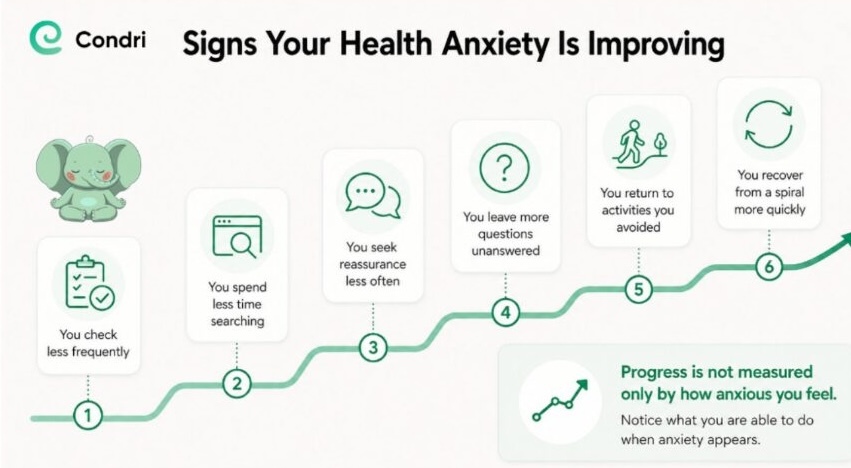
Recovery is not measured only by how anxious you feel.
A particularly useful measure is behavioural flexibility: what you are able to do when anxiety appears.
If your only question is:
“Was I anxious today?”
then a difficult day can look like failure.
Try asking different questions.
| Instead of only asking… | Also notice… |
| “Am I anxious?” | “Can I continue despite anxiety?” |
| “Do I feel certain?” | “Can I tolerate not knowing?” |
| “Is the sensation gone?” | “Can I stop monitoring it?” |
| “Did I have a health worry?” | “Did the worry dictate my behaviour?” |
| “Did reassurance work?” | “Could I resist the urge to seek reassurance?” |
| “Did I get triggered?” | “Could I return to my day afterwards?” |
You might also notice that:
- You check less frequently.
- You spend less time searching.
- You seek reassurance less often.
- You can leave more questions unanswered.
- You return to activities you previously avoided.
- Health worries take up less of your day.
- You recognise the cycle earlier.
- You recover from a spiral more quickly.
- You spend less time mentally reviewing symptoms.
- You are able to experience bodily sensations without immediately interpreting them as threatening.
- You can make decisions without needing complete certainty.
You can still have health-anxious thoughts while making meaningful progress.
That is why overcoming health anxiety does not have to mean:
“I never worry about my health again.”
It can mean:
“Health worries no longer dictate how I spend my time or what I do.”
Prepare for Setbacks Without Returning to Old Habits
A return of health-related worry does not automatically mean that your previous progress has disappeared.
Health anxiety may become louder during periods of:
- Stress.
- Illness.
- Medical appointments.
- Health-related news.
- Someone close becoming unwell.
- Major life changes.
- Poor sleep.
- Other periods of increased uncertainty.
Rather than asking:
“Why am I back at the beginning?”
try asking:
“Which part of my old cycle is showing up again?”
You can create a short setback plan.
My common triggers
What situations tend to make health anxiety louder?
My old safety behaviours
What checking, searching, reassurance or avoidance habits do I tend to return to?
My early warning signs
What tells me the cycle is beginning to take up more of my time?
Skills I want to return to
What has helped me respond differently?
Support I can use
Who can support me emotionally, and what professional help can I access if I need it?
A setback plan changes the goal from eliminating every future anxious thought to recognising the cycle sooner.
You may not be able to control every thought, sensation or moment of uncertainty.
You can, however, practise changing what happens next.
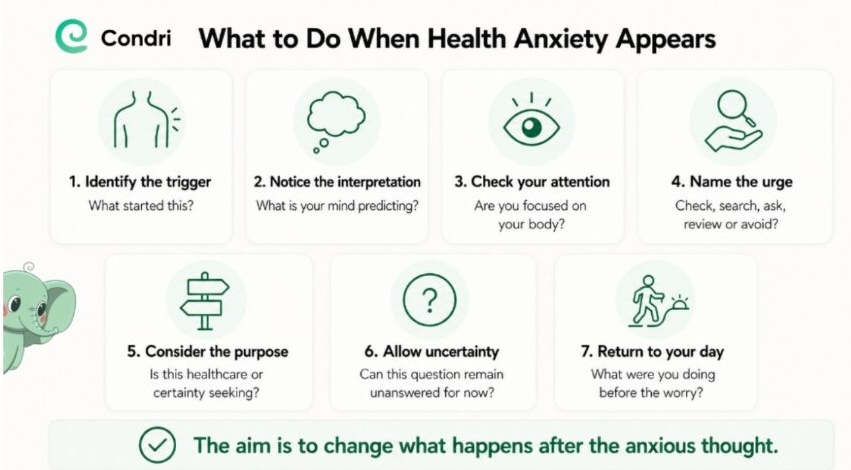
A Practical Summary: What to Do When Health Anxiety Appears
When a health worry appears, you can work through the following questions:
1. What triggered this?
Was it a sensation, piece of information, health story, appointment, uncertainty or something else?
2. What interpretation did my mind make?
What is my mind predicting or fearing?
3. What am I noticing in my attention?
Have I become intensely focused on my body or on health information?
4. What am I tempted to do?
Check? Search? Ask someone? Review? Avoid? Measure? Monitor?
5. Is this appropriate healthcare or an anxiety-driven attempt to obtain certainty?
If medical assessment is genuinely needed, seek it.
If the behaviour is repetitive and reassurance-driven, consider practising a different response.
6. Can I allow some uncertainty to remain?
You do not need to answer every anxious question immediately.
7. What was I doing before the worry appeared?
If appropriate, return to that activity.
This is not about “winning” an argument with your anxiety.
It is about changing the pattern that follows the anxious thought.
References and Evidence
**NHS. Health anxiety.**Current NHS guidance describes health anxiety, common checking, reassurance seeking, health-information searching and avoidance behaviours, as well as self-help approaches and when to seek GP support. (nhs.uk)
**NHS. Anxiety, fear and panic.**Provides current information about physical and psychological symptoms of anxiety and routes to professional support, including NHS Talking Therapies. (nhs.uk)
**Thomson, A. B., et al. Cognitive behavior therapy for health anxiety: systematic review and meta-analysis of clinical efficacy and health economic outcomes.**This systematic review and meta-analysis included 19 randomised controlled trials and found moderate-to-large pooled effects for CBT for health anxiety, with benefits generally maintained at follow-up. (PubMed)
**Cooper, K., et al. Cognitive Behaviour Therapy for Health Anxiety: A Systematic Review and Meta-Analysis.**A systematic review and meta-analysis of randomised controlled trials found substantial evidence supporting CBT for health anxiety. (PubMed)
**Recent network meta-analysis of psychological interventions for health anxiety, 2026.**A contemporary network meta-analysis examined 35 randomised controlled trials involving 3,263 participants and found significant benefits for several psychological interventions, including CBT, exposure therapy, acceptance and commitment therapy, metacognitive therapy and mindfulness-based cognitive therapy. Component analysis identified exposure and response prevention, cognitive restructuring and mindfulness among potentially beneficial treatment components. (PubMed)
**NICE. Digitally enabled therapies for adults with anxiety disorders.**NICE material identifies high-intensity CBT for health anxiety within NHS Talking Therapies and notes the limited availability of a dedicated NICE guideline specifically for health anxiety. (Nice)
Common questions
- What Is Health Anxiety?
- Health anxiety is a persistent pattern of worrying about being ill or becoming ill that begins to interfere with everyday life. It can involve heightened attention to bodily sensations, threatening interpretations, checking, reassurance seeking, health-information searching, mental checking or avoidance.Source: nhs.uk
- Can Health Anxiety Cause Physical Symptoms?
- Anxiety can produce or intensify physical sensations, including changes in heartbeat, breathing, muscle tension, dizziness, headaches and digestive symptoms. These sensations are real, but they should not automatically be assumed to be caused by anxiety. New, persistent or concerning symptoms may require medical assessment.Source: nhs.uk
- How Do I Know Whether I Am Checking Because I Need To or Because I Am Anxious?
- Consider the purpose and pattern of the behaviour. Appropriate monitoring generally follows a sensible medical reason or professional recommendation. Anxiety-driven checking is more likely to be repetitive, difficult to resist and aimed primarily at obtaining certainty or reducing distress. If you are unsure whether a symptom requires medical assessment, seek appropriate healthcare advice rather than using this article to decide.
- Is Googling Symptoms Making My Health Anxiety Worse?
- Repeatedly searching symptoms for reassurance can maintain health anxiety by increasing attention to illness-related information and creating new uncertainties to analyse. The NHS identifies obsessive health-information searching as a common feature of health anxiety and recommends gradually reducing this behaviour.Source: nhs.uk
- Can Reassurance Make Health Anxiety Worse?
- Reassurance can reduce anxiety temporarily, but repeatedly using reassurance to achieve certainty can become part of the health-anxiety cycle. The aim is not to reject emotional support. It is to reduce repetitive attempts to make another person prove that your feared health outcome cannot happen.
- How Can I Tolerate Uncertainty About My Health?
- Practise allowing uncertainty to exist without automatically performing the behaviour you normally use to remove it. For example: “I notice that I want certainty right now. I can leave this question unanswered for the moment and continue with what I was doing.” The goal is not to convince yourself that everything is definitely fine. It is to become more able to continue with life while uncertainty is present.
- Does CBT Help Health Anxiety?
- Yes. CBT is an established psychological treatment for health anxiety, and systematic reviews and meta-analyses have found meaningful benefits compared with control conditions. Recent research also supports CBT and related psychological approaches, with exposure and response prevention and cognitive restructuring among components associated with improved outcomes.Source: Pubmed
- Is ERP Used for Health Anxiety?
- Exposure and response prevention can form part of CBT-based work for health anxiety, particularly where avoidance, checking, reassurance seeking or other safety behaviours maintain the problem. ERP should not involve deliberately creating medical risk, ignoring symptoms that require assessment or disregarding legitimate medical advice.
- When Should I Speak to a GP?
- Consider speaking to your GP or another appropriate healthcare professional if health worries are significantly affecting your daily life, are difficult to manage, or self-help is not helping. You should also seek appropriate medical assessment when you have a physical concern that requires professional evaluation.
- Can Health Anxiety Come Back After Improving?
- Yes. Periods of stress, illness, medical appointments, health-related news or increased uncertainty can reactivate old patterns. A return of symptoms does not necessarily mean that previous progress has disappeared. A useful response is to identify which part of the cycle has returned and resume the skills you have previously practised.
- The Goal Is Not Perfect Certainty
- You may never reach a point where you have absolutely no health-related worries. That does not mean recovery is impossible. A more realistic and clinically useful goal is to change your relationship with health worries. You can learn to recognise: “This is a health-anxiety thought.” “I am looking for certainty.” “I am becoming highly focused on my body.” “I have the urge to check.” “I want reassurance.” “I am avoiding something because it feels threatening.” And then practise asking: “What happens if I respond differently this time?” Over time, progress can mean spending less time checking, searching and reviewing. It can mean returning to activities that anxiety pushed out of your life. It can mean allowing unanswered questions to remain unanswered for longer. It can mean noticing bodily sensations without automatically treating them as evidence of serious illness. And it can mean learning that anxiety does not have to disappear before you continue living your life. The aim is not: “I never worry about my health.” The aim is: “Health worries no longer dictate how I spend my time, attention and choices.” If you would like to begin by understanding your own patterns more clearly, take Condri’s Health Anxiety Quiz and explore how checking, reassurance seeking, symptom searching, avoidance and difficulty with uncertainty may be affecting you.