What Are the Physical Symptoms of Health Anxiety?
Anxiety can affect your body as well as your thoughts, emotions and behaviour. When you are anxious, your body’s stress response can produce genuine physical sensations, including a faster or more noticeable heartbeat, changes in breathing, dizziness, sweating, shaking, muscle tension, nausea and digestive discomfort.
However, these sensations are not unique to anxiety. The same physical symptom can have many possible causes, and an online article cannot determine what is causing an individual symptom.
For someone experiencing health anxiety, the difficulty is often not simply the physical sensation itself. It can be what happens after the sensation appears.
You may notice a sensation, interpret it as a possible sign of serious illness, become more alert to your body, check for further evidence, search for explanations online or ask someone for reassurance. These responses may reduce anxiety temporarily, but they can also keep your attention focused on the sensation and reinforce the urge to check again when uncertainty returns.
Understanding this cycle can help you work on health anxiety without dismissing genuine physical symptoms or avoiding appropriate medical care.
Important
Health anxiety does not mean that physical symptoms should be dismissed. People experiencing health anxiety can have genuine physical sensations and can also have genuine medical conditions.
New, persistent, worsening or otherwise concerning symptoms may require medical assessment. Follow advice from your GP or another appropriate healthcare professional, including recommended investigations and monitoring.
This article focuses on anxiety-related patterns such as body monitoring, repeated checking, reassurance seeking, symptom searching and avoidance. It is not a tool for deciding whether an individual symptom is medically serious.
What Is Health Anxiety?
Health anxiety involves persistent or excessive worry about having, developing or missing an illness. It can become particularly difficult when health concerns begin to take up significant amounts of time, attention or behaviour.
A person experiencing health anxiety may become highly alert to bodily sensations or changes. A normal or ambiguous sensation can then be interpreted as evidence of something serious.
For example:
Physical sensation → threatening interpretation → anxiety → increased monitoring →checking or reassurance → temporary relief → renewed uncertainty
The sensation itself may be genuine. The difficulty is the meaning attached to it and the behaviours that follow.
Research into health anxiety has identified several cognitive and behavioural processes that may contribute to its maintenance, including attention to health-related information, interpretations of bodily sensations and behavioural responses such as avoidance. More recent research continues to examine how these mechanisms interact. (PubMed)
This is why working on health anxiety does not mean trying to convince yourself that every physical sensation is “just anxiety”.
Instead, it involves learning to distinguish between an appropriate response to a health concern and an anxiety-driven pattern of repeatedly trying to obtain certainty.
Why Can Anxiety Feel So Physical?
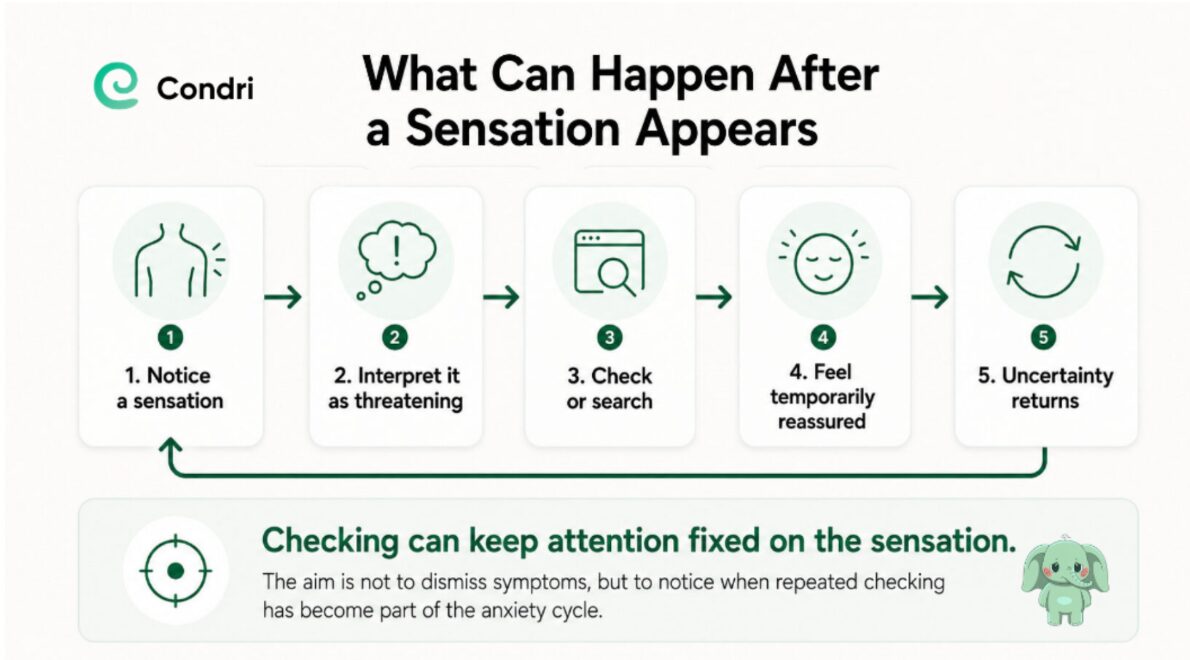
When you experience anxiety, your body can respond as though there is a threat that needs to be dealt with. Stress hormones and changes in the body’s arousal systems can affect heart rate, breathing, sweating, muscle tension, digestion and other physical processes.
The NHS describes a range of physical symptoms that can occur with anxiety, including a faster or more noticeable heartbeat, dizziness, headaches, chest pain, sweating, breathlessness, shaking and digestive symptoms. It also emphasises that people should not self-diagnose the cause of symptoms. (nhs.uk)
The experience is therefore not imaginary.
You can genuinely feel your heart beating faster. You can genuinely feel light-headed. Your muscles can genuinely become tense.
The important clinical distinction is that a physical sensation being real does not automatically tell you what caused it.
That distinction is particularly important in health anxiety.
How Attention Can Make Bodily Sensations More Noticeable
One of the less obvious parts of health anxiety is the role of attention.
When you become concerned about your health, you may begin monitoring your body more closely. You might repeatedly ask yourself:
- “Does my chest feel normal?”
- “Is my heart still beating quickly?”
- “Does this side feel different?”
- “Am I breathing properly?”
- “Is the dizziness still there?”
- “Do I feel more tired than I did yesterday?”
This increased monitoring can make sensations more noticeable.
It does not mean that the sensations are imagined, and it does not prove that anxiety is causing them. Rather, attention influences which sensations enter your conscious awareness and how much importance you give them.
Research has found evidence of increased attention to health-related threat in people with higher health anxiety, although the mechanisms involved are complex and continue to be studied. (PubMed)
This can create a feedback loop:
Notice a sensation → become concerned → monitor more closely → notice more sensations →become more concerned
The more time you spend scanning your body for evidence, the harder it can become to let ordinary sensations move in and out of awareness.
Racing Heart and Heart Palpitations
Anxiety and stress can be accompanied by an increased or more noticeable heartbeat. You may experience your heart as racing, pounding, fluttering or beating more forcefully.
With health anxiety, the sensation can quickly become the focus of attention.
You might:
- repeatedly check your pulse
- look at your smartwatch
- compare your heart rate at different times
- deliberately test whether your heart is still beating quickly
- search online for possible explanations
- ask someone whether the sensation sounds concerning
These behaviours can provide temporary reassurance, but they may also keep your attention focused on your heartbeat.
A noticeable or racing heartbeat can have many possible explanations. An online article cannot determine its cause for an individual, so concerns about persistent, new or otherwise concerning symptoms should be discussed with an appropriate healthcare professional.
Chest Tightness and Chest Discomfort
Stress and anxiety can be associated with chest tightness or discomfort, sometimes alongside changes in breathing or muscle tension.
Chest sensations can be particularly difficult when you have health anxiety because they may immediately attract attention and trigger a catastrophic interpretation:
“What if this means something is seriously wrong?”
You may then begin checking your breathing, monitoring your chest, searching for symptoms or asking someone for reassurance.
It is important not to use an article about anxiety to decide that an individual chest symptom is caused by anxiety.
If you are concerned about a physical symptom, seek appropriate individual medical advice.
Shortness of Breath and Changes in Breathing
Anxiety can affect breathing. You may breathe more quickly, become more aware of each breath or experience a sensation of breathlessness.
With health anxiety, breathing itself can become something you monitor.
You might repeatedly test whether you can take a deep breath, check whether your breathing feels “normal” or deliberately change your breathing to see whether the sensation disappears.
This can increase your awareness of breathing and make it harder to stop monitoring it.
The important point is not that paying attention to breathing proves anxiety is the cause. Rather, repeated monitoring can become part of the health-anxiety cycle.
If you are concerned about breathlessness or another breathing problem, seek appropriate medical advice rather than trying to determine its cause through repeated self-testing.
Dizziness and Feeling Light-Headed
Dizziness and light-headedness can occur during periods of anxiety, including when breathing patterns and bodily arousal change.
For someone with health anxiety, dizziness can quickly become something to test or monitor.
You might repeatedly stand up to see whether the sensation returns, test your balance, monitor how your head feels or search online for possible explanations.
The more closely you monitor the sensation, the more attention it may receive.
This does not establish what is causing the dizziness. It simply illustrates how attention and checking can become involved in the health-anxiety cycle.
Headaches and Pressure in the Head
Headaches can occur for many different reasons, and stress or muscle tension may be associated with some types of headache.
When health anxiety is present, a headache or sensation of pressure may become something you repeatedly monitor for changes.
You might compare today’s sensation with yesterday’s, repeatedly assess its intensity or search for possible serious causes.
The sensation itself cannot tell you its cause.
If you are concerned about a headache or another physical symptom, individual medical assessment is the appropriate way to address that concern.
Muscle Tension, Aches and Pains
Muscle tension is a common part of the body’s response to stress and can contribute to sensations such as tightness, stiffness or aching.
You may tense muscles without consciously noticing, particularly during prolonged periods of worry.
When a sensation becomes the focus of health anxiety, you may begin pressing, stretching, comparing or repeatedly checking the affected area.
The behaviour can then keep your attention focused on the sensation.
Rather than asking only, “What does this sensation mean?”, it can also be useful to notice:
“What do I usually do when I notice it?”
That question can help identify whether anxiety-driven monitoring or checking has become part of the pattern.
Tingling, Pins and Needles and Numbness
Tingling, pins and needles or numb sensations can occur in a range of circumstances, including during periods of anxiety.
These sensations can also have many other possible causes.
When health anxiety is involved, you may respond by repeatedly touching an area, comparing one side of your body with the other, testing whether the sensation has changed or searching online for explanations.
These behaviours may increase attention to the sensation without establishing what is causing it.
If you are concerned about numbness, tingling or another physical symptom, seek appropriate medical advice rather than attempting to determine its cause through repeated self-checking.
Shaking and Trembling
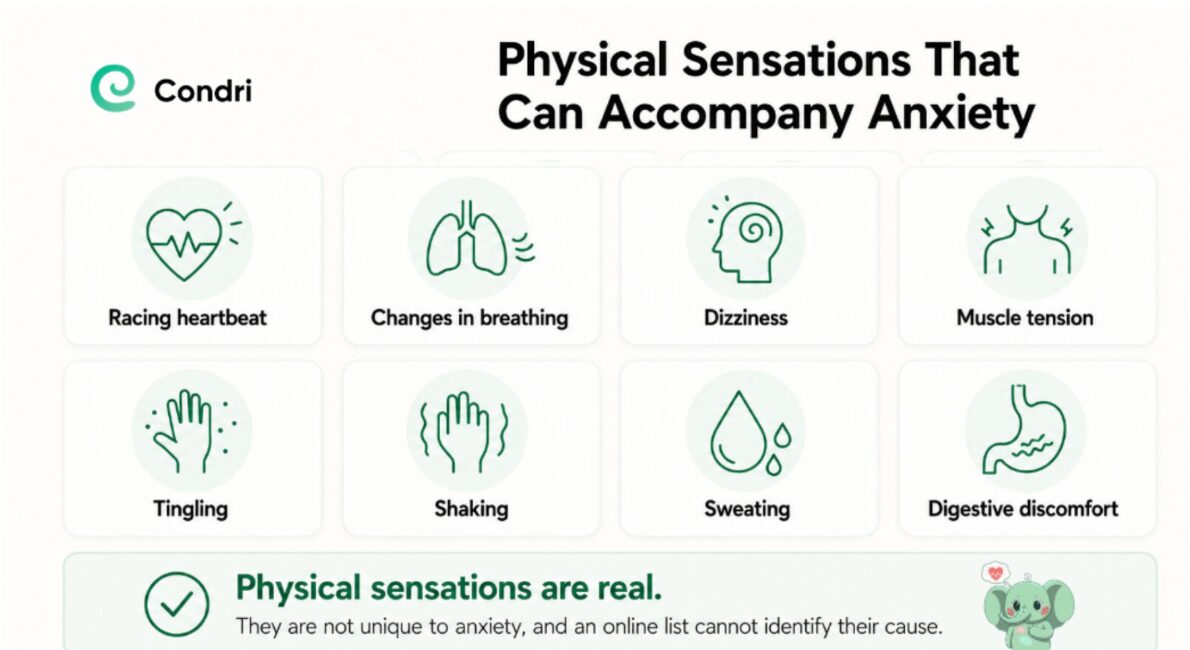
Anxiety can activate the body’s stress response and may be accompanied by shaking or trembling.
A brief tremor can become particularly noticeable when you are already monitoring your body closely.
You might then start watching for it to happen again, deliberately testing whether you can reproduce it or checking whether it has completely disappeared.
This can turn a passing physical experience into an ongoing focus of attention.
The aim in health-anxiety work is not to prove that the sensation is harmless. It is to recognise when repeated monitoring has become part of the response to uncertainty.
Sweating, Feeling Hot or Cold and Chills
Sweating and changes in temperature sensation can occur during periods of heightened anxiety or stress.
You may notice feeling hot, cold, flushed or clammy.
With health anxiety, these sensations can lead to repeated temperature checks or increased monitoring:
“Am I still hot?”
“Has my temperature changed?”
“Why do I suddenly feel cold?”
The presence of sweating or a change in temperature does not, by itself, establish its cause.
If you are concerned about a physical change, appropriate medical advice is more useful than repeated attempts to interpret the sensation yourself.
Nausea, Stomach Pain and Digestive Symptoms
Anxiety and stress can affect the digestive system. Some people experience nausea, stomach discomfort, changes in appetite or changes in bowel habits during periods of heightened anxiety. (nhs.uk)
For someone with health anxiety, digestive sensations can become another area for close monitoring.
You may begin analysing meals, bowel movements or every change in how your stomach feels.
The cycle can then look like:
Notice a sensation → interpret it as threatening → monitor for more evidence → search or seek reassurance → feel temporary relief → notice another sensation → begin monitoring again
The digestive sensation is real. The health-anxiety cycle concerns what happens around it.
Feeling Tired or Physically Drained
Persistent anxiety can be exhausting.
Worry requires sustained attention, while muscle tension, disrupted sleep and repeated monitoring can contribute to feeling physically drained.
At the same time, tiredness has many possible explanations and should not automatically be attributed to anxiety.
In health anxiety, fatigue can itself become another symptom to analyse:
“Am I more tired than usual?”
“Does this mean something has changed?”
“Why am I still tired today?”
Repeatedly trying to answer these questions can pull you back into monitoring and uncertainty.
Difficulty Sleeping and Waking During the Night
Health worries can make it difficult to switch off at bedtime.
When your surroundings are quiet, you may also become more aware of bodily sensations that would normally receive less attention.
For example, you might wake during the night, notice a sensation and immediately reach for your phone to search for an explanation.
That can quickly become:
Sensation → fear → searching → temporary reassurance → another question → more searching
The aim is not to prove that the sensation is “only anxiety”.
Instead, notice what happens after the sensation appears.
Do you:
- search for it?
- check your body?
- monitor a wearable?
- ask someone for reassurance?
- reread information you have already seen?
- mentally review what happened earlier?
Recognising the response can help you identify the health-anxiety cycle.
When Physical Symptoms Become Part of a Health-Anxiety Cycle
Not every physical sensation is health anxiety.
The more useful question is often not:
“Is this symptom caused by anxiety?”
but:
“What happens when I notice it?”
For example:
Sensation
You notice your heart beating more strongly.
↓
Interpretation
“What if this is a sign of something serious?”
↓
Anxiety
You become frightened and increasingly alert.
↓
Attention
You start monitoring your heartbeat.
↓
Safety behaviour
You check your pulse, smartwatch or search online.
↓
Temporary relief
You find an explanation that reassures you.
↓
Renewed uncertainty
“But what if that explanation doesn’t apply to me?”
↓
More monitoring
You check again.
This is the maintenance cycle that health-anxiety treatment often aims to change.
Appropriate Healthcare vs Anxiety-Driven Checking
Working on health anxiety does not mean stopping all checking or avoiding healthcare.
Some health behaviours are appropriate.
For example, attending a recommended appointment, following a clinician’s monitoring plan or seeking assessment for a new concern can be sensible healthcare.
A behaviour becomes more relevant to health anxiety when it is repeated primarily to obtain certainty or reduce anxiety, particularly when the same question has already been addressed.
Ask yourself:
“Am I doing this because I have been advised to, or because anxiety is demanding another check?”
That question does not tell you whether a physical symptom is medically significant. It helps you identify the behaviour that may be maintaining the anxiety.
What If I Keep Checking My Symptoms?
If you repeatedly check your body, start by noticing the behaviour rather than trying to eliminate every sensation.
You might:
- notice the urge before acting on it
- delay a repetitive check
- reduce how frequently you perform the check
- avoid repeating a check you have already completed
- notice whether you have replaced one form of checking with another
- return your attention to the activity you were doing
For example, you might stop checking a symptom in the mirror but start photographing it instead.
Or you might stop touching an area but begin checking a wearable repeatedly.
The behaviour has changed, but its purpose may still be the same: trying to remove uncertainty.
The aim is to reduce anxiety-driven checking, not medically recommended monitoring.
Can Searching Physical Symptoms Make Health Anxiety Worse?
Repeated symptom searching can become another form of safety behaviour.
A search may begin with a reasonable question. But health anxiety can turn one search into many:
- searching the same symptom using different wording
- opening multiple websites
- reading forums
- watching health videos
- comparing your experience with other people’s experiences
- looking for increasingly specific explanations
- asking an AI tool the same question in several ways
- searching until you find an answer that feels reassuring enough
The difficulty is that online information can always produce another possibility or another question.
The search therefore may not resolve uncertainty. It can create more information to analyse.
Before searching, ask:
“Do I genuinely need this information, or am I trying to make the anxiety go away?”
If you recognise that the search is reassurance-driven, you can practise delaying it and returning to what you were doing.
If you genuinely need individual medical advice, use an appropriate healthcare professional rather than attempting to resolve the question through repeated online searching.
Can Reassurance Make Health Anxiety Worse?
Reassurance can be comforting, and seeking emotional support is not inherently a problem.
The difficulty arises when reassurance becomes a repeated attempt to achieve certainty.
You might ask:
“Does this sound serious?”
Someone reassures you.
You feel better.
Then another doubt appears:
“But what if they missed something?”
You ask again.
This can create a repeating cycle.
You may also seek reassurance indirectly by describing a symptom to someone and waiting for them to tell you that it sounds normal, or by asking the same question in slightly different ways.
A different approach is to ask for support without asking the other person to remove the uncertainty:
“I’m feeling anxious and have an urge to ask for reassurance. Can you help me stay with what I’m practising instead?”
This allows you to receive emotional support while reducing the role of reassurance as a certainty-seeking behaviour.
What Can Help With Physical Symptoms and Health Anxiety?
If physical sensations are becoming part of a health-anxiety cycle, CBT-based approaches can help you examine what happens between noticing a sensation and responding to it.
CBT may involve:
- identifying threatening interpretations
- understanding the health-anxiety maintenance cycle
- recognising body monitoring and safety behaviours
- reducing repetitive checking and reassurance seeking
- working with uncertainty
- testing predictions through behavioural experiments
- approaching situations that have been avoided
- changing unhelpful interpretations
- reducing mental checking and rumination
- developing more flexible responses to health-related thoughts and sensations
Research supports CBT as an effective psychological treatment for health anxiety, although individual responses vary. Systematic reviews and meta-analyses have found meaningful benefits compared with control conditions, and more recent evidence continues to examine which treatment components contribute to improvement. (PubMed)
The goal is not to replace:
“What if something is wrong?”
with:
“Nothing is wrong.”
That can simply become another form of reassurance.
A more useful CBT-based response may be:
“I have noticed a health-related thought and an urge to obtain certainty. I can decide what action is actually needed without automatically following the urge to check.”
How Condri Can Help You Understand the Pattern
Physical sensations can be frightening, particularly when you are already worried about your health.
Condri is designed specifically for health anxiety, helping users recognise patterns that can maintain health anxiety and practise responding differently when those patterns arise.
Its approach is centred on evidence-informed psychological principles, including CBT-based formulation, reducing anxiety-driven safety behaviours, working with uncertainty and gradually changing checking, reassurance and avoidance patterns.
Condri does not attempt to diagnose physical symptoms or provide reassurance that a symptom is medically harmless.
If physical sensations regularly lead you into repeated checking, searching or reassurance seeking, Condri’s health anxiety quiz can help you explore the broader pattern behind those worries rather than attempting to determine the medical cause of an individual symptom.
When Should You Speak to a GP About Health Anxiety?
Consider speaking to your GP or another appropriate healthcare professional if worries about your health are taking up significant amounts of time, affecting everyday life or becoming difficult to manage.
The NHS advises seeking help when health worries are preventing you from leading your normal life or when self-help is not working. CBT is one of the psychological treatments that may be offered for health anxiety. (nhs.uk)
It can be useful to describe the wider pattern rather than only the latest symptom.
For example, you could explain:
- how much time you spend worrying about your health
- how frequently you check your body
- how often you search for symptoms
- how much reassurance you seek
- what you avoid because of health concerns
- how health anxiety affects work, relationships or everyday activities
- what self-help approaches you have tried
If you have a physical symptom that concerns you, discuss it with an appropriate healthcare professional rather than trying to determine its cause through repeated online research.
How Do You Know If Health Anxiety Is Improving?
Improvement is not necessarily measured by whether you experience no physical sensations or never feel anxious.
A more useful measure can be what you do when a sensation or health worry appears.
Instead of only asking:
“How anxious am I?”
also ask:
“What did I do when the anxiety appeared?”
You might notice:
| Instead of only asking… | Also notice… |
| “Am I anxious?” | “Can I continue despite feeling anxious?” |
| “Do I feel certain?” | “Can I tolerate not knowing?” |
| “Is the sensation gone?” | “Can I stop monitoring it?” |
| “Did I have a health worry?” | “Did the worry dictate what I did?” |
| “Did reassurance make me feel better?” | “Could I resist the urge to seek reassurance?” |
| “Did I notice a symptom?” | “Could I notice it without repeatedly checking it?” |
Progress can include:
- checking less frequently
- spending less time searching
- seeking reassurance less often
- mentally reviewing symptoms less
- tolerating unanswered questions
- returning to activities you had avoided
- noticing the cycle earlier
- recovering more quickly after a trigger
- allowing sensations to be present without constantly monitoring them
- continuing with meaningful activities despite uncertainty
You can still have health-related thoughts and physical sensations while making meaningful progress.
Recovery is partly about behavioural flexibility, not simply eliminating anxiety.
Preparing for Setbacks
Health anxiety can become more noticeable during periods of stress, illness, medical appointments, health-related news or major changes in life.
A return of health-related worry does not automatically mean that previous progress has disappeared.
Instead of asking:
“Why am I back at the beginning?”
try asking:
“Which part of my old cycle has started to reappear?”
You can create a simple setback plan:
**My common triggers:**What situations tend to make health anxiety louder?
**My old safety behaviours:**What checking, searching, reassurance or avoidance habits do I tend to return to?
**My early warning signs:**What tells me the cycle is starting to take up more of my time?
**Skills I want to return to:**What have I practised that helps me respond differently?
**Support I can use:**Who can support me emotionally, and what professional help is available if I need it?
The aim is not to eliminate every future health-related thought.
It is to recognise the cycle sooner and practise changing what happens next.
References / Evidence
- NHS. Health anxiety. NHS mental health guidance. (nhs.uk)
- NHS. Anxiety, fear and panic. NHS mental health guidance, reviewed July 2026. (nhs.uk)
- Leonidou C, Panayiotou G. How do illness-anxious individuals process health-threatening information? A systematic review of evidence for the cognitive-behavioral model. Journal of Psychosomatic Research. 2018;111:100–115. (PubMed)
- Shi C, Taylor S, Witthöft M, et al. Attentional bias toward health-threat in health anxiety: a systematic review and three-level meta-analysis. Psychological Medicine. 2022;52(4):604–613. (PubMed)
- Guthrie AJ, Paredes-Echeverri S, Bleier C, et al. Mechanistic studies in pathological health anxiety: A systematic review and emerging conceptual framework. Journal of Affective Disorders. 2024;358:222–249. (PubMed)
- Cooper K, Gregory JD, Walker I, et al. Cognitive Behaviour Therapy for Health Anxiety: A Systematic Review and Meta-Analysis. Behavioural and Cognitive Psychotherapy. 2017. (PubMed)
- Olatunji BO, Kauffman BY, Meltzer S, Davis ML, Smits JAJ, Powers MB. Cognitive-behavioral therapy for hypochondriasis/health anxiety: a meta-analysis of treatment outcome and moderators. Behaviour Research and Therapy. 2014. (PubMed)
- Hedman E, et al. Cognitive behavior therapy for health anxiety: systematic review and meta-analysis of clinical efficacy and health economic outcomes. 2019. (PubMed)
- Recent systematic review and network meta-analysis of psychological interventions for health anxiety, including analysis of treatment components such as exposure and response prevention and cognitive restructuring. 2026. (PubMed)
Common questions
- Can health anxiety cause physical symptoms?
- Anxiety can be accompanied by genuine physical sensations because the body’s stress response can affect processes such as heart rate, breathing, muscle tension, sweating and digestion. However, these sensations are not specific to anxiety, so an online article cannot determine what is causing an individual symptomSource: https://www.nhs.uk/mental-health/feelings-symptoms-behaviours/feelings-and-symptoms/anxiety-fear-panic/
- What does health anxiety feel like physically?
- Health anxiety can occur alongside sensations such as a noticeable or racing heartbeat, changes in breathing, dizziness, headaches, muscle tension, sweating, shaking, nausea and digestive discomfort. These sensations can have many possible causes and should not be used on their own to diagnose health anxiety.
- Can health anxiety cause heart palpitations?
- Anxiety and stress can be associated with an increased or more noticeable heartbeat. However, palpitations can have different causes. If you are concerned about palpitations, particularly if they are new, persistent or otherwise concerning, seek appropriate medical advice rather than trying to determine their cause through repeated online searching.
- Can anxiety cause dizziness or tingling?
- Dizziness, light-headedness and tingling can occur during periods of anxiety, including alongside changes in breathing. However, these sensations can also have other explanations, so they should not be used on their own to conclude that anxiety is the cause.
- Why do I notice so many physical sensations when I have health anxiety?
- Health anxiety can lead to increased body monitoring and attention to health-related information. When you repeatedly scan your body, sensations that might otherwise receive little attention can become more noticeable or significant to you. This does not mean the sensations are imagined. Attention can influence how prominent a sensation becomes in your awareness. Research has found evidence of attention-related processes in health anxiety, although the mechanisms are complex.Source: https://pubmed.ncbi.nlm.nih.gov/35341486/
- Can checking my body make health anxiety worse?
- Repeated checking can become part of the health-anxiety maintenance cycle. You may notice a sensation, interpret it as threatening, check your body or search online, feel temporary relief and then become uncertain again. Gradually reducing repetitive, anxiety-driven checking can be an important part of psychological work on health anxiety. This does not mean stopping medical monitoring recommended by a healthcare professional.
- Is Googling symptoms bad for health anxiety?
- Searching for health information is not inherently problematic. The difficulty is when searching becomes repetitive and is primarily used to reduce anxiety or obtain certainty. Searching the same symptom repeatedly, changing the wording, comparing your experience with others or asking multiple sources for reassurance can keep the cycle going.
- Can reassurance make health anxiety worse?
- Repeated reassurance can temporarily reduce anxiety while strengthening the urge to seek reassurance again when uncertainty returns. This does not mean you should avoid emotional support. The aim is to reduce reassurance being used as a repeated attempt to establish certainty about your health.
- How can I stop monitoring my body?
- Begin by identifying when monitoring is driven by anxiety rather than by appropriate medical advice. You can then practise noticing the urge, delaying repetitive checks and returning attention to your activity. Avoid replacing one checking behaviour with another, such as replacing mirror checking with repeated photographs or wearable monitoring.
- Can I have health anxiety and a real medical condition?
- Yes. Health anxiety does not mean that a person cannot have a genuine physical illness or experience genuine physical symptoms. The psychological focus is on the way health-related uncertainty, sensations and perceived threats are interpreted and responded to. Appropriate medical assessment and monitoring should always be followed.
- Does CBT help health anxiety?
- CBT is an established psychological treatment for health anxiety. Research has found beneficial effects compared with control conditions, although outcomes vary between individuals. CBT for health anxiety may include work on threat interpretations, safety behaviours, checking, reassurance, avoidance, uncertainty and behavioural experiments. Source: https://pubmed.ncbi.nlm.nih.gov/28229805/
- Is exposure and response prevention used for health anxiety?
- Exposure-based and response-prevention strategies may form part of CBT for health anxiety, particularly when avoidance, checking or other safety behaviours are maintaining the problem. Exposure is not about deliberately putting yourself in medical danger or ignoring legitimate health advice. It should be appropriate to the individual’s circumstances and, where necessary, planned with a qualified professional. Recent research continues to investigate which treatment components are most useful for health anxiety.Source: https://pubmed.ncbi.nlm.nih.gov/42169209/
- When should I speak to a GP about health anxiety?
- Consider speaking to your GP or another appropriate healthcare professional if health worries are interfering with your normal life, taking up substantial amounts of time or becoming difficult to manage. The NHS also recommends seeking help when self-help is not working.Source: https://www.nhs.uk/mental-health/conditions/health-anxiety/