The Health Anxiety Cycle Explained
The health anxiety cycle describes a pattern in which a sensation or health-related event prompts a frightening thought, followed by an urge to check, search, seek reassurance or avoid something. Those responses are understandable attempts to feel safe. They may bring brief relief, but when repeated mainly to remove uncertainty, they can leave the next worry feeling harder to face.
Understanding the cycle can help you notice what happens after a worry appears and choose a more considered response. It cannot tell you what a symptom means medically, and recognising the pattern does not mean you have a diagnosis.
How does the health anxiety cycle work?
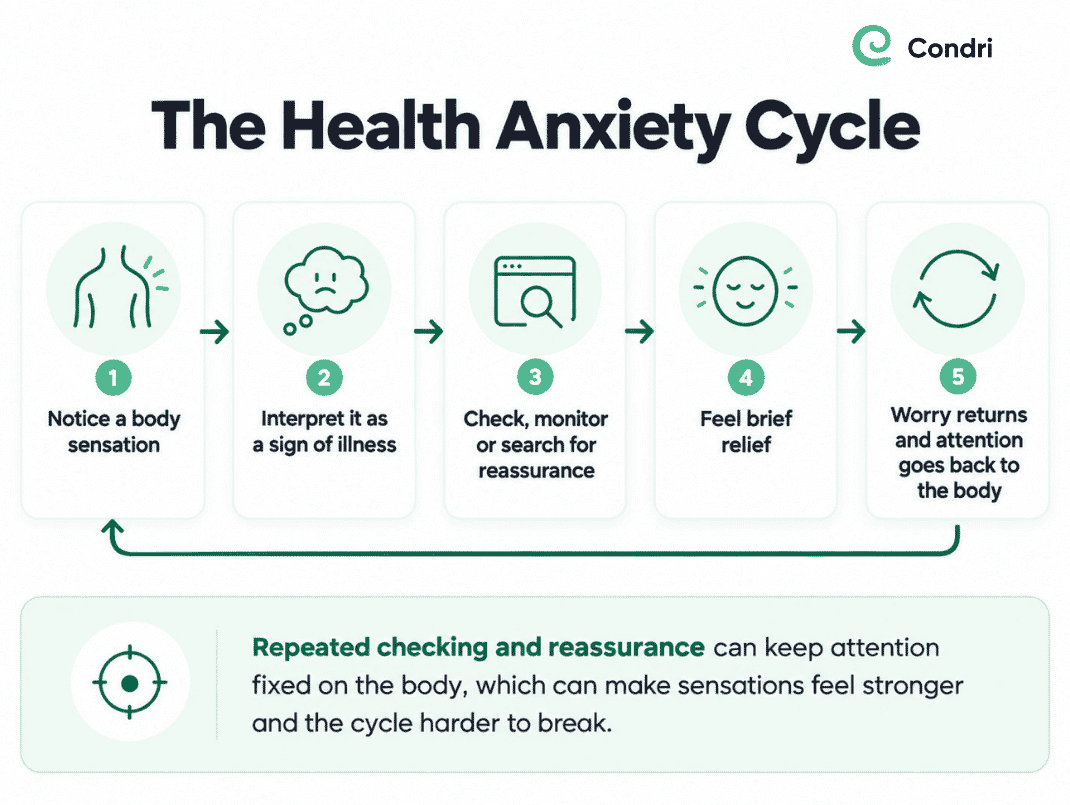
One way to picture the pattern is:
Trigger → Frightening interpretation → Anxiety and an urge to act → Checking, reassurance or avoidance → Brief relief or further doubt → Greater watchfulness for the next trigger
The sequence is not fixed. A trigger might be a bodily sensation, a medical appointment, test results, a story about illness or a thought that seems to arrive without warning. Anxiety may also make you more aware of physical sensations. None of these possibilities establishes what caused a symptom. Health anxiety and a physical health condition can exist at the same time.
[Internal link: Condri’s guide to health anxiety triggers]
A trigger catches your attention
You notice a sensation, a change or a piece of health information. Your attention may settle on it, especially if you have been worried about your health. You might find yourself monitoring it or comparing it with something you noticed before.
It is understandable to pay attention to your health. The cycle concerns what happens when attention becomes caught in repeated attempts to resolve a fear.
[Internal link: Condri’s guide to physical sensations and health anxiety]
Your mind offers a frightening interpretation
A thought may appear quickly: “What if this is serious?” or “What if something has been missed?” The thought can feel convincing, particularly when you are distressed.
Try gently separating what you noticed from what your mind is suggesting: “I’ve noticed something, and I’m having a frightening thought about it.” That leaves room to take a medical concern seriously without treating the thought itself as a medical conclusion.
You feel an urge to seek safety or certainty
You might check your body, look up symptoms, ask someone for reassurance or avoid an activity that brings up fear. You might also review a conversation with a clinician in your mind, revisit an earlier result or repeatedly weigh up the likelihood of an illness.
These actions and mental habits are often called safety behaviours in psychological treatment. They make sense as attempts to cope with uncertainty. When they become repetitive, however, they may keep your attention on the feared possibility and make checking feel necessary before you can get on with your day. NHS guidance identifies frequent checking, reassurance seeking, searching and avoidance as common features of health anxiety.
[Internal link: Condri’s guide to Googling symptoms]
Relief fades, or searching raises new doubts
Imagine asking someone close to you whether they think a symptom is serious. Their answer may ease the fear for a while. Later, a new question appears: “What if I explained it badly?” You may feel drawn to ask again.
Searching can work differently. One result may reassure you while another introduces a new concern. Either way, the urge to settle the uncertainty can bring you back to the same activity.
This does not mean that asking for support is wrong. The question is whether you are seeking useful help or repeatedly trying to obtain a level of certainty that no answer seems able to provide.
What can keep the cycle going?
The pattern may grow to include more sources of reassurance: a search, a second website, an AI tool, a question to a partner and another search. For some people, the reviewing happens mostly in their thoughts and is much less visible to others.
Avoidance can also offer short-term relief. You might withdraw from a conversation about illness or stop an ordinary activity because it brings up uncomfortable sensations or uncertainty. Over time, this can narrow your life. Any activity restrictions or monitoring recommended by a healthcare professional still need to be followed.
Not every check is excessive. Seeking assessment for a new or concerning symptom, attending an appointment, asking a clinician a relevant question and following an agreed care plan are appropriate forms of healthcare. The distinction depends on the circumstances, including whether the action is medically indicated and whether it is being repeated primarily to quieten the same fear.
What might the cycle look like in everyday life?
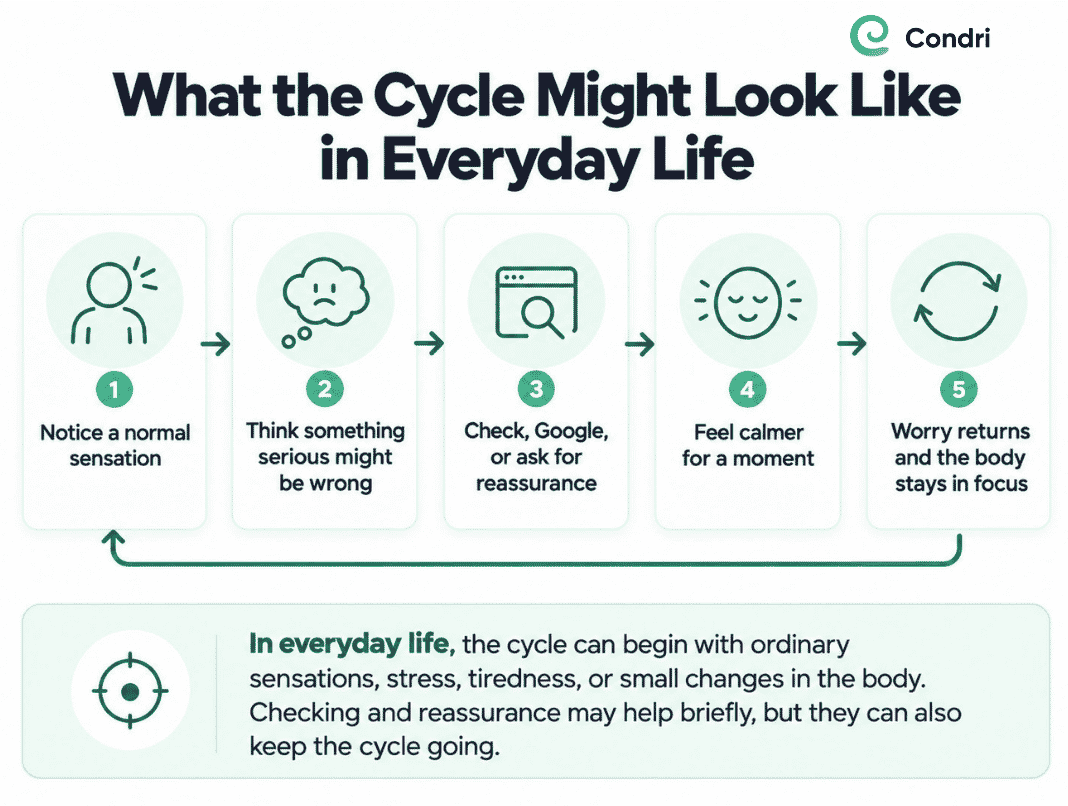
You notice an unfamiliar sensation. The thought “What if it means something serious?” appears, followed by anxiety and an urge to search for an explanation. A reassuring result brings some relief. Later, doubt returns and another search feels necessary.
The same pattern might begin with a news story rather than a sensation. You read about an illness, wonder whether it could affect you and start monitoring your body for signs.
These examples illustrate a psychological pattern; they are not a way to judge whether a symptom needs medical attention.
How can you respond differently?
You do not have to make a frightening thought disappear before choosing what to do next. A gentle pause can create space for a considered decision:
- Notice: “Something has caught my attention, and I feel frightened.”
- Name the urge: “I want to check or ask again so I can feel certain.”
- Consider the care question: “Is there a new concern that needs medical advice, or am I repeating a search I have already used to settle this fear?”
- Choose your next step: Seek appropriate care or follow your agreed medical plan when needed. If this is a familiar, repetitive anxiety-driven urge, you might practise delaying a check and returning to something that matters to you.
During that pause, you could feel your feet on the floor or notice your breathing. Mindfulness can help you remain present with discomfort; it cannot establish that a symptom is medically safe. Speak to yourself as you would to someone you care about: “This feels frightening. I can take it seriously and still choose my next step thoughtfully.”
Change can be gradual. NHS self-help guidance suggests noticing how often checking, reassurance seeking or health-information searching occurs and gradually reducing those behaviours. That advice does not apply to medically recommended monitoring or indicated care.
[Internal links: Condri’s guide on how to overcome health anxiety; Condri’s guide to ERP for health anxiety]
When should you seek medical or psychological support?
A qualified healthcare professional can assess a symptom or change that concerns you. Seek medical advice if a symptom is new, persistent, changing or worsening, or if you are unsure how to follow an existing care plan. Do not stop medication, recommended monitoring or other treatment because you recognise an anxiety pattern.
If you think you need medical help now, NHS 111 can direct you to appropriate care. In a life-threatening emergency, call 999. These services assess urgency; an article or self-help app cannot do so for you.
If health worries are interfering with daily life or self-help is not helping, speak to a GP. In England, you can also refer yourself to an NHS talking therapies service. Psychological support and physical healthcare can be appropriate at the same time.
How can therapy help?
Cognitive Behavioural Therapy (CBT) can help you understand your own cycle and practise responding differently to frightening interpretations, repeated checking, reassurance seeking and avoidance. Work may include gradually approaching uncertainty while reducing an anxiety-driven response. It should be adapted to the person and their medical circumstances.
Research supports CBT for health anxiety. A 2026 review also found evidence for several other psychological approaches, including exposure therapy and acceptance and commitment therapy, compared with a waiting list. These findings do not establish that one approach, or one self-help tool, is best for everyone. The aim is greater freedom in how you respond while uncertainty is present.
[Internal link: Condri’s guide to CBT for health anxiety]
How may Condri help?
Condri is a health-anxiety self-help app informed by lived experience and established psychological approaches. Practices informed by CBT, exposure and response prevention, acceptance, mindfulness and compassion-focused principles may help you recognise a pattern, make room for difficult feelings and practise a different response.
Condri does not determine the cause of symptoms or assess individual medical risk. A healthcare professional can address medical concerns, and individual psychological support may help when health worries are taking up a great deal of your life.
The cycle may be familiar, but you do not have to criticise yourself for being caught in it. Checking and reassurance are understandable ways of trying to feel safe. With support and practice, you may find more room to care for your health and give attention to your relationships, activities and values, even when certainty is unavailable.
4. Authoritative sources used
- NHS: Health anxiety — patterns, self-help, GP advice and talking therapies.
- Cumbria, Northumberland, Tyne and Wear NHS Foundation Trust: Health Anxiety self-help guide— the cycle, reassurance, checking and avoidance.
- NHS: When to use 111 and When to call 999 — urgent-care wording.
- BABCP: Anxiety and CBT — collaborative use of CBT.
- Cooper et al., 2017, systematic review of CBT for health anxiety and Lai et al., 2026, review of psychological interventions — treatment evidence and its limits.
Common questions
- Can health anxiety cause physical symptoms?
- Anxiety can cause physical sensations such as a racing heart, dizziness, sweating and muscle tension. These sensations may lead to further worry and checking. However, physical symptoms should not automatically be attributed to anxiety. Speak to a healthcare professional about new, persistent or concerning symptoms.
- Why do I keep checking my symptoms?
- Repeated checking can become a way of trying to feel safe or certain about your health. It may provide temporary reassurance, but the worry can return, creating another urge to check. Recognising this pattern can help you gradually change how you respond.
- Can reassurance make health anxiety worse?
- Reassurance can provide short-term relief, but repeatedly asking the same questions may keep the health anxiety cycle going. Once the relief fades, new doubts can appear. Seeking appropriate medical advice is different from repeatedly looking for certainty about a fear that has already been addressed.
- How long does the health anxiety cycle last?
- There is no set timeframe. Some people experience brief periods of worry, whereas others find themselves repeatedly checking symptoms or seeking reassurance throughout the day. The pattern can vary depending on personal circumstances, triggers and the support available.
- Can you break the health anxiety cycle?
- Yes, people can learn to respond differently to the thoughts and behaviours that keep health anxiety going. Approaches such as Cognitive Behavioural Therapy (CBT) can help reduce repeated checking, reassurance seeking and avoidance. Progress often happens gradually, and professional support may be helpful.
- Is it possible to have health anxiety and a genuine medical condition?
- Yes. Health anxiety and physical health conditions can exist at the same time. Experiencing health anxiety does not mean your symptoms are imaginary or that medical concerns should be ignored. Continue following medical advice and seek assessment when symptoms are new, changing or concerning.